
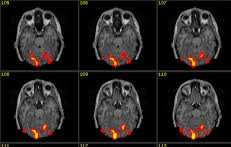
Brain-imaging technology has given parapsychology a new way to ask an old question: what happens in the brain when anomalous cognition or influence is claimed? Studies using fMRI, MRI and related methods have explored presentiment, remote perception, brain-to-brain effects and the possibility that ordinary self-monitoring inhibits psi.
- Imaging studies of presentiment have reported differential brain activity before emotionally charged stimuli appear.
- Work with selected psychics and remote-viewing targets has attempted to link successful performance with specific neural patterns.
- Some researchers have proposed that frontal systems tied to self-awareness may suppress psi expression rather than produce it.
Presentiment
In a 2002 study by Bierman and Scholte, presentiment effects in the brain were probed using functional magnetic resonance imaging (fMRI). Ten subjects viewed randomly ordered sequences of emotional and neutral images. Female subjects exhibited significant differences in brain activity before being exposed to frightening images as compared to neutral images (p = 0.05). When males were tested, they showed increased brain activity before seeing erotic images (p = 0.05).
Bierman independently demonstrated presentiment of erotic images (p = 0.01).1Bierman & Scholte (2002).
Testing Psychics
Gerard Senehi
In 2008, a group of Indian researchers examined the brain activity of Gerard Senehi, a 46-year-old Indian psychic, using fMRI. The claimant attempted to describe a picture being drawn by an experimenter in a different room, and this was found to be significantly more accurate than a description given by a non-psychic control person. Additionally, the psychic’s fMRI scan revealed significantly more activity in the right parahippocampal gyrus than normal. This brain area is associated with spatial awareness and memory, indicating which processes were active during testing.2Venkatasubramanian et al. (2008).
Ingo Swann
In the late 1990s, Ingo Swann was extensively tested by Michael A Persinger, who probed for neural correlates of successful remote viewing performance. An initial EEG test revealed a notable spike in the 7-Hz range measured from the occipital lobes was found. Following this, magnetic resonance imaging (fMRI) of his brain found unusual features within the parieto-occipital region of the right hemisphere. Further testing showed that Swann’s remote viewing ability could be enhanced by applying a magnetic field.3Persinger, et al. (2002).
Brain to Brain
Leanna Standish at Bastyr University conducted experiments with emotionally bonded pairs, such as couples and twins. In her first experiment, EEG spikes in neural activity in one individual were found to synchronize with those in the EEG readout of another remotely located person when that person was exposed to a flashing light or loud noise.4Standish et al. (2004).
These findings were replicated using functional magnetic resonance imaging (fMRI). One member of a participant couple, having been electrically and magnetically shielded, received a stimulus in the form of a flickering checkerboard pattern. The other was placed in a scanner wearing sensory isolating goggles and monitored for changes in brain activity. Correlations between the two were found at a statistically significant level (p = 0.001).5Standish et al. (2005).
Moulton and Kosslyn
Harvard psychologist Stephen Kosslyn and Samuel Moulton published a high profile study investigating telepathy. Nineteen pairs of individuals sharing an emotional bond were recruited, one acting as the ‘sender’, the person who transmits an emotional target to the other, the ‘receiver’. Near the end of the session, the receiver chooses which of the two images is the target. Guessing accuracy was almost exactly at chance (49.9%), and there were no significant differences in brain activity between hits and misses. One person demonstrated quite pronounced brain differences (p = 0.001) but this was dismissed as artefactual.6Moulton & Kosslyn (2008).
Brain Damage and Psi
Morris Freedman is a Toronto-based neurologist who has carried out experiments suggesting that psi effects may be prevalent in individuals with frontal lobe brain damage. In previous research he provided robust evidence for a PK-enhancing effect of frontal lobe lesions, thought to occur through reduced self-awareness.7Freedman et al. (2003). In a second major study done more than a decade after the original work, Freedman and his colleagues attempted to identify specific frontal brain regions that may inhibit psi expression. Similar to the previous research, the experimental task was to influence the output of a random event generator translated into movement of an arrow on a computer screen, either to the right or left. In two participants who showed a significant PK effect in moving the arrow to the right, frontal volume loss was determined using brain magnetic resonance imaging (MRI). The primary area of lesion overlap in both patients was in the left medial middle frontal region, which corresponds closely to frontal lobe brain regions associated with self-awareness. The significant PK effect in moving the arrow to the right was contralateral to the side of the primary lesion.
Notably, the effect sizes were much larger in participants with frontal lobe damage compared to normal participants. Freedman and colleagues concluded that the medial frontal lobes may act as a biological filter to inhibit psi through mechanisms related to self-awareness.8Freedman (2018).
Review
A review of neuroimaging psi data was carried out in 2013 by Rabeyron, Evrard and Acunzo. They considered six functional neuroimaging studies of distant intentionality/telepathy, where a remotely-located individual attempts to send information to, or simply focus on, a receiver; they also reviewed a brain imaging precognition study. They found the overall evidential base to be quite high, with only one negative study, but conclude that general methodological quality is low. They make several suggestions for improving experimental rigor, including the introduction of counter-balancing of trials, proper randomization techniques, adequate shielding between receiver and outside environment, and recruiting enough subjects to achieve sufficient statistical power.9Acunzo, et al. (2013).
Division of Perceptual Studies
The Division of Perceptual Studies (DOPS) of the University of Virginia’s Department of Neurobehavioral Sciences has established a state-of-the-art EEG lab, the Ray Westphal Neuroimaging Laboratory, under the direction of Edward Kelly and Ross Dunseath. This facility includes an electromagnetically shielded chamber and advanced neuroimaging technology. Researchers are planning to use it to study altered states and psi, out-of-body experience, advanced meditation and psi, trance mediumship, and PK in talented individuals.10https://med.virginia.edu/perceptual-studies/our-research/neuroimaging-studies-of-psi/
Michael Duggan
Works Cited
Acunzo, D., Evrard, R., & Rabeyron, T. (2013). Anomalous experiences, psi and functional neuroimaging. Frontiers in Human Neuroscience 7, 893.
Alexander, C.H., Persinger, M.A., Roll, W.G., & Webster, D.L. (1998). EEG and SPECT data of a selected subject during psi tasks: The discovery of a neurophysiological correlate. Proceedings of the 41st Annual Convention of the Parapsychological Association. Durham, North Carolina, USA.
Bierman, D., & Scholte, H. (2002). Anomalous anticipatory brain activation preceding exposure of emotional and neutral pictures. Journal of International Society of Life Information Science, 380-88.
Broderick, D., & Goertzel, B. (eds.) (2015). Evidence for Psi: Thirteen Empirical Research Reports. Jefferson, North Carolina, USA: McFarland.
Broughton, R.S. (1975). Psi and the two halves of the brain. Journal of the Society for Psychical Research 48, 133-147.
Charman, R.A. (2006). Direct brain to brain communication: Further evidence from EEG and fMRI studies. Paranormal Review 40, 3- 9.
Charman, R.A. (2009). Identical twins, telepathy, and an experiment to ‘resolve the psi debate’ once and for all. Paranormal Review 51, 25-31.
Freedman, M., Binns, M., Comishen, M., Strother, S., Chen, R., Cusimano, M.D., Black, S.E., & Alain, C. (2018). Mind-matter interactions and the brain: A pilot EEG study. Proceedings of the 37th Annual meeting of the Society for Scientific Exploration. Broomfield, Colorado, USA.
Freedman, M., Binns, M., Gao, F., Holmes, M., Roseborough, A., Strother, S., Vallesi, A., Jeffers, S., Alain, C., Whitehouse, P., Ryan, J. D, Chen, R., Cusimano, M D., & Black, S.E. (2018). Mind-matter interactions and the frontal lobes of the brain: A novel neurobiological model of psi inhibition. EXPLORE: The Journal of Science and Healing 14/1, 76-85.
Freedman, M., Jeffers, S., Saeger, K., Binns, M., & Black, S.E. (2003). Effects of frontal lobe lesions on intentionality and random physical phenomena. Journal of Scientific Exploration 17, 651-68.
Kittenis, M., Caryl, P. G. & Stevens, P. (2004). Distant psychophysiological interaction effects between related and unrelated participants. Proceedings of the 47th Annual Convention of the Parapsychological Association, Raleigh, North Carolina, USA.
Lavoie, A. (2008). Neuroimaging fails to demonstrate that ESP is real. [Unpublished manuscript.]
Moulton, S. T., & Kosslyn, S. M. (2008). Using neuroimaging to resolve the psi debate. Journal of Cognitive Neuroscience 20, 182-92.
Persinger, M.A., Roll, W.G., Tiller, S.G. Koren, S.A., & Cook, C.M. (2002). Remote viewing with the artist Ingo Swann: neuropsychological profile, electroencephalographic correlates, magnetic resonance imaging (MRI), and possible mechanisms. Perceptual and Motor Skills 94/3, 927-49.
Richards, T., Kozak, L., Johnson, C., & Standish, L. (2005). Replicable functional magnetic resonance imaging evidence of correlated brain signals between physically and sensory isolated subjects. Journal of Alternative and Complementary Medicine 11, 955-63.
Standish, L.J., Johnson, L.C., Kozak, L., & Richards, T. (2003). Evidence of correlated functional magnetic resonance imaging signals between distant human brains. Alternative Therapies in Health and Medicine 9, 122-28.
Standish, L.J., Kozak, L., Johnson, C., & Richards, T. (2004). Electroencephalographic evidence of correlated event-related signals between the brains of spatially and sensory isolated human subjects. Journal of Alternative and Complementary Medicine 10, 307-14.
Stanford, R.G. (1971). EEG alpha activity and ESP performance: A replicative study. Journal of the American Society for Psychical Research 65, 144-54.
Stanford, R.G. (2006). Making sense of the extrasensory: Modeling receptive psi using memory-related concepts. European Journal of Parapsychology 21, 122-47.
Torkelson, C., Sweet, E., Martzen, M., Sasagawa, M., Wenner, C., Gay, J., & Standish, L. (2012). Phase 1 clinical trial of trametes versicolor in women with breast cancer. ISRN Oncology 12, 1-7.
Venkatasubramanian, G., Jayakumar, P.N., Nagendra, H.R., Nagaraja, D.D.R., & Gangadhar, B.N. (2008). Investigating paranormal phenomena: Functional brain imaging of telepathy. International Journal of Yoga 1, 66–71.
Wackermann, J., Seiter, C., Keibel, H., & Walach, H. (2003). Correlations between brain electrical activities of two spatially separated human subjects. Neuroscience Letters 336, 60-64.
Warren, C.A., McDonough, B.E., & Don, N.S. (1992a). Event-related brain potential changes in a psi task. Journal of Parapsychology 56, 1-30.
Warren, C.A., McDonough, B.E., & Don, N.S. (1992b). Partial replication of single subject event-related potential effects in a psi task. Proceedings of the 35th Annual Convention of the Parapsychological Association, Durham, North Carolina, USA.
White, R.A. (1964). A comparison of old and new methods of response to targets in ESP experiments. Journal of the American Society for Psychical Research 58, 21-56.