
The 1928 Battersea disturbances belong to the ambiguous heartland of poltergeist research, where noisy, object-moving episodes can look both extraordinary and suspiciously human. Investigated by Harry Price, the case combined classic household phenomena with hints that some incidents may have been exaggerated or staged for domestic reasons.
- Rappings, movements and other disturbances in a crowded Battersea household broadly matched the poltergeist pattern.
- Harry Price treated the case seriously enough to document it, while leaving room for ordinary trickery in at least part of the affair.
- A mixed case of this kind is a reminder that poltergeist investigations often involve both anomalous-seeming events and strong incentives for mischief or embellishment.
Disturbances
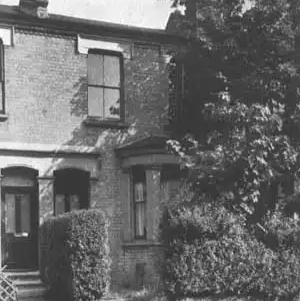
The disturbances took place in late 1928 at a two-story terrace house (pictured above) in Eland Road in Battersea, a riverside district of west-central London.1Price (1945). All information in this article is drawn from this source unless otherwise noted. The house was occupied by the Robinson family: Frederick, aged 27, a teacher; his 86-year-old father Henry, an invalid; his three sisters Lillah, Kate and Mrs Perkins, a widow, all of whom were teachers; and Mrs Perkins’ fourteen-year-old son Peter.
In November 1928, lumps of coal, salt chunks and coins were seen and heard to fall on a lean-to conservatory behind the house. A new barrage occurred in early December, this time breaking windows. Having called the police, Frederick and an officer, standing in the back garden, witnessed pieces of coal and pennies crash onto the conservatory roof, ‘but we could not trace their flight’. The officer was struck on the helmet and ran to the back wall to find the thrower, but no one was there.
A domestic servant left on 19 December, terrified after finding red-hot cinders in the outhouse. Frederick and the police officer, keeping watch in the kitchen, witnessed two potatoes being hurled.
On another day, loud bangs were heard all over the house. A window in Henry’s room was smashed, and he had to be carried out. While engaged in this, Frederick and a helper witnessed a heavy chest of drawers in the room overturn. A ‘great crash’ was heard in another room.
Occurrences and Investigation
In January, newspaper reports brought the incidents to the attention of paranormal investigator Harry Price, who made a visit together with a newspaper reporter. They at once noticed ‘considerable damage’ in the form of broken windows, smashed furniture and shards of ornaments. Having heard a description of the incidents from Kate and Frederick Robinson, he doubted that the family had caused it.
Price and the reporter, named Grice, inspected the damage, finding interior and exterior windows smashed, doors and furniture broken, a mess of coal and other objects on the conservatory roof. They also saw some damage to adjoining houses. While conversing with the Robinsons, Price said, ‘some hard object fell with a resounding thwack in the passage at the back of us’. They found a metal ferro-cerium gas-lighter with a wooden handle, about eight inches long, lying on the floor between the kitchen and the scullery. It was usually kept on the gas stove in the scullery, and the Robinsons declared it had been there when Price arrived. No one was visible who could have moved it.
The next day, Frederick Robinson was taken to St John’s Hospital in Battersea for psychological examination, the police having come to suspect him of causing the disturbances. (Price had judged him to be mentally normal and intelligent.) The disturbances continued in his absence. The widowed daughter, Mrs Perkins, told Price on 23 January that in addition to charcoal and other objects being flung at the house, the furniture had been very active:
Chairs, of their own volition, ‘had marched down the hall in single file’ and three times Mrs. Perkins attempted to lay the table for Saturday’s dinner. On each occasion the chairs had piled themselves up on the table, making it impossible for the woman to proceed with the preparation of the meal.2Price (1945), 233.
After Frederick had been taken away, his sister stated, an attaché case flew from a kitchen chair to the floor, an umbrella sprang from the stand in the hall to the kitchen floor, a cruet crashed to the ground and the table, just set for dinner, fell over. ‘We were so frightened that we went outside,’ Mrs Perkins said. ‘Through the kitchen window we saw all the kitchen chairs fall over … An extraordinary part about it is that the furniture seemed heavy to pick up again.’ Price noted, ‘It is often alleged that objects displaced by Poltergeists acquire extra weight.’3Price (1945), 234.
These incidents were witnessed by Kate Robinson, Mrs Perkins, and her son Peter Perkins, who reportedly was so frightened he became reluctant to sit on a chair in case it moved, and soon was sent to the country to recover.
Price and Grice continued conversing in the kitchen with the two daughters when there was a sound as of a heavy object falling onto the floor of the scullery. Price found a pair of women’s shoes, one of which contained an ornamental bronze cherub. Both daughters cried out in astonishment upon seeing it, saying that it had been sitting on the mantlepiece unmoved for 25 years. Standing close to both the women, Price had seen no suspicious movement on the part of either, and he calculated that to travel from its normal position, the ornament would have had to make two right-angle turns and travelled over the heads of the four people.
The women then vacated the property, out of fear of the disturbances and the gathering crowds, some of whom threatened to force an entrance. On their return a few days later, on 25 January Price brought a medium to the house to give her impressions; she commented on the ‘miserable’ atmosphere. Frederick Robinson returned home, having been judged to be of sound mind. The phenomena now ceased for good.
An account of the phenomena by Frederick Robinson in 1941 added a further striking detail: slips of paper with messages on them appearing. He wrote:
Held up to the light these slips revealed writing as if done with a pin – the messages were sometimes threatening, and sometimes more sober in character. I recall one night after an unusually loud series of rappings seeing a message on a slip of paper come down from nowhere to fall on my bed. Upon elucidation, I read this: ‘I am having a bad time here. I cannot rest. I was born during the reign of William the Conqueror’. The message was signed by the gruesome name of ‘Tom Blood’. Sometimes it was ‘Jessie Blood’.4Cited by Price (1945), 238.
Hypotheses
Considering alternatives, Price noted the presence of a private psychiatric hospital some eighty yards from the house and wondered whether patients there might have thrown the objects. But this could not account for items damaged inside the house. He acquitted the boy Peter Perkins, who had had been absent much of the time and lacked the physical strength to cause some of the furniture damage. He also rejected the possibility that the incidents had been faked by the younger family members in order to force the removal of their ailing elderly father, noting that the phenomena continued long after he had been moved. He concluded tentatively that the occurrences were genuine poltergeist phenomena.
By contrast, Frederick Robinson claimed that the disturbances occurred only when Peter was in the house. This would accord with the established connection between poltergeist activity and children or adolescents.
SPR investigators who visited the house over a period of several days witnessed incidents which they suspected could have been staged, ‘by several different persons acting independently with different motives’, although they acknowledge this could not have applied to the original external disturbances.5Anon. (1928), 286.
Newspaper Archive
A digitized collection of contemporary news articles about the occurrences can be viewed here, at the Poltergeist Archive.
KM Wehrstein
Literature
Anon. (1928). Notes on recent cases. Journal of the Society for Psychical Research 24, 285-87.
Morris, R. (2006). Harry Price: The Psychic Detective. London: Sutton.
Price, H. (1945). Chapter XX: The Battersea poltergeist. In Poltergeist Over England: Three Centuries of Mischievous Ghosts, London: Country Life, 229-39. [Web page.]