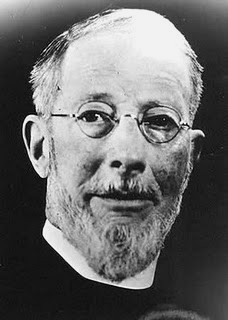
British Methodist minister Charles Drayton Thomas (1867–1953) investigated mental mediumship, chiefly through more than five hundred sittings with Gladys Osborne Leonard. His book, newspaper and proxy tests sought to distinguish spirit communication from living-agent ESP, while his findings strengthened his Christian belief in postmortem survival.
- Thomas developed book and newspaper tests intended to obtain information unavailable to the medium or sitter.
- His proxy sittings with Gladys Osborne Leonard tested communications for people unknown to both medium and proxy sitter.
- Thomas concluded that Leonard’s controls and communicators were independent surviving personalities rather than secondary personalities of the medium.
Life and Career
Charles Drayton Thomas – who went by his middle name, Drayton – was born on 19 March 1867 in Taunton, Somerset, England.1WikiTree (n.d.). Most biographies give Thomas’s birth year as 1868 but WikiTree identifies it as 1867, providing the month and day. His father, John Wesley Thomas, was a Wesleyan Methodist minister2On Wesleyan Methodism in England, see here.
Although he first went into business, Drayton Thomas felt called to the ministry and entered Richmond Theological College in 1889. After serving on various circuits from 1892 to 1907, he was appointed to a Wesleyan Methodist Church in London, where he stayed the remainder of his career. He then continued preaching and lecturing in retirement until shortly before his death, on 14 July 1953, at age 85.3Allison (1954); Anon. (n.d.), citing Hart (1959).
Drayton Thomas joined the Society for Psychical Research (SPR) in the early 1900s and was a member of its governing council for nineteen years, from 1934 to 1953. Although a committed theologian, he proved to be a careful and scientific-minded investigator. Beginning in 1917, he conducted research with the medium Gladys Osborne Leonard, with whom he had more than five hundred experimental sittings.
Thomas was interested in the theoretical possibility that mediums were reading the minds of sitters rather than picking up information from the deceased and pioneered what came to be called ‘book tests’ and ‘newspaper tests’, the results of which opposed both simple and a more complex forms of living-agent ESP as explanations.
In addition to evidence suggestive of spirit communication, Thomas explored the nature of spirit life, asking questions about the transition immediately after death, the spirit body, advancement in the afterlife realms, how spirits communicate, whether they required food and sleep, the age and appearance of spirits, animal survival and other aspects of the afterlife environment. He authored several well-received books, including Some New Evidence for Human Survival (1922) and Life Beyond Death with Evidence (1928).
Psychical Research
Overview
Thomas began to sit with Leonard anonymously on 3 February 1917, having read the account of Oliver Lodge of communications through Leonard from his deceased son, Raymond.4Lodge (2016). Thomas distinguished himself by keeping ‘full and annotated records of his sittings’, which he made available to other investigators.5Salter (1953) His later investigations included gramophone recordings of mediumistic sessions, lodged with the SPR archives.
Thomas entered into his research without intent to contact anyone in particular, but his father, who had died in 1903, soon made an appearance. Drayton’s sister Etta communicated also, after her death in 1920, as did some departed friends. It was Drayton’s father, however, who had the most profound effect on him and whose communications contributed the most to the question of postmortem survival.
Most of Thomas’s experiments with Leonard involved the trance-voice method (that is, Leonard in trance would speak in voices other than her normal one) but some involved direct-voice (the voices were heard to speak independently of Leonard, coming from somewhere around her) as well as via table-tilting (so many tilts of the table for each letter of the alphabet).
Thomas noted that there was less difficulty in getting names by means of table-tilting, although it was much slower and more cumbersome.6Thomas (1922, 32) and (1928, 335). Spoken names came through the ‘voice’ methods with great difficulty, as the result of telepathic communication between spirits and Feda, Leonard’s ‘control’. Names were not easily conveyed by thought images, through which telepathy functioned.7Thomas (1928), 45, 221-35. An example given by Thomas’s father was a man named ‘Meadow’. The father said he tried to connect the idea of a man with a green meadow when referring to Mr. Meadow, but was unable to get the name through.8Thomas (1928), 221.
Book Tests
Along with copious personal details that left no doubt about his identity, the elder Thomas proposed attempting the trials that came to be known as the ‘book tests’. He told his son that the tests had been devised by others in a more advanced sphere than his and the idea passed on to him.
For the tests, Drayton Thomas would arrange a notebook on a table with a lighted lamp. Leonard would take a seat several feet from him and after two or three minutes of silence, would go into trance. Suddenly, in a clear and distinct voice, Feda would take over her body and begin relaying messages from the elder Thomas and others in the spirit world.
There was no similarity between the voices of Leonard and Feda, who spoke like a young girl. Moreover, Feda spoke with an accent and had frequent lapses of grammar. Occasionally, just after Leonard entered the trance state, Thomas would hear whispering of which he could catch fragments, such as, ‘Yes, Mr. John, Feda will tell him…Yes, all right…’ Feda typically referred to herself in the third person, e.g., ‘Feda says she is having trouble understanding Mr. John’.9Thomas (1922), 23.
The idea behind the book tests was to communicate information gleaned by the father from a book in the son’s extensive library. In one of the earliest experiments, the father told the son to go to the lowest shelf and take the sixth book from the left. On page 149, three-quarters down, he would find a word conveying the meaning of falling back or stumbling. When the younger Thomas arrived home that evening after his sitting with Leonard, he went to the book and place on the page, where he found the words, ‘…to whom a crucified Messiah was an insuperable stumbling-block’.10Thomas (1922), 30.
The father explained to the son, through Feda, that he was able to get the ‘appropriate spirit of the passage’ much easier than he could the actual words. However, over a period of eighteen months, he found himself able to pick up more and more words and numbers, gradually shifting from ‘sensing’ to ‘clairvoyance’. The father made it abundantly clear that he was experimenting on his side as much as his son was on the material side of the veil.11Thomas (1922), 117-19.
It was certain that Leonard had never visited Thomas’ house and knew nothing of the library of books in it. Realizing, however, that his subconscious might somehow have recorded such detailed information in the book when he read it years before as well as the exact location of the book in his library, Thomas decided to experiment with books in a friend’s house. He informed his father of the plan so that the father knew where to search.
In one of the tests there, Feda relayed to Thomas that on page 2 of the second book from the right on a particular shelf, he would find a reference to sea or ocean. She added that the discarnate Thomas was not sure which, because he got the idea and not the words. When Drayton Thomas pulled the book from the shelf of his friend’s house, he read, ‘A first-rate seaman, grown old between sky and ocean’.12Thomas (1922), 54.
In another experiment, Drayton Thomas was told to look at page 9 where he would find a reference to changing of colours. Upon opening this book, Thomas found, ‘Along the northern horizon the sky suddenly changes from light blue to a dark lead color’.13Thomas (1922), 54-55.
Over a period of about two years, father and son carried out 348 tests. Of those, 242 (69.5%) were deemed good, 46 (13.2%) indefinite, and 60 (17.3%) failures. The discarnate Thomas explained the failures as his inability to get the idea through the mind of the medium or the medium’s mind somehow distorting the message.
Newspaper Tests
After the book tests, the elder Thomas suggested they experiment in a different way – with what came to be called the ‘newspaper tests’. These began late in 1919, some two years after the book tests ended. In the newspaper tests, the discarnate Thomas would provide various names to be found at certain places on certain pages in newspapers and magazines not yet printed. Thus, he would exercise a sort of precognitive clairvoyance. This would seemingly rule out what Hornell Hart14Hart (1959). came to term ‘Super-ESP’, the ability of the medium to go beyond reading the mind of the sitter and tap into the mind of anyone having a particular knowledge of a subject.
In each newspaper test, Thomas would immediately write down the information he received from his father through Leonard and file it in a sealed envelope with the SPR, at a time before the type was set at the newspaper office, usually by the Times or Daily Telegraph. Further, Thomas would check newspapers from at least ten other days, looking for the same text appearing by chance in those other editions, providing a check against coincidence.
Some of the newspaper tests were inconclusive and a few were failures, but the positive results again far outnumbered the failures.15Thomas (1922), 86-88.
When Thomas asked his father how he was able to obtain information from newspapers not yet typeset, the father replied that he did not quite understand it himself. He referred to it as some kind of ‘etheric foreshadowing’, likening it to seeing the shadow of a man around the corner before actually seeing the man himself.16Thomas (1922), 117-19, passim.
When Drayton Thomas asked what produces the ‘shadow’ of the object, his father replied that he had not figured it out. ‘I suspect, but I am not sure, that whatever is about to materialise on earth has its spiritual counterpart, which is reflected, say on the atmosphere or ether, but not visible to all’. He added,
Admitting that each object may have such counterpart, you will ask how an event yet to happen can have its spiritual counterpart? I think in the same way that an intention may be sensed by a sensitive before it is put into action by the sitter. Sometimes when a man proposes to commit murder his intended victim feels a sense of impending danger. Animals feel this even more than do human beings, seeing what is about to happen.
Now the things I see are frequently but the spiritual counterparts of things which are about to take form; some of my tests from the Times might be called shadows of a substance. When you see a shadow it is but an outline, and you do not look for detail, and that explains the difficulty of these tests; we cannot always sufficiently observe detail.17Thomas (1922), 117-19.
The elder Thomas further explained that although he had moved from sensing a word to seeing it, he could not always make out the word clearly. Thus, in one instance he gave the word ‘rain’ for what proved to be ‘raisin’.18Thomas (1922), 117-18. At another sitting, he explained that although the words might not yet be set in type, someone had formulated the wording and so that that person’s thoughts were on them.19Thomas (1922), 117-18. Nonetheless, he thought that for the most part the process was beyond human comprehension.
Drayton Thomas remarked,
I regard book and newspaper tests as a further addition to the ‘signs and wonders’ by which many in the next life are endeavoring to attract the attention of mortals to the reality of their life and to the true meaning of our temporary existence on earth. Extended knowledge would surely transform the conventional ideas about death, and inspire greater desire to live in harmony with the wise purposes of the Infinite One who, father-like, watches over each and all in this world and the next.20Thomas (1922), 114.
Proxy Sittings
Another attempt to limit the possibility of Super-ESP came with so-called proxy sittings, where Drayton Thomas would act as the sitter in sessions with Leonard, taking the place of the person for whom communications were intended. Because Thomas did not know the deceased communicators, it could not be said that Leonard was obtaining the information from his mind. Thomas wrote three major papers on his proxy sittings, including the one described next.21Thomas (1932–33, 1935, 1939).
In September 1932, Thomas received a letter from a stranger, a Mr Hatch, who said that his step-grandson, Bobbie Newlove, had died a few weeks earlier of diphtheria at the age of ten. Having read Thomas’ book Life beyond Death with Evidence,22Thomas (1928). he wondered if it were possible for Thomas to contact the boy. While not optimistic, Thomas decided to do a proxy sitting. After Leonard went into trance, he handed her the letter in a folder, hoping that this would facilitate contact with the boy through her psychometric ability. This worked. Contact was made with the deceased Bobby and over eleven sittings much evidential information came through Leonard. Some of it was unknown even to the boy’s family at the time, but later verified as correct23Thomas (1935)..
Other Investigations
Drayton Thomas contributed importantly to the study of mental mediumship in other ways and for that reason was treated extensively by Hornell Hart in Enigmas of Survival.24Hart (1959). In addition to book and newspaper tests and proxy sittings, Hart highlighted Thomas’s use of word associations to probe the quality of mediumistic communications,25Thomas (1922) and in later investigations with WW Carington. his attention to communications spoken directly through the entranced Leonard without the intercession of Feda (direct-voice phenomena), and his interest in evidence that communicators employed precognition.
Thomas’s Conclusions
Although many psychical researchers held that a medium’s controls, like Leonard’s Feda, amounted to ‘secondary personalities’ buried in the subconscious mind, Thomas disagreed. He thought that his research clearly supported the spirit hypothesis for controls as well as communicators. ‘While studying the literature of psychical research, during the period before my personal investigations commenced, I was inclined to think that mediumistic controls were dream aspects of a medium’s own mind, or even instances of secondary personality’, he wrote. ‘Experience showed me that these hypotheses fail to meet the facts. The controls studied by me not only claimed to be distinct individuals, but were proved to be so by every test I could apply; never did slip or slightest indication warrant the supposition that they were other than the intelligent and self-possessed individuals they claimed to be’.26Thomas (1928), 161..
Thomas further discounted the religious idea that low-level, earthbound, or evil spirits were impersonating a sitter’s loved ones. ‘Throughout eleven years of frequent converse with those beyond the veil I have found nothing to suggest that they are other than they claim to be; nor have I ever observed the slightest indication that those speaking to me are animated by anything save the sincerest desire for my betterment’, he reported. ‘If throughout these years, I have been speaking with those who wish to amuse themselves by deceiving me, or to do me hurt by impersonating my loved ones, then the only possible conclusion would be that they are taking considerable pains for no intelligent end. Such amusement must have pulled on them long ago’27Thomas (1928), 54..
In sum, Thomas concluded that his research had supplemented and reinforced his Christian faith, both in times of bereavement and in the prospect of old age and death.28Thomas (1928), 291.
Selected Works
Books
The following books are in addition to those listed under Works Cited.
The Mental Phenomena of Spiritualism (1930). London: London Spiritualist Alliance.
In the Dawn Beyond Death [1936]. London: Lectures Universal.
An Amazing Experiment (1936). [Full text.] London: Lectures Universal.
Beyond Life’s Sunset (1939). Lectures Universal Ltd.
From Life to Life: A Story of Family Reunion After Death (1945). London: Rider. Reprinted 2019 by White Crow Books, Hove, UK.
Precognition and Human Survival: A New Type of Evidence (1949). [Full text.] London: Psychic Press.
Articles
Thomas, C.D. (1924). Concerning the Price-Hope case. [Full text.] Journal of the Society for Psychical Research 21, 190-200. (Drayton’s statement and rebuttal from the SPR)
Thomas, C.D. (1928). The modus operandi of trance communication according to descriptions received through Mrs Osborne Leonard. [Full text.] Proceedings of the Society for Psychical Research 38, 49-100.
Thomas, C.D. (1946–49). The volume of Byron: A significant book-test. [Full text.] Proceedings of the Society for Psychical Research 48, 230-37.
Thomas, C.D. (1946–49). A new hypothesis concerning trance-communications. [Full text.] Proceedings of the Society for Psychical Research 48, 121-63.
Michael Tymn
Works Cited
Allison, L.W. (1954). Obituary: The Reverend C. Drayton Thomas. [Embedded in PDF.] Journal of the American Society for Psychical Research 48, 37-38.
Anon. (n.d.). Charles Drayton Thomas biography (n.d.). [Full text.] SurvivalAfterDeath.info.
Hart, H. (1959). The Enigma of Survival: The Case for and Against the After Life. Springfield, Illinois, USA: Charles C Thomas.
Lodge, O.J. (1916). Raymond, or Life and Death: With Examples of the Evidence for Survival of Memory and Affection after Death. [Full text.] New York: George H. Doran Company.
Salter, H. de G. (1953). Obituary: The Rev. C. Drayton Thomas. [Embedded in PDF.] Journal of the Society for Psychical Research 37, 677.
Thomas, C.D. (1922). Some New Evidence for Human Survival. [Full text.] London: London: W. Collins Sons. Reprinted 1924 by E.P. Dutton, New York. Revised ed. 1948,
Thomas, C.D. (1928). Life beyond Death with Evidence. [Full text.] London: W. Collins Sons.
Thomas, C.D. (1932–33). A consideration of a series of proxy sittings. [Embedded in PDF.] Proceedings of the Society for Psychical Research 41, 139–85.
Thomas, C.D. (1935). A proxy case extending over eleven sittings with Mrs Osborne Leonard. [Embedded in PDF.] Proceedings of the Society for Psychical Research 43, 439–519.
Thomas, C.D. (1938–39). A proxy experiment of significant success. [Embedded in PDF.] Proceedings of the Society for Psychical Research 45, 257–306.
WikiTree (n.d). Charles Drayton Thomas (1867–1953). [Full text.] WikiTree.