Efforts to connect consciousness research, quantum theory, and paranormal claims have produced some of the most ambitious speculative models in contemporary science. Thomas Campbell’s work is a notable example, combining altered-state research, simulation theory, and proposed quantum experiments into a single consciousness-centred account of reality.
- Campbell’s My Big TOE argues that consciousness is primary and that physical reality is a rendered virtual environment rather than a self-subsisting material world.
- His proposed quantum experiments are intended to distinguish between mere detection and conscious observation, though they have not entered mainstream physics.
- Supporters see his work as an attempt to reopen neglected questions about consciousness, while critics regard it as highly speculative and methodologically weak.
Life and Career
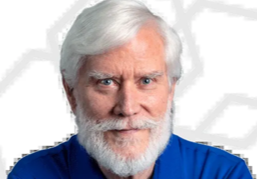
Thomas Warren Campbell was born on 9 December 1944. He studied mathematics and physics as an undergraduate, received a Master’s degree in physics from Purdue University in 1968, and began doctoral work in experimental nuclear physics at the University of Virginia without completing the programme. Campbell later worked in military and aerospace contexts, including systems-risk analysis associated with NASA and work for the Department of Defense.1Campbell (n.d.); Campbell et al. (2017).
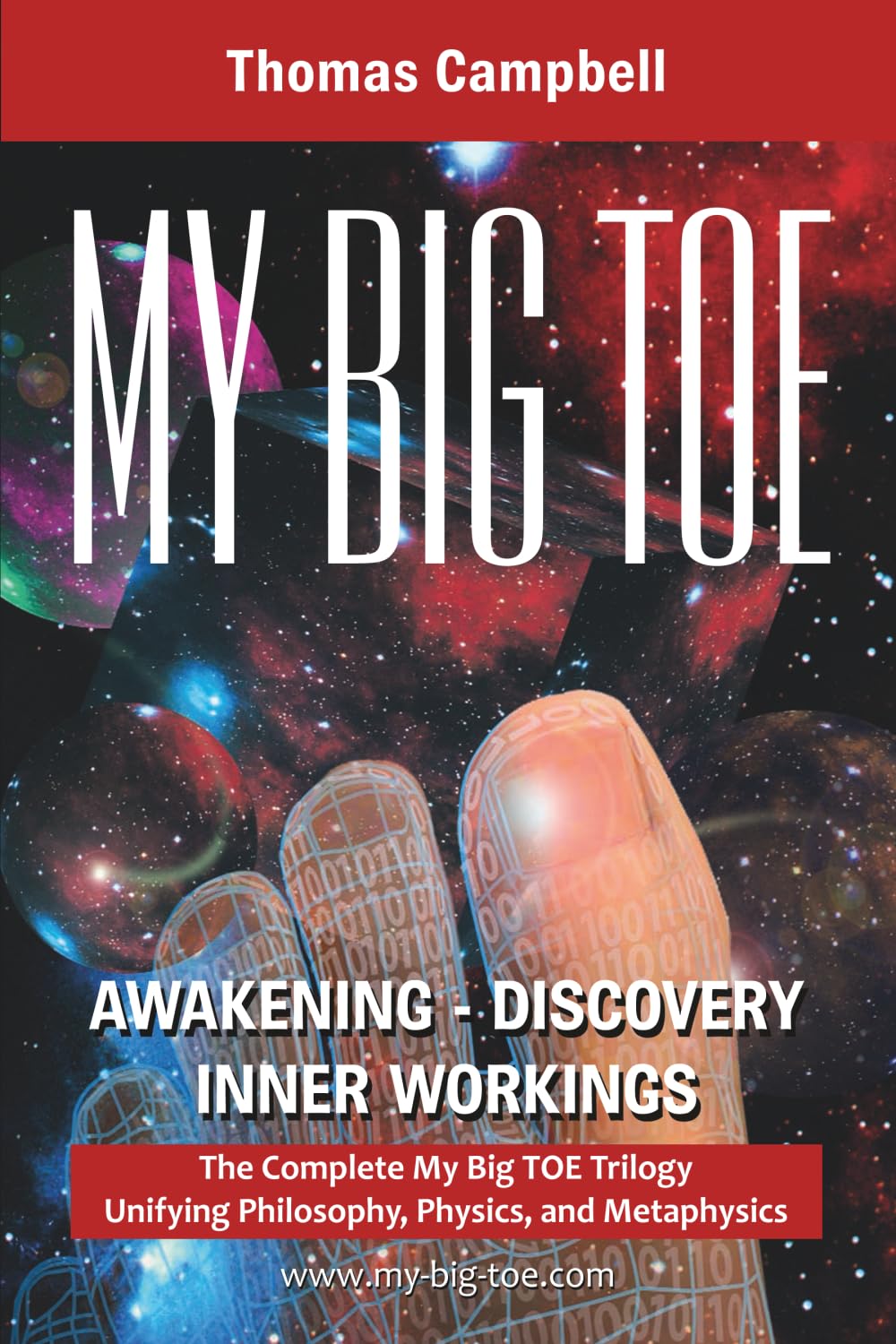
In the early 1970s, Campbell began researching altered states with Robert Monroe, who had founded the Monroe Institute to investigate the out-of-body experience and broader questions about the nature of consciousness.2Monroe (1985). Campbell is best known for his trilogy My Big TOE (‘TOE’ standing for ‘Theory of Everything’), brought together in a single volume in 2003. His central claim is that consciousness is fundamental to the universe and that physical reality emerges from consciousness rather than the reverse. In this account, the physical universe is best understood as a virtual reality or computed information environment rather than as a self-subsisting material world.3Campbell (2003).
Monroe Institute
At the Monroe Institute, Campbell worked alongside engineer Dennis Mennerich. Both men are associated with early Monroe Institute programmes using Hemi-Sync, the binaural-beat technology most closely identified with Monroe’s work.4Monroe Institute (2018).
Campbell has written and spoken of spending decades exploring consciousness through meditation and out-of-body experiences, treating those experiences as an important empirical basis for his later theorising. Mainstream science has not regarded such subjective reports as decisive evidence, however, and this remains one of the main dividing lines between Campbell’s work and conventional academic approaches to consciousness research.5Campbell (2003).
My Big TOE
Campbell’s My Big TOE presents an ambitious attempt to unify physics, philosophy, psychology, and metaphysics within a single model. Its fundamental claim is that consciousness is the primary ontological reality. Matter and energy are derivative, not foundational.6Campbell (2003).
A key metaphor in the trilogy is virtual reality. Campbell argues that the physical world is rendered for conscious participants in much the same way that a game engine renders a game environment. From this perspective, features of quantum mechanics that appear counter-intuitive within materialist metaphysics – such as indeterminacy, nonlocality, and wave-particle duality – become more intelligible.7Campbell (2003).
Campbell distinguishes his position from simulation arguments such as Nick Bostrom’s by insisting that consciousness, not posthuman computation, is primary.8Bostrom (2003); Campbell (2003). In Campbell’s account, the larger system generates virtual realities in order to facilitate the development of individuated consciousness through free-will choices.
Virtual Reality Hypothesis
Campbell argues that reality is computed from the top down rather than built up from mindless bottom-up particle interactions. In this framework, wave functions represent possibilities within an information system, and definite outcomes are rendered when observation requires them. He contends that this model addresses the quantum measurement problem more economically than interpretations that assume a fully self-existing material world.9Campbell et al. (2017).
Campbell has also argued that the model avoids solipsism because multiple units of consciousness participate in the same virtual environment under shared constraints.10Campbell (2003). He presents his theory as a scientific rather than religious model, maintaining that it should stand or fall by its explanatory coherence and by experimental tests rather than by belief or authority.11Campbell (2003); Campbell et al. (2017).
Quantum Experiments
In 2016, Campbell publicly presented a set of quantum experiments designed to test whether conscious observation, rather than mere machine detection, determines certain quantum outcomes. The proposals were later described in a 2017 paper, ‘On testing the simulation theory’, published in the International Journal of Quantum Foundations.12Campbell et al. (2017).
These proposed experiments draw on versions of the double-slit experiment and delayed-choice quantum eraser paradigms. Their key claim is that which-way information should matter only if it becomes available to a conscious observer. If information is detected by apparatus but never made available for observation, Campbell predicted that the interference pattern should persist.
A personal communication from David Chartrand to the author of this article in 2026 reported that tests at Polytechnique Montréal over three years and seven quantum-erasure experiments had falsified one version of Campbell’s simulation hypothesis. Because this claim rests on personal communication rather than a conventional published source, it should be treated as provisional pending formal publication.13Personal communication from David Chartrand (2026); Testing Reality (n.d.).
Public Outreach
Campbell has devoted much of his later career to public communication. Through lectures, workshops, interviews, websites, and a substantial online video archive, he has built an international audience for My Big TOE and related consciousness research. A recurrent theme in Campbell’s outreach is that readers and listeners should not accept his model on faith. Instead, he urges them to test it through meditation, altered-state exploration, and critical reflection on both personal experience and scientific evidence.14Campbell (2003); Campbell (n.d.).
In 2018 Campbell founded the Center for the Unification of Science and Consciousness (CUSAC), a 501(c)(3) non-profit organization. Its stated mission is to address the hard problem of consciousness and to support experimental work at the intersection of consciousness studies and physics.15Center for the Unification of Science and Consciousness (CUSAC) (n.d.). CUSAC presents Campbell’s physics experiments as one strand within a broader research programme and continues to foreground his role as founder. Public materials also identify David Chartrand as executive director and describe ongoing work intended to advance experimental approaches to Campbell’s ideas.
CUSAC provides a platform for promoting the idea that such experiments are technically feasible with standard quantum-optics methodology, offering a route towards empirical testing.16Campbell et al. (2017). As of April 2026, however, official My Big TOE and CUSAC materials continued to present the programme as ongoing rather than completed in a form that had altered mainstream physics discussion.17Center for the Unification of Science and Consciousness (CUSAC) (n.d.); Testing Reality (n.d.).
Criticisms and Controversy
Campbell’s work has attracted criticism from both scientists and philosophers. One line of criticism is that the virtual-reality analogy is suggestive rather than demonstrative: it may offer an evocative metaphor without yielding independent evidence that reality is literally simulated.18Arvan (2014); Bostrom (2003).
A second criticism concerns method. Campbell’s theoretical system is closely tied to subjective altered-state experiences, yet such experiences are notoriously difficult to verify, operationalise, and integrate into standard scientific practice.19Chalmers (1995).
A third criticism is that even if Campbell’s proposed experiments produced unusual results, it would remain debatable whether those results uniquely supported his wider metaphysical framework. Competing interpretations of quantum mechanics already exist, and critics argue that anomalous experimental outcomes would not by themselves establish a consciousness-generated virtual reality.20Bostrom (2003); Chalmers (1995).
For supporters, by contrast, Campbell’s work is valuable precisely because it attempts to connect domains that mainstream scholarship usually treats separately: quantum foundations, consciousness studies, altered states, and paranormal claims. Whether that synthesis proves scientifically persuasive remains an open question.21Campbell (2003); Campbell et al. (2017).
Conclusion
Campbell’s work represents one of the more elaborate modern attempts to build a consciousness-centred theory of reality. His synthesis of altered-state research, simulation theory, and proposed quantum tests has attracted a substantial popular following while remaining outside mainstream scientific acceptance. An enduring interest of his work lies not only in its conclusions but also in the questions it tries to force into relation with one another: whether consciousness can be fundamental, whether quantum theory points beyond materialism, and whether apparently anomalous human experience can be studied in a disciplined way. Those questions remain unsettled, and Campbell’s programme continues to be judged accordingly.22Campbell (2003); Chalmers (1995).
Michael Duggan
Works Cited
Arvan, M. (2014). A unified explanation of quantum phenomena? The case for the peer-to-peer simulation hypothesis as an interdisciplinary research program. Philosophical Forum 45/4, 433-46. [Abstract.]
Bostrom, N. (2003). Are you living in a computer simulation? Philosophical Quarterly 53/211, 243-55. [PDF Download.]
Campbell, T. (2003). My Big TOE: A Trilogy Unifying Philosophy, Physics, and Metaphysics. Huntsville, Alabama, USA: Lightning Strike Books. [Web page.]
Campbell, T. (n.d.). Tom Campbell. My Big TOE. [Web page.]
Campbell, T., Owhadi, H., Sauvageau, J., & Watkinson, D. (2017). On testing the simulation theory. International Journal of Quantum Foundations 3, 78-99. [PDF Download.]
Chalmers, D.J. (1995). Facing up to the problem of consciousness. Journal of Consciousness Studies 2/3, 200-19. [PDF Download.]
Center for the Unification of Science and Consciousness (CUSAC) (n.d.). About CUSAC. [Web page.]
Monroe, R. (1985). Far Journeys. New York, New York, USA: Doubleday.
Monroe Institute. (2018, July). From the director’s chair: July 2018. The Monroe Institute. [Web page.]
Testing Reality. (n.d.). About. [Web page.]