
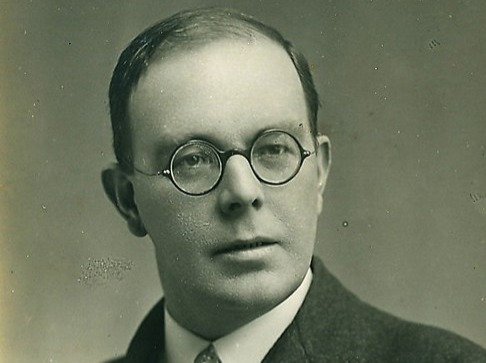
Cyril Burt (1883–1971), one of Britain’s most influential psychologists, took a serious interest in parapsychology, arguing that claims of extra-sensory perception and other psychic phenomena merited scientific attention. His writings on psi, produced after retirement, approached these disputed phenomena with caution, curiosity and rational scrutiny.
- After retiring from academic psychology, Burt wrote and lectured on ESP, survival, out-of-body experiences and the implications of parapsychology for general psychology.
- Burt regarded telepathy and precognition as well-attested phenomena and thought psychical research deserved the same seriousness as other empirical inquiries.
- After his death, Burt was charged with fabricating his research findings on intelligence, and although many of the charges have since been exposed as conjectural, his reputation has suffered as a consequence.
Life and Career
Cyril Lodowic Burt was born on 3 March 1883 in London. His family later settled in Snitterfield, Warwickshire, where his father ran a medical practice. He studied classics at Jesus College, Oxford. Influenced by William McDougall, he turned to psychology, assisting McDougall in 1907 with a nationwide study of mental characteristics.
Burt lectured in psychology and physiology at Liverpool University and, in 1913, accepted a part-time post as educational psychologist for the London County Council. He resigned in 1931 to take up a professorship in psychology at University College, London. He was elected president of the British Psychological Society, and in 1946 was knighted for his work in psychology. However, he never had formal training as a psychologist.1Hearnshaw (1979); Britannica (2026).
Burt retired from University College in 1950 but remained active professionally, including editing the British Journal of Statistical Psychology.2Ward (1993). He became a honorary President of Mensa in 1959.3Papers of Sir Cyril Burt – 1886-1970: D191/9. Burt died on 10 October 1971 in London.4Britannica (2026).
Controversy
The ‘Burt Affair’, as it has been called, concerns the posthumous charge that Burt manipulated or falsified IQ-test results that supported his theories about the genetic transmission of intelligence,5Heywood (1972), 70-79; Hearnshaw (1979); Joynson (1989). but these charges were based on circumstantial evidence and have themselves been questioned.6Jensen (1978); Fletcher (1991); Ward (1993); Rushton (1994); Tredoux (2015).
It is very possible that the matter will never be settled to the satisfaction of all. However, if not intentional fraud, it appears that Burt may have suffered from incompetence stemming in part from a lack of proper training and that he may have abused his authority as one of the most respected British psychologists of his day.7Chamarette (2025).
Ray Ward, writing in The Skeptic (UK), remarked with evidently unintentional irony,
The Burt affair is significant for the study of paranormal beliefs for two reasons. It is an excellent example of how thorough research can totally demolish conclusions which appear to be established beyond all reasonable doubt; and, much more important, it is a classic case of the way in which people who form a conviction have no problem in finding evidence to support it and ignoring all contrary evidence. Hearnshaw decided Burt was guilty, suggested mental illness as an explanation, and found causes for it.8Ward (1993), 10.
Parapsychology
Whatever the truth about his psychological research, Burt’s parapsychological pursuits appear always to have been rational and open-minded, Rosalind Heywood noted in her obituary of the man in the Journal of the Society for Psychical Research.9Heywood (1972), 70-79.
In 1934, Burt was appointed to the management committee of the University of London’s Council for Psychical Investigation, founded by the paranormal investigator Harry Price. Burt’s wife became involved in Price’s card-guessing experiments and the couple visited Borley Rectory, an apparently haunted location Price was investigating. The committee wound up work in 1938.10Valentine (2013), 378-79.
Additionally, Burt gave a lecture on parapsychology at Gresham College in 1935, later brought to light by Anita Gregory and included in her edited collection of Burt’s writings on extra-sensory perception, published in 1975.11Burt (1975b), 15-25. However, for most of his career, Burt appears to have held his parapsychological interests in abeyance. They became significant only in retirement, beginning with a review of Gertrude Schmeidler’s 1960 monograph ESP in Relation to Rorschach Test Evaluation,12Burt (1960). after which he began to contribute more regularly.
Burt did not undertake experimental tests of ESP, so there is no suggestion that he falsified data in parapsychology. He displayed a notably flexible cast of mind in ‘Psychology and Psychical Research’, his Frederic WH Myers Memorial Lecture of 1968.13Burt (1968). In it, he discussed such issues as the psychic factor, the limitations of the senses, the views of physicists and parapsychologists, and the out-of-body experience.
Burt’s conclusions in that lecture suggest an effort to understand the nature of so-called paranormal manifestations rather than simply accept or reject them. Concerning ESP, he wrote that the process resembled the obscure intuitive insights of ordinary life and what Michael Polanyi called ‘tacit knowledge’.14Burt (1968), 76.
Burt also wrote that uncertainty left the question of survival open in both directions, although he thought an important result of psychological and parapsychological investigations was to suggest the possibility of survival in some form or other, albeit not necessarily in the form depicted by traditional piety or fourth-century metaphysics.15Burt (1967), 140-41.
Burt further wrote that there appeared to be ‘well-attested phenomena’ such as telepathy and precognition.16Burt (1967), 63. He compared the positive evidence for parapsychology to the kinds of statistical, observational and experimental support accepted for other, more familiar scientific theories.
Selected Works
Books
The Study of the Mind (1930). London: BBC.
How the Mind Works (1934). New York: D. Appleton-Century Company.
The Subnormal Mind (1937). London: Oxford University Press.
The Factors of the Mind (1940). London: University of London Press.
Psychology and Psychical Research: The Seventeenth Frederic W.H. Myers Memorial Lecture (1968). London: Society for Psychical Research.
The Gifted Child (1975). London: Hodder & Stoughton.
E.S.P. and Psychology (1975, ed. by A. Gregory). London: Weidenfeld & Nicolson.
Articles
The inheritance of mental ability (1958). American Psychologist 13/3, 1-15.
Experiments on telepathy in children (1959). British Journal of Statistical Psychology 12/1, 55-99.
Field theories and statistical psychology (1959). British Journal of Statistical Psychology 12/2, 153-64.
The mentally subnormal (1960). Medical World 93, 297-300.
Structure of the mind (1961). British Journal of Statistical Psychology 14/2, 145-70.
Theories of mind (1961). Journal of the Society for Psychical Research 41, 55-60.
Correspondence: The Psychical Research Foundation (1961). Journal of the Society for Psychical Research 41, 110.
Jung’s account of his paranormal experiences (1963). Journal of the Society for Psychical Research 42, 163-80.
Evolution and parapsychology (1966). Journal of the Society for Psychical Research 43, 391-422.
Parapsychology and its implications (1966). International Journal of Neuropsychiatry 2/5, 363-77.
The implications of parapsychology for general psychology (1967). Journal of Parapsychology 31/1, 1-18.
Book Chapters and Introductions
Introduction (1964). In The Infinite Hive: A Personal Record of Extra-Sensory Experiences by R. Heywood. London: Chatto & Windus.
Psychology and parapsychology (1967). In Science and ESP, ed. by J.R. Smythies. London: Routledge & Kegan Paul.
Book Reviews
Review of ESP in Relation to Rorschach Test Evaluation by G. Schmeidler (1959). Journal of the Society for Psychical Research 40, 422-24.
Review of The Existence of Mind by J. Beloff (1962). Journal of the Society for Psychical Research 41, 431-37.
Review of The Divine Flame by A. Hardy (1967). Journal of the Society for Psychical Research 44, 189-95.
Archival Resources
Liverpool University Special Collections and Archives holds Burt’s personal papers (Ref: D191), and the papers of his secretary Margarethe Archer (Ref: D432). Liverpool University Special Collections and Archives also provides access to the archival record for the Cyril Burt papers.
The British Psychological Society’s History of Psychology Centre holds Burt’s correspondence and reprints, c. 1920–1971.
Melvyn Willin
Works Cited
Britannica (2026). Sir Cyril Burt. [Web page. Full text.]
Burt, C.L. (1960). Review of ESP in Relation to Rorschach Test Evaluation by G. Schmeidler. Journal of the Society for Psychical Research 40, 422-24.
Burt, C.L. (1967). Psychology and parapsychology. In Science and ESP, ed. by J.R. Smythies. London: Routledge & Kegan Paul.
Burt, C.L. (1968). Psychology and Psychical Research: The Seventeenth Frederic W.H. Myers Memorial Lecture. London: Society for Psychical Research.
Burt, C.L. (1975). Psychical research. In E.S.P. and Psychology, ed. by A. Gregory, 15-25. London: Weidenfeld & Nicolson.
Chamarette, R.M. (2025). Rethinking psychology gone wrong. The Psychologist (British Psychological Society). [Web page. Full text.]
Fletcher, R. (1991). Science, Ideology and the Media: The Cyril Burt Scandal. New Brunswick, New Jersey, USA: Transaction Publishers.
Hearnshaw, L.S. (1979). Cyril Burt: Psychologist. London: Hodder & Stoughton.
Heywood, R. (1972). Professor Sir Cyril Burt. Journal of the Society for Psychical Research 46, 70-79.
Jensen, A.R. (1978). Sir Cyril Burt in perspective. American Psychologist 33/5, 499-503. [Web page. Full text.]
Joynson, R.B. (1989). The Burt Affair. London: Routledge.
Rushton, J.P. (1994). Victim of scientific hoax. (Cyril Burt and the genetic IQ controversy). Society (March-April), 31/3, 40. [Upstream. Full text.]
Tredoux, G. (2015). Defrauding Cyril Burt: A reanalysis of the social mobility data. Intelligence 49, 32-43. [Web page. Full text.]
Valentine, E. (2013). Looking back: Spook hunting and ghost busting. The Psychologist (May). [Web page. Full text.]
Ward, R. (1993). The Cyril Burt affair, and historic accusations of fraud. The Skeptic 7/2, 9-10 [Web page. Full text.]