
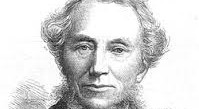
Edward William Cox helped shape an early naturalistic response to mediumistic phenomena, treating them as genuine but non-spiritual effects of a bodily ‘Psychic Force’. His career linked law, publishing and experimental psychology at a formative moment in Victorian debates over Spiritualism, science, mind and human agency.
- Lawyer and publisher who founded or ran several newspapers and journals before turning serious attention to psychology and séance phenomena.
- Held that mediumistic effects were real yet produced by an automatic force generated within the human organism rather than by spirits.
- Worked with William Crookes on mediumistic investigations, later breaking with him over the Florence Cook materialization case.
Contents
Life and Career
The son of a manufacturer, Edward William Cox (1809–1879) was born in Taunton, Somerset, in which town he became a solicitor.1This section is mainly based on Berger & Berger (1991), 81-82. His publishing enterprises began in 1836, when he established the Somerset County Gazette and then the Law Times, which he ran for nearly 25 years. He also founded or acquired other English journals: The Critic, The Field, The Queen, and the County Courts’ Chronicle.
In 1843 he was called to the bar and joined the Western Circuit, later moving to London. From 1857 to 1868 he held legal appointments as judicial officer or judge, such as Recorder of Helston and Falmouth Recorder of Portsmouth. He authored books and manuals about criminal law, the formation of the lawyer and orator, sleep and dreams, heredity, physiology, and other matters. This and his trajectory in the publishing business were pivotal for his accession to the rank of Serjeant-at-Law (a member of the order of barristers at the English bar), the title by which he is known in the parapsychological literature.
A conservative in politics, he stood unsuccessfully for parliament. His investments and business ventures made him very wealthy, and he acquired large properties in London and elsewhere.
Psychical Research and Psychology
In the late 1860s Cox became interested in the phenomena of spiritualism and participated in a committee appointed by the London Dialectical Society. During the 1870s he attended séances with DD Home and other celebrated mediums. He believed that séance phenomena were genuine, but did not attribute them to any supernatural agency, preferring to view them as a matter for experimental psychology.2Noakes (2019), 47, 250. He was co-founder and only president of the short-lived Psychological Society of Great Britain, which aimed to investigate spiritualist claims about the action of discarnate agencies.3Oppenheim (1985), 30.
For Cox, the goal of psychology was to reveal the ‘hidden springs’ of the ‘mechanism of man’, helping to solve the deepest problems of life and mind.4Cox (1878), iv. He argued that mediumistic effects were produced by a natural, bodily force – what he called the Psychic Force – generated within the human organism and operating automatically through the nervous system. This force, he believed, could act beyond the limits of muscular power, much like magnetism or electricity, and should therefore be studied experimentally. Cox’s psychology rejected both religious ideas of a separate soul and crude materialism, positioning mediumship as evidence of a natural but poorly understood psychophysical process rather than spirit intervention.
William Crookes
Cox acted as an assistant to William Crookes in some of his experiments with mediums. He agreed with Crookes that the latter’s experiments with DD Home provided evidence of the ‘Psychic Force’, consistent with Benjamin W Richardson’s theory of a gaseous ‘atmosphere’ within the nervous system, which shrouded the body and mediated sensory experiences.5Noakes (2019), 170; Crookes, Huggins & Cox (1871), 181. Later he became disillusioned with Crookes, believing that he had acted fraudulently in the case of Florence Cook’s supposed materializations of ‘Katie King’.6Oppenheim (19985), 18. Berger & Berger (1991), 82. Shepard & Spence (1991), 334.
William Carpenter
The physiologist and psychologist William B Carpenter was a vocal opponent of spiritualism and psychical research, making hostile public comments about Crookes and other investigators.7Noakes (2019), 251-52 He argued that séance phenomena were caused by what he called ‘unconscious cerebration’. Cox wrote that such hypothesis might not be altogether incorrect, but totally opposed Carpenter’s rejection of the soul as a ‘positive fact’. He stressed that ‘psychology begins … where physiology ends’, and that it asserts ‘the existence of something more than the brain, something invisible … but not the less real’. Mind, he added, may or may not be a function of the body, but there is scientific evidence of the soul’s existence. Such evidence is in our consciousness and is strengthened by the action of the Psychic Force.8Cox (1872), 76-77.
Experiment with Henry Slade
In 1876, Cox had a private sitting in London with the controversial US medium Henry Slade, testing his alleged faculty to communicate with spirits by means of slate writing. Cox stated that he witnessed materializations and other spiritualistic phenomena, but added that how this was done, and by what agency, was ‘a problem for psychology to solve’.9Cox (1876).
Roberto R Narváez
Selected Works
Cox, E.W. (1872). Spiritualism Answered by Science; with the Proofs of a Psychic Force. London: Longmans and Co.
Cox, E.W. (1876). A sitting with Dr. Slade. The Spiritualist 11 August, 18-19.
Cox, E.W. (1878). A Monograph of Sleep and Dream. London: Longman and Co.
Cox, E.W. (1879a). The progress of psychology I. The Spiritualist 14 November, 229-31.
Cox, E.W. (1879b). The progress of psychology II. The Spiritualist November 21, 247-51.
Cox, E.W. (1879c). The Mechanism of Man: An answer to the Question What am I? (2 vols.) London: Longmans and Co.
Works Cited
Berger, A.S., & Berger, J. (1991). The Encyclopedia of Parapsychology and Psychical Research. New York: Paragon House.
Brock, W.H. (2008). William Crookes (1832–1919) and the Commercialization of Science. Ashgate Publishing, Ltd.
Crookes, W., Huggins, W., & Cox, E.W. (1871). An experimental investigation of spiritual phenomena. The Spiritualist 15 July, 180-82.
Noakes, R. (2019). Physics and Psychics. The Occult and the Sciences in Modern Britain. Cambridge: Cambridge University Press.
Oppenheim, J. (1985). The Other World: Spiritualism and Psychical Research in Britain, 1850-1914. Cambridge, UK: Cambridge University Press.
Shepard, L. & Spence, L. (1991). Encyclopedia of Occultism & Parapsychology (3rd ed., vol 1). Detroit, Michigan, USA: Gale Research, Inc.