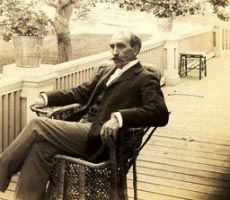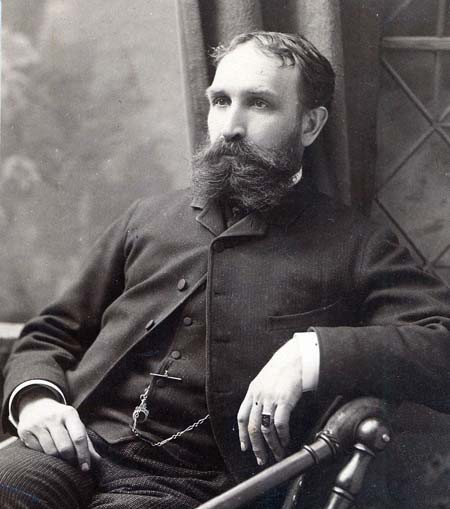
A leading Unitarian minister who turned to psychical investigation to aid his parishioners, Minot Judson Savage (1841–1918) argued that evidential mediumistic communications pointed to postmortem survival. He sought to reconcile Christianity with evolutionary theory and to show how they related to psychic phenomena.
- Savage regarded living-agent telepathy as too limited to explain many mediumistic and clairvoyant phenomena.
- Personal sittings with Leonora Piper and other mediums helped convince him that discarnate intelligences sometimes communicated with the living.
- Savage argued that psychical research must remain scientific, while allowing for the independent agency of surviving personalities.
Life and Career
Minot Judson Savage was born on 10 June 1841 in Norridgewock, Maine, USA. His father was a Calvinist and he joined the Congregational Church in 1854, when he was thirteen. Although chronically ill health meant that he never received much formal schooling, he graduated from the Bangor Theological Seminary in 1864. He spent nine years as a Congregationalist minister before coming to question what he considered God’s cruelty and the idea that the Scriptures were infallible, leading him to convert to Unitarianism in 1873.1This section is informed by Eliot (1952); Harvard Divinity School Library (n.d.); and Harvard Square Library (2014).
Savage acted as a Unitarian minister in Chicago from 1873 to 1874, then was at the Church of the Unity in Boston from 1874 to 1896. He was associate minister of the Church of the Messiah in New York City from 1896 to 1906. He served on the board of directors of the American Unitarian Association, on the Council of the National Conference, and as a delegate to the International Council. Harvard University bestowed on him an honorary Doctor of Divinity degree in 1896.
In 1876 Savage published The Religion of Evolution, which presented Darwinian theories as religion and brought him some notoriety. He was an advocate of Darwinian optimism and social reform and also wrote poetry and hymns. A popular preacher, he attracted thronging congregations. His sermons were printed weekly and distributed the world over in the pamphlet series Unity Pulpit and Messiah Pulpit.
Savage married the daughter of a fellow clergyman in 1864 and with her had two children, a son and a daughter. He died at age 77 on 22 May 1918 while attending the annual Unitarian meetings in Boston. He is regarded as one of the great preachers of the late nineteenth century, his attempt to reconcile evolution with religion being one of the earliest attempts along those lines.
Engagement with Psychical Research
Overview
For many years, Savage was a sceptic of spiritualist claims to be in touch with the surviving dead.2Eliot (1952), 201. Eventually, he began to enquire into the reality of spirit communication
because my parishioners were coming to me for help and sympathy; and I found I ought to have something better than prejudice to give them. I never tried to get into communication with a personal friend, as dearly as I should love to do so. I have never made that my object. I have simply studied to find if there be any truth here.3Savage (1899), 266.
Savage was sitting with mediums long before the formation of the London-based Society for Psychical Research (SPR) in 1882 and the Boston-centred American Society for Psychical Research (ASPR) in 1885.4Savage (1899), 251, 266. He became a charter member of the ASPR.5Associate Members (1885–89).. He was on familiar terms with Richard Hodgson, who assumed the helm of the ASPR when it became a Branch of the SPR in 1890, and with James Hervey Hyslop, who reconstituted the ASPR as Section B of his American Institute for Scientific Research following Hodgson’s death in 1905. Savage participated in the ASPR’s Committee on Mediumistic Phenomena under Hodgson6Knapp (2017), 162. and was a member of the board of trustees under Hyslopuntil forced to resign in 1907 for reasons of health.7Hyslop (1907).
Leonora Piper
Savage does not say exactly when he began sitting with Leonora Piper but it must have been towards the start of her mediumship in 1884, perhaps even before William James became acquainted with her.8Savage (1902a), 73.
In Savage’s first sitting with Piper, his deceased father appeared unexpectedly. Savage’s father had never lived in Boston and was unknown to Piper, yet her spirit control Phinuit described him with precision, ‘pointing out certain peculiarities which the ordinary observer, even if he had seen him, would not have been likely to notice’.9Savage (1902a), 73.
Phinuit identified the communicator as Savage’s father and added, ‘He calls you Judson’. This was appropriate, although it was a little-known fact. Most of the family called Savage by his first name, Minot. Phinuit then said that Savage’s brother John was there as well. Phinuit described John and how he died, although Piper could not have known anything about him, either.10Savage (1902a), 73-77.
At a later sitting, Savage’s daughter, Gertrude, visited Mrs. Piper anonymously. A friend made the appointment for her under an assumed name. As a test, the friend gave her three locks of hair. ‘[Gertrude] knew nothing about them, not even as to whether they had been cut from heads of people living or dead’, Savage related. She carried the locks to the session in a book, carefully placed between different pages. After Piper had entered the trance state, Gertrude put the locks in her hand one at a time. Phinuit gave the name of the friend, the names of the three people whose hair she held, told whether they were living or dead, and provided other details. Gertrude made careful notes and after the sitting verified that Piper (or Phinuit) had been correct about all.11Savage (1902a), 77-78.
In On the Cosmic Relations, Henry Holt described a communication through Piper involving Minot Savage and his brother, the Rev WH Savage. Phinuit told WH Savage that somebody named Robert West was there and wanted to send a message to his brother. The message was in the form of an apology for something West had written about Minot Savage ‘in advance’. This made no sense to WH Savage, but he passed the message on to his brother, who explained that West was editor of a publication called The Advance in which he had criticized his work in an editorial.
During the sitting, WH Savage asked West to describe himself. West gave what turned out to be an accurate description, including the information that he had died from hemorrhage of the kidneys. In a sitting two weeks later, West again communicated, stating that his body was buried in Alton, Illinois, and that his tombstone was memorialized with the inscription, ‘Fervent in spirit, serving the Lord.’ WH Savage had no knowledge of any of this at the time, but later confirmed it all.12Holt (1914), 415-16.
On another occasion, Minot Savage’s deceased son Philip communicated through Piper’s automatic writing. Philip asked his father to go to his room, look in a desk drawer and find papers he wished to have destroyed. Philip had died two years before, at age 31, and Savage had never visited him in his last place of residence. However, he went there and found papers in the drawer indicated. Looking through them, he ‘at once saw the meaning and importance of what he had asked me to do. There were things there which he had jotted down and trusted to the privacy of his drawer which he would not have had made public for the world’.13Savage (1902b), 123-24.
Savage was one of the 27 people recruited by William James to sit with Piper in a test of ability to communicate with the deceased. Twelve of the 27 received nothing of significance, but the other fifteen, including Savage, were supplied meaningful information, James reported.
Other Experiences
As a member of the ASPR Committee on Mediumistic Phenomena, Savage had sittings with many mediums in addition to Piper.14Knapp (2017), 162. Often the sittings were evidential and made a great impression on him. He described them at length in Can Telepathy Explain? Results of Psychical Research (1902) and in a contribution to a volume devoted to Piper’s mediumship published by the Medico-Legal Journal the same year.15Savage (1902a, 1902b).
Mediumship was not the only psychic activity with which Savage was acquainted. Early in his investigations, he encountered physical phenomena, including levitations. ‘I have seen tables and chairs lifted in a way not to be explained by any ordinary methods, and this a good many times’, he wrote. ‘On one occasion, when seated in a heavy arm chair, I was myself gently and quietly lifted into the air while a skeptical friend looked on and carefully studied what was taking place’.16Savage (1902), 59-60.
Thoughts about Psychic Phenomena
Telepathy
Savage’s conception of telepathy appears to be of a faculty confined to the living, probably as a result of the theorization of Edmund Gurney and some other SPR members of the day, but he developed his own theories about it.
In Savage’s opinion, telepathy was not the best explanation of clairvoyance, mediumship, clairaudience, apparitions, and other paranormal phenomena. He acknowledged a psychical form of interaction which could be called telepathy, but thought it operated exclusively between two persons, and he attacked the idea that its workings depended fundamentally on dividing the mind into a conscious part and a subconscious part. Although he agreed with Frederic WH Myers that the mind could function below the level of consciousness, he denied that the subconscious was an independent entity endowed with great powers, contending that such a notion was ‘arbitrary’.17Savage (1899), 155-56; (1902b), 128-30. For an early criticism of Savage’s position, see Hudson (1896), chs. IV-V.
In Can Telepathy Explain?, Savage wrote:
On the telepathic theory it would seem that the sitter ought to get what he expects, i.e., such things as are in his own mind. If the mental states and the knowledge of the sitter are somehow reflected in the subconscious self of the psychic, or if the psychic is able in any way to get at the mental conditions and the memory of the sitter, then the result ought to be a correct transcript of these things. But in my experience, it has been … common for me to be … surprised by getting things which I did not expect, and frequently statements which were the direct opposite of what I supposed to be true [no matter whether the psychic was in a state of trance or not].18Savage (1902), 158-59.
Furthermore, he contended that the subconscious could not be very powerful, since it did not follow the ‘law of suggestion’: in a certain sitting, there were ‘things of which the medium knew absolutely nothing about … things not only not suggested by the sitters, but statements concerning things of which the sitters were ignorant … and … opposite to the opinions of the sitters … [and also] statements of things not only [denied] by the sitters, but to which they were violently antagonistic’.19Savage (1902a), 165.
These unexpected outcomes and errors suggested to Savage the limited applicability of the ‘telepathic theory’; perhaps it applied only to ‘physical phenomena’ and apparitions.20Savage (1902), 160-62; Savage (1893), 17-18.
The Spiritistic Theory
Savage believed that the ‘spiritistic theory’ not only explained the insufficiencies of living-agent telepathy, but also, and with greater precision, all variety of psychical phenomena. A spiritualist understanding of results seemed more natural than those of living-agent telepathy and hence deserved to be considered whenever another scientific account was lacking. Savage wrote:
The only person in the universe which ever does things is either a human being or a being with quasi-human intelligence. We have no knowledge of intelligently exercised force except such as is under the guidance of a human or quasi-human will. [Then,] on the supposition that people do live through the fact of, and after death, the theory of their agency in accomplishing the things which we are discussing [of a paranormal nature], is much simpler … than any other….21Savage (1902), 168-71.
Thus, instead of assuming an arbitrary almighty subconscious, we can assume the continued existence of people who once inhabited this earth, living in some other place after death and still exercising their intelligence. To accept that there are ‘invisible beings about us, who are interested in our affairs, and who, under certain conditions, can come into contact with our lives’, was for Savage entirely rational thinking.22Savage (1902), 173.
However, it must be borne in mind that ‘the people from this world make mistakes and forget, and there is no reason to suppose that the moment a man dies he becomes either a perfect angel or a perfect devil’. When we pass into the next world, we do not change but ‘carry with us our personal consciousness, our memory of what we have been, and who have been our friends, and those most closely associated with us.’23Savage (1899), 272-73; (1902b), 130. Savage dedicated chapter XIII of Life Beyond Death to speculation about the conditions and features of the lands where the personalities of those who leave us carry on with their modes of being. His descriptions were sometimes reminiscent of Emanuel Swedenborg and other writers of mystical tendencies:
If no one can say whether death changes the ‘personal characteristics’ of any human being, then the dead may continue to act just as they did while incarnated, and the consequences of their actions become somehow perceived, with all possible errors or inconsistencies, in the ‘paranormal experiences’ of those who still live in this world.24Savage (1902b), 129-30.
This whole standpoint is at the basis of Savage’s theory of immortality (see below).
Psychical research must be scientific, yes, but the investigators should consider the rational possibility that each individual survives as an independent being, and hence that
these personalities cannot be dealt with, manipulated, ordered to go and come as a chemist deals with his elements in the laboratory. By the very supposition involved in these studies, a different method … must be followed … [one] just as scientific as any other, and yet [attentive to] the facts and conditions, and abide by them.25Savage (1902a), 179. See also Savage (1891).
The Afterlife
In the later years of his research career, Savage concluded that psychic facts and events (ghosts, clairvoyance, raps, mediumship, and so on) are actually natural and self-evident, and that their existence is easier to believe and understand than any scientific theory proposed to explain them, including living-agent telepathy. He was then only one of many men who, according to him, had come to accept ‘that there is no … way of explaining that which has been over and over again proved to be fact’, without supposing that every paranormal occurrence took place in so far as it was in communication with ‘some invisible intelligence’.26Savage (1899), 269.
This can be valued as a mere ‘provisional hypothesis’; however, it works as a simple enough explanation. But the most important thing was, for Savage, that all the ‘psychical’ experiences and facts which one can get to know first-hand ‘take us over the border and whisper in our ears the certainty of immortal life’.27Savage (1899), 268-70; (1902b), 134-35.
Selected Publications
The Religion of Evolution (1876).
The Morals of Evolution (1880).
Beliefs About Man (1884).
Life Beyond Death (1901).
Immortality (1906).
Roberto R Narváez, Michael Tymn and James G Matlock
Works Cited
Associate Members (1885–89). [Embedded in PDF.] Proceedings of the American Society for Psychical Research 1, 59.
Eliot, S.A. (1952). Minot Judson Savage, 1841-1918. [Embedded in PDF.] In Heralds of a Liberal Faith, Vol. 4, ed. by S.A. Eliot, 206-10. Boston: Bacon Press.
Harvard Divinity School Library. (n.d.). Savage, Minot J. [Full text.] Web page.
Harvard Square Library. (2014). Savage, Minot Judson (1841–1918). [Full text.] Web page.
Holt, H. (1914). On the Cosmic Relations. [Full text.] Boston and New York: Houghton Mifflin.
Hudson, T.J. (1896). A Scientific Demonstration of the Future Life. [Full text.] Chicago, Illinois, USA: A.C. McClurg and Company.
Hyslop, J.H. (1907). Editorial. [Embedded in PDF]. Journal of the American Society for Psychical Research 1/1, 35-39.
Knapp, K.D. (2017). William James: Psychical Research and the Challenge of Modernity. Chapel Hill, North Carolina, USA: University of North Carolina Press.
Savage, M.J. (1891). A reply to Mr. Hawthorne. [Download PDF.] The Arena 3, 680-91.
Savage, M.J. (1893). Psychics: Facts and Theories. [Full text.] Boston: Arena Publishing Company.
Savage, M.J. (1899). Life Beyond Death. [Full text.] New York & London: G.P. Putnam’s Sons.
Savage, M.J. (1902a). Can Telepathy Explain? Results of Psychical Research. [Full text.] New York & London: G.P. Putnam’s Sons.
Savage, M.J. (1902b). Results of psychical research. [Embedded in PDF.] In Spiritism, Hypnotism and Telepathy as Involved in the Case of Mrs. Leonora Piper and the Society for Psychical Research, ed. by C. Bell, 114-35. New York: Medico-Legal Journal.