The Ouija board is a spirit-communication device whose history crosses Spiritualism, parlour gaming, psychical research, literature, and popular culture. Claims about its dangers remain controversial, but its use has also generated evidence relevant to automatisms, mediumship, implicit cognition, and the study of anomalous information.
- The board’s movements are commonly explained either as spirit agency, unconscious muscular action, or deliberate fraud.
- Historical Ouija cases range from literary productions attributed to Patience Worth to allegedly veridical ‘drop-in’ communicator cases investigated by Alan Gauld.
- Modern experiments suggest Ouija use can sometimes express information outside conscious awareness, though that does not itself demonstrate survival or spirit contact.
History
This section is adapted from Supernatural Machines: The History of Spirit Communication Devices by David Brandon Hodge, to be published in late September 2026.1Hodge (2026).
Ouija is the most well-known séance apparatus that evolved from a long legacy of evolutionary forms that have their roots in the Spiritualist movement. Prior to its introduction in 1890, Spiritualists had long established the use of alphabet cards for the practice of alphabet calling, in which participants would point to letters and numbers on a printed card and await spiritual raps or tilting tables to spell out messages one letter at a time. Many enthusiasts reported their hands being seized by ‘an involuntary motion of the hand’ they attributed to an ‘agency beyond the control of the medium’, similar to automatic writing.2Member of the First Circle (1851), 49.
The popularity of table-tipping in the early 1850s, when séance participants began to experience similar involuntary movements of tables beneath their fingertips, kickstarted an ongoing evolution of séance apparatus that harnessed these mysterious interactions in various ways to produce alphabetic means of communication, such as Adolphus Wagner’s Psychographen and Isaac Pease’s Spiritual Telegraph Dial, or created new cooperative methods of automatic writing, such as the planchette – heart-shaped boards fitted with wheels and a pencil to produce spirit writing – which first saw use among Parisian séance circles in 1853.3Hodge (2025).
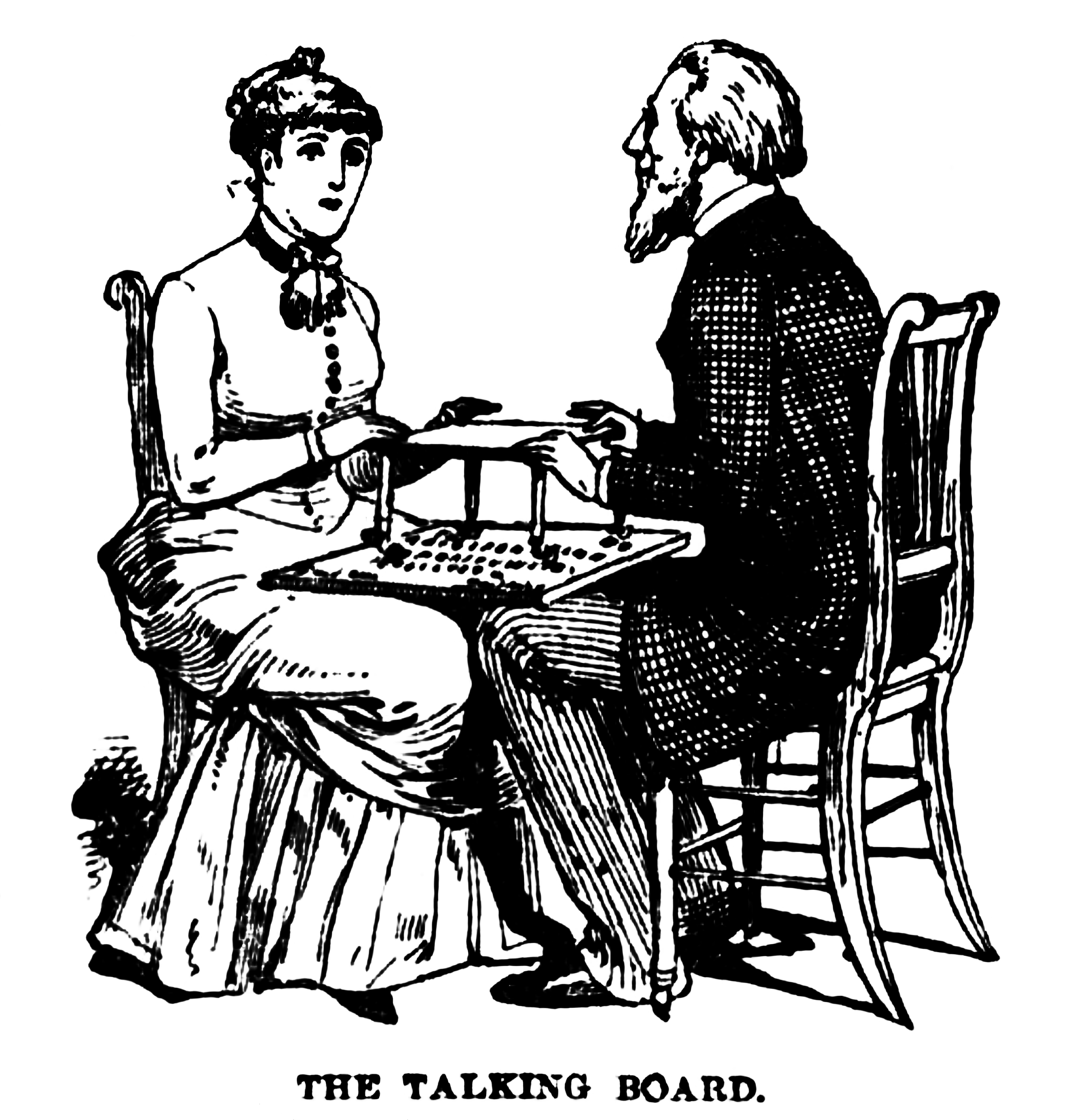
Ouija boards, known generically as talking boards, were the direct descendants of these spiritual innovations. In 1886, in the wake of a resurgence in popular interest in automatic writing planchettes in America, Spiritualist groups in northern Ohio began to pair modified planchettes with the alphabetic systems of old, printing letters and numbers on wooden boards and using the mysteriously moving planchette to point out messages one letter at a time. News of the innovation spread rapidly in American newspapers and the objects initially known as the ‘New Planchette’ were soon dubbed ‘Talking Boards’.4The New Planchette (1886). Several manufacturers rushed to offer new alphabetic means of spirit communion, including Thomas Lees’ Psychobrette and Hudson Tuttle’s Psychograph, or Dial Planchette.
While he would never acknowledge any inspiration taken from the 1886 ‘New Planchette’ articles, Charles Kennard of Chestertown, Massachusetts, would claim that in that same year he envisioned an identical breakthrough, imagining he could receive efficient communications ‘if words could be spelled by the alphabet’. He struck on what he believed was an original idea: ‘In 1886 I made a crude board, using a cake board and a table with four legs and a pointer, marking the alphabet and numerals in pencil’, and used the pairing to autonomously spell out messages letter by letter.5Kennard (1919a, 1919b). Despite Kennard’s claims of originality, surviving illustrations from the 1886 ‘New Planchette’ articles demonstrate that the designs that would eventually become Ouija closely conformed to the drawings of Ohio talking boards then being featured in American newspapers.
Kennard commissioned local cabinetmaker and undertaker Ernest Christian (‘E.C.’) Reiche to produce ‘about a dozen boards a little neater in appearance than the cake board’,6Kennard (1919b). which he then offered for sale locally, but after Reiche exited the partnership, Kennard put his commercial ambitions on hold until his move to Baltimore, Maryland, in 1890. In Baltimore, Kennard partnered with local lawyer Elijah Bond, the two working together to patent their apparatus design as they brought on new moneyed investors, including local customs official Col Washington Bowie and US Senator Harry Welles Rusk. Contrary to later false reports that the board’s name was a compound of the French and German words for ‘yes’ (‘oui’ and ‘ja’),7For one early erroneous example, see Notes & Queries (1892). The true account from Kennard appears in Kennard (1919b). the company’s founders themselves verified that the board had actually named itself at the hands of Elijah Bond’s sister-in-law, the ‘strong medium’ Helen Peters, under whose hands the planchette spelled out ‘O-U-I-J-A’ when the board was asked what it would like to be called.
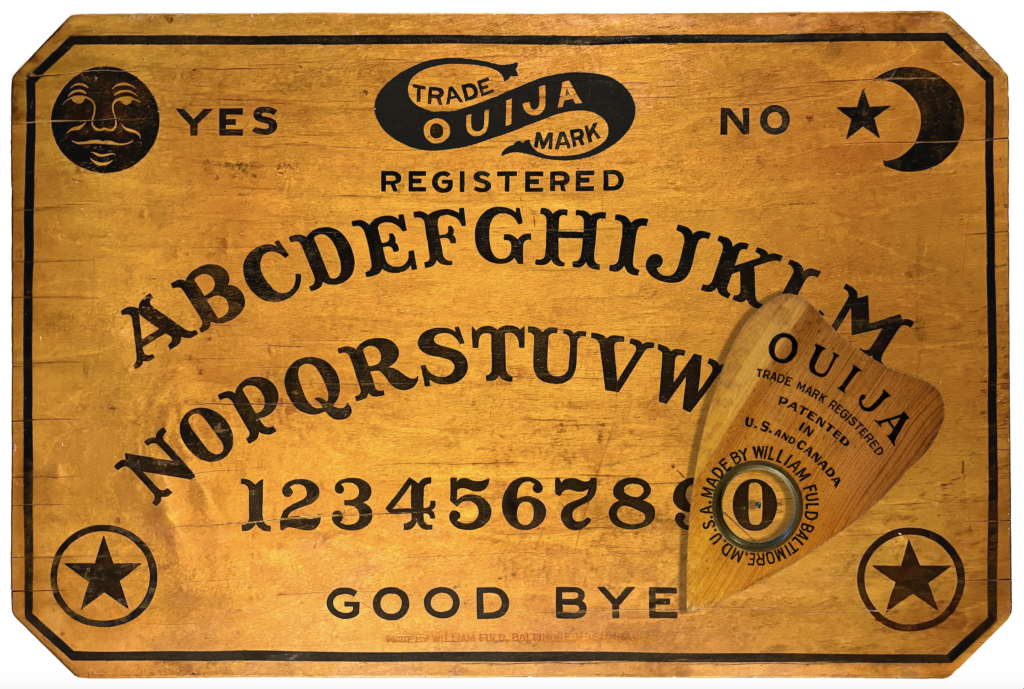
The Kennard Novelty Company debuted Ouija in 1890, and the board was a breakout success, bridging the gap between autonomous spirit communication techniques long used by Spiritualists and secular pop culture interests in parlour entertainment. The company would see many changes in its first years, including the loss of both creative founders with the departures of Charles Kennard and Elijah Bond, both of whom would go on to produce new talking boards with other companies. Eventually, company foreman William Fuld would license Ouija’s production rights from the remaining executives, and champion Ouija through successive generations of waxing and waning popularity, including the apex of Ouija’s cultural popularity in the early 1920s.
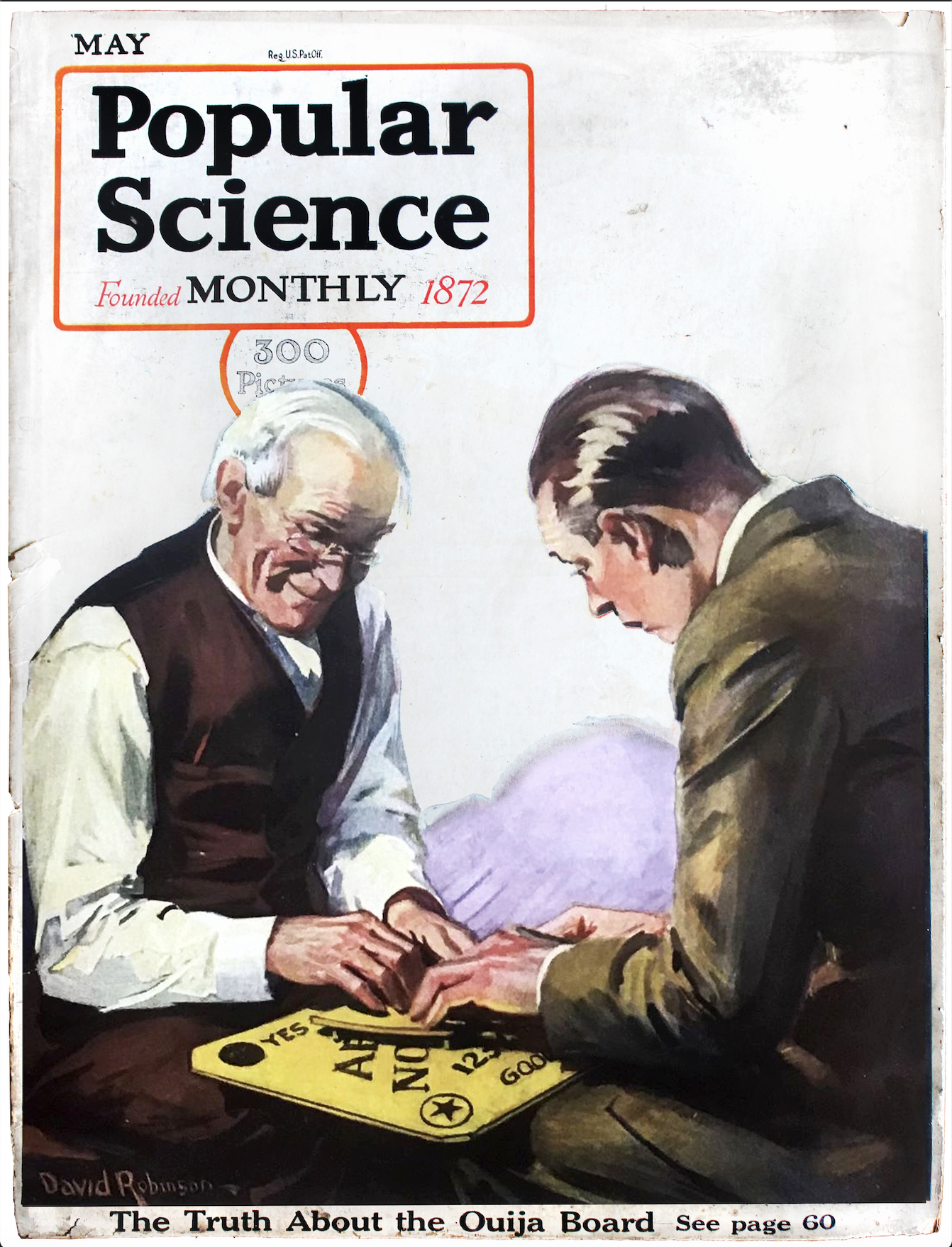
Throughout this time, Ouija would continue to evolve, and Fuld introduced many new innovations to the product. Countless competitors, too, would spring up over the decades to offer new forms of talking boards under a host of names, including Wilder Manufacturing Company’s Mitche Manitou, American Novelty Co.’s Ouija Queen, and Haskelite’s Mystic Tray, among hundreds of others. The Fuld family would continue to produce Ouija until its sale to Parker Brothers in 1966, and the year following the acquisition Ouija famously outsold Parker Brothers’s most iconic and best-selling game, Monopoly.8Dietsch (1967). Ouija sold 2.3 million units to Monopoly’s 2 million, stoking an ongoing demand in an oftentimes controversial spotlight that successive companies – including current owners Hasbro – have managed to maintain to the modern era.9Hodge (2026).
The Ouija Board in Use
Theories
Competing explanations have been offered to explain the way the planchette moves as it creates coherent messages. One, the ‘spiritualistic’ theory, is that the energy is channelled from an external source, by spirits of the dead, or possibly also ‘elementals’ or ‘demons’. By contrast, the ‘automatistic’ theory states that the energy comes from the hands of the operators, via muscle spasms guided by their subconscious minds – an interpretation introduced by Michael Faraday in his investigation of ‘table tipping’10Faraday (1853), the séance-room phenomenon where a table moves with just people’s fingers touching it. This theory refers only to how the planchette is moved, leaving open the possibility that the information is gathered by ESP. A third possibility is that the planchette is being deliberately moved by one or more of the participants in order to create a false impression of spirit communication.
Is the Ouija Board a Dangerous Tool?
This question is closely linked to accepting the possibility that the spiritualistic theory of using the Ouija board may be correct. The Scottish astronomer and psychical researcher Archie Roy compared the use of the Ouija board to ‘picking up total strangers in a bar and inviting them home’.11Zammit (n.d.).
The danger apparently gets greater if a strict religious view is taken. J. Godfrey Raupert, a devout Christian and a leading member of the Society for Psychical Research (SPR), argued that it is never possible to conclusively identify the particular spirit communicating.12Raupert (1919), 216. This means in effect that the entity pretending to be a loved one could be a mischievous or even evil entity picking up the relevant information by other (paranormal) means. Hugh Lynn Cayce, the son of the famous American psychic Edgar Cayce, further stated that instances of people getting into extreme difficulty with the board are ‘not uncommon, unfortunately. The frightening thing about them is that they can be duplicated by the thousands from the case histories of present-day inmates of mental institutions all over the world’.13Zammit (n.d.).
However, when looked at carefully, there seems to be little evidence to back up the claim that Ouija has literally driven thousands mad. Alan Murdie, chair of the Ghost Club, puts it succinctly, saying: ‘The view that Ouija boards are in some way dangerous only seems to have grown up since the mid-1960s with increased channelling and occult experimentation in North America; rather like rumours of Satanism and black magic cults, stories of harmful Ouija board experiments have entered into popular folklore and horror fiction. Solid examples – i.e. those with names, places and dates and corroborating evidence – are hard to come by’.14Murdie (2008), 21. If we look, for example, at a case involving a man drowning his dog, sceptics have pointed out that the man ‘seems to have now dropped his alibi and has pleaded guilty to causing unnecessary suffering to a protected animal’.15Skeptic Boot-Blog (2015).
This demonisation of the Ouija board seems especially to have occurred following the book and film The Exorcist,16Blatty (1972). publicised with some justification as the most terrifying book ever written. The Ouija board’s inclusion in the book and film changed its public perception, this only six years after Parker Brothers bought the rights and in effect produced the Ouija board as a ‘toy’. It is likely the 2014 movie Ouija has had a similar but much smaller impact.
The Ouija Board as a Tool for Paranormal Investigation?
There is a strange switching of allegiances when this question is asked, in that those who fear the Ouija board tend also to be those who believe it actually works. For example, J Godfrey Raupert, despite in general disapproving of its use, admitted ‘while much Ouija or planchette writing is automatic and natural, intercourse with the spirits can be established by these means … that in view of the abundant evidence, any other explanation would present greater and indeed insuperable difficulties’.17Raupert (1919), 234. What, then, is the evidence for the effectiveness of the board, and would it be evidence for an afterlife or possibly hidden powers within?
By definition, for any evidence to impress, it would need to bring forward facts or knowledge or skills that were not readily available to the sitter or sitters. One of the most interesting historical cases is that involving Pearl Curran, who in 1912 started experimenting with a Ouija board and initially got communications apparently from her recently dead father. Within a year, however, she was contacted by an entity who named herself Patience Worth, apparently born in 1649 in England, a poor uneducated country girl who immigrated to America and was slaughtered in an Indian raid in 1694. What was unique about these ongoing communications, though, was not any possible past life of ‘Patience’, but the fact that over a period of five years ‘she dictated four million words—epigrams, poems, allegories, short stories, plays and full-length novels’.18Hunt (1985), 28.
Patience’s writings were of a very high calibre. One of the books, for example, dictated in this fashion, called The Sorry Tale, about the life of Christ, became a bestseller and was reviewed by the New York Times in 1917 as ‘a wonderful, beautiful and a noble book’.19Hunt (1985), 29. This was something that, on the surface at least, neither Pearl Curran, with only basic schooling, nor ‘Patience’ (if indeed a peasant farmer) could have produced. Walter Franklin Prince of the American Society for Psychical Research investigated this phenomenon. He could not come to a firm conclusion about it, believing that ‘We must either accept Patience Worth as a spirit or as one of the most amazing phenomena to come from the human subconscious’.20Hunt (1985), 34. In either case, the phenomenon is of great interest and anomalous to the extent that it is not fully understood.
Another famous case which started with similarities is that of Betty White who, with the help of her husband Stewart, spent seventeen years with a group of discarnate beings calling themselves the Invisibles, collecting messages about the importance of spiritual development amongst humanity, which they published in 1937.21White (1937/1988). What is of interest here is that whilst the initial communications were from a Ouija board, the later communications were through automatic writing and trance mediumship. This makes the clear point that whatever the mechanisms of Ouija, they are similar to other types of psychic communication or divination and should therefore not have any special dangers or differences from these other processes.
So far this article has concentrated on the use of Ouija boards by one person. Much of their mythology and reality, however, come from their collective use.
Perhaps one of the best-known collective Ouija-board sessions (at least with regard to the subsequent publicity regarding its findings) is the sessions organised by paranormal investigator AD Cornell at the Ferry Boat Inn in 1953. This was a series of three sessions which gave the identity of a supposed ghostly White Lady as that of Juliet Tewslie, who may have died in 1050 or 1402 (depending on the session) as the result of her unrequited love for a local woodcutter. The story appeared in the local press and in Farmers Weekly and then went viral, even in those pre-internet times, appearing in Marc Alexander’s Haunted Pubs in Britain22Alexander (1984)., Guy Playfair’s The Haunted Pub Guide23Playfair (1985). and Joan Forman’s Haunted East Anglia24Forman (1990)..
However, as Cornell points out, ‘If we examine the text of the Ouija board messages which represent the sole source of the story … there were various obvious mistakes, contradictions and changes of mind … [T]here was a settlement in Holywell in Norman times despite her (Juliet’s) denial … (and) one can only conclude that Juliet was somewhat confused’.25Cornell (1995). Cornell also pointed out that as the participants were seeking the identity of a White Lady, their questions may well have been leading.
The situation of conflicting and incorrect information seems to be very common. The Ghost Club investigation, for example, gained information from a Ouija board while investigating a London-based insurance company building. Here the spirit of the wife of a Reginald Fox gave the name of a street in Hatfield where they used to live. The inconvenient truth, however, was that the street did not exist.26Fraser (2010), 110.
Perhaps, however, it is not the number of people involved that affects the success of a sitting, but the fact that even two or three sittings are unlikely to fine-tune any processes, be they paranormal or not?
SPR investigator Alan Gauld in 1959 investigated a Ouija sitters’ group that had been sitting at intervals between 1937 and 1964.27Gauld (1971). The group had been obtaining a series of ‘drop-in’ communications, which are communications from people who were apparently not in any way associated with the group when alive. The group reported to Gauld that they had ‘drop-in’ communicators from sittings they had done through the Second World War. Gauld thoroughly checked the information given to him both as to its substance and to ascertain if the information could have been known to the sitters previously. Some of the communicated facts proved to be quite impressive, particularly from the communicator given the pseudonym Gustav Adolf Biedermann, who stated that ‘he was a naturalized German and had lived at a place called Charnwood Lodge, that he was a rationalist and was over 70 when he died’.28Spedding (1975).
The Biedermann communicator also claimed a connection with London University. When Gauld checked, all his statements were confirmed. What is more interesting, however, was that the only public sources that had reference to his full name were the catalogue of the London Library, the British Museum Library and the Psychological Registry for 1929. Another ‘drop-in’ communicator, known by the pseudonym Harry Stockbridge, had his membership in the Northumberland Fusiliers established from old military records. All these were very obscure sources and there was no obvious motive for fraud, as the group did not even know an investigator would check the facts well over a decade later.29Guiley (2000), 112.
Gauld reflected on these findings in a later paper,30Gauld (1993). noting that of the total of 38 ‘drop-in’ communicators he had investigated, thirteen had been uncheckable; fifteen were not possible to verify, at least to that date; but ten had been verified to some extent. This seemed very impressive and indicated that possibly something happens when sitters are constantly trained on a Ouija board (as opposed to that one-off late-night sitting as a laugh during Halloween). Stranger still, however, is that recent scientific tests also may indicate that ‘something’ is happening with the board.
A report in New Scientist in 2012 reported on Ouija experiments done by the University of British Columbia in Canada, suggesting that the unconscious plays a role in cognitive functions we usually consider the preserve of the conscious mind.31Wilson (2012). By doing a general-knowledge quiz with yes-or-no answers, ‘when using the computer, if the subjects said they didn’t know the answer to a question, they got it right about half the time, as would be expected by chance. But when using the Ouija, they got those questions right 65% of the time – suggesting that they had a subconscious inkling of the right answer and the Ouija allowed that hunch to be expressed’.32Wilson (2012). This shows that the Ouija board is potentially a channel for utilising the hidden powers of the mind.33See also Gauchou et al. (2012).
It may well be that these new powers are just an improvement in referring to hidden memories from the subconscious (which may possibly explain drop-in cases as actually cases where sitters already have a fleeting knowledge of that person). It does not, however, discount the possibility that the subconscious may have psychic powers which can be heightened through use of that smooth wooden board and planchette. In either case, Ouija becomes a very interesting tool which should be freed from its B-movie mystique and used (where appropriate) in paranormal experimentation.
Literary Productions
Pearl Curran’s writings as Patience Worth are not the only fictional works to be produced with the aid of Ouija. In 1916, two St Louis mediums, Emily Grant Hutchings and Lola Hays, claimed that Mark Twain, who had died five years prior, had dictated a novel, Jap Herron, through their board. The book was published but Twain’s daughter successfully sued to block its distribution and it has only recently been made widely available.34Hutchings (1917/2023). Several decades later, poet James Merrill used an Ouija board to compose his acclaimed The Changing Light at Sandover 35Merrill (1982); see Hammer (2015) and ‘Even the spirits get a say’ (2016). The French writer Victor Hugo was a dedicated Spiritualist who felt he had communicated with various famous deceased persons through his board, but the extent to which his fiction was received from them is far from clear.36Chambers (2008). Similarly, although Michael Tymn37Tymn (2026). has speculated that Harriet Beecher Stowe wrote Uncle Tom’s Cabin with the help of an Ouija board, this seems not to be the case. Stowe is known to have been drawn to Spiritualism and dabbled with Ouija, but it does not appear that she used it composing any of her novels.38Koester (2014).
David Brandon Hodge and John Fraser
Note: David Brandon Hodge is responsible for the History section and John Fraser for the remainder of this article except for the section on literary productions, which was added during editing.
Works Cited
Alexander, M. (1984). Haunted Pubs in Britain. London: Sphere Books
Bond, E.J. (1891). Toy or game. [U.S. Patent No. 446,054.] [Web page.]
Chambers, J. (2008). Victor Hugo’s Conversations with the Spirit World: A Literary Genius’s Hidden Life (2nd ed). Rochester, Vermont, USA: Destiny Books.
Cornell, A.D. (1995). Sources of errors in paranormal statements. Psi Researcher 16S.
Dietsch, R. (1967, 7 October). Americans again turning to Ouija board for advice. Evansville Press.
‘Even the spirits get a say’: A look into James Merrill’s Ouija poems. (2016). Poetry Foundation. [Web page.]
Faraday, M. (1853). Experimental investigation of table-moving. Journal of the Franklin Institute 56/5, 328-33.
Forman, J. (1990). Haunted East Anglia (1974). Peterborough, UK: Jarrold.
Fraser, J. (2010). Ghost Hunting: A Survivor’s Guide. Stroud, UK: The History Press.
Gauchou, H.L., Rensink, R.A., Fels, S., & Smilek, D. (2012). Expression of nonconscious knowledge via ideomotor actions. Consciousness and Cognition 21/2, 878-95. [Full paper.]
Gauld, A. (1971). A series of drop-in communicators. Proceedings of the Society for Psychical Research 55, 273-340.
Gauld, A. (1993). A series of drop-in communicators: Supplementary information. Proceedings of the Society for Psychical Research 57, 311-16.
Hammer, L. (2015). James Merrill: Life and Art. New York: Knopf.
Hodge, B. (2015). Ghosts in the machines: The world’s earliest commercial spirit communication devices. Paranormal Review 73 (Winter).
Hodge, D.B. (2026). Supernatural Machines: The History of Spirit Communication Devices. San Rafael, California, USA: Insight Editions. [Forthcoming 18 August.]
Hunt, S. (1985/1992). Ouija: The Most Dangerous Game. New York: Harper & Row. [Book excerpt.]
Hutchings, E.G. (1917/2023). Jap Herron: A Novel Written from the Ouija Board. New York: Mitchell Kennerley. Reprinted 2023 by Matt Lake, Media Gothic.
Kennard, C.W. (1919a, 9 November). Another talking board to communicate with mystic forces in the vast unknown. Baltimore American.
Kennard, C.W. (1919b, 9 November). Letters to the Editor. Mr. Charles W. Kennard says he is inventor of Ouija Board. Baltimore Sun.
Koester, N. (2014). Harriet Beecher Stowe: A Spiritual Life. Grand Rapids, Michigan, USA: William B. Eerdmans Publishing Co.
Member of the First Circle (1851). A History of the Recent Developments in Spiritual Manifestations, in the City of Philadelphia. Philadelphia, Pennsylvania, USA: G.S. Harris.
Merrill, J.I. (1982). The Changing Light at Sandover. Dover, New Hampshire, USA: Atheneum.
Murdie, A. (2008). The unconscious mind, the case for the defence. Ghost Club Newsletter Autumn, 21.
Notes & queries (1892, 25 June). Boston Evening Transcript.
Playfair, G. (1985). The Haunted Pub Guide. Edinburgh, Scotland, UK: Harrap.
Raupert, J.G. (1919). The New Black Magic and the Truth About the Ouija-Board. New York: Devin-Adair Co. [Book excerpt.]
The new planchette: A mysterious talking board and table over which northern Ohio is agitated (1886, 28 March). New York Daily Tribune.
Tymn, M. (2026). Was Uncle Tom’s Cabin dictated by Spirit? White Crow Books. [Blog post, 20 April.]
White, S.E. (1937). The Betty Book. New York: Dutton. [Book excerpt.]