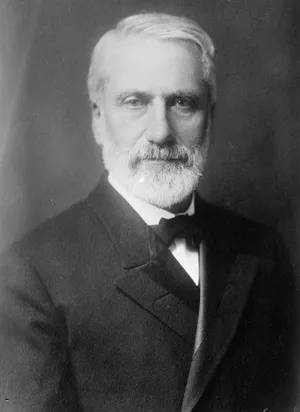
Isaac K Funk (1839–1912) was an American clergyman, editor, publisher, lexicographer and psychical investigator, best known as co-founder of Funk & Wagnalls. In later life he investigated mediumship, published two books on psychic phenomena and argued that spiritualist claims deserved careful study despite widespread fraud and uncertainty.
- Funk co-founded Funk & Wagnalls and helped develop major reference works, including the Standard Dictionary of the English Language.
- He investigated mediums and published two books on psychic phenomena, including The Widow’s Mite and Other Psychic Phenomena and The Psychic Riddle.
- Although open to evidence suggestive of discarnate intelligence, Funk repeatedly stated that fraud and unknown psychic factors had to be taken seriously.
Life and Career
Isaac Kaufman Funk was an American clergyman, editor, publisher and lexicographer, born on 10 September 1829 in Clifton, Ohio. After graduating from Wittenburg College in Springfield, Illinois, in 1860, he attended the Lutheran Wittenburg Theological Seminary, where he was awarded a Doctor of Divinity (DD) degree in 1861. He was granted an honorary Doctor of Laws (LLD) from the same institution in 1896.1Anon. (1912). There appears to be some uncertainty about Funk’s middle name, which is spelled variously as Kaufman, Kauffman and Kauffmann. ‘Kaufman’ is adopted here following Johnson (1912), who knew him personally.
After receiving his DD, Funk spent several years ministering at churches in Ohio, Indiana, and Brooklyn, New York. He resigned from the last post in 1872 to travel to Europe, Egypt and Palestine. In 1873, he turned to journalism and founded several periodicals, largely on religious topics, and in 1877 established a publishing company, I. K. Funk, Inc. The following year he was joined in this venture by a former Wittenburg classmate, lawyer and accountant Adam Willis Wagnalls, and in 1879 the company name was changed to Funk & Wagnalls.2Anon. (1912); Makeley (n.d.).
Funk was a prohibitionist who was active in the temperance movement. In 1884, he had a vision about what he should do to fight liquor trafficking and as a result created The Voice as a national Prohibition Party organ.3Johnson (1912). Funk & Wagnalls became a major outlet for the writings of prohibition activists.4Makeley (n.d.).
Funk was interested in politics. He ran as the Prohibition Party candidate for mayor of Brooklyn in 1885 and as the Prohibition Party candidate for Congress from New York districts in 1888, 1892 and 1896, then for Brooklyn Borough President in 1897, although he was unsuccessful each time.5Makeley (n.d.).
Funk & Wagnalls published the first edition of its Standard Dictionary of the English Language between 1893 and 1895 and the first edition of the Funk & Wagnalls Standard Encyclopedia in 1912.
Funk married Eliza Thompson of Carey, Ohio, in 1864. At her death four years later, he wed her sister, Helen G Thompson, who died in 1911. Funk himself died at his home in Montclair, New Jersey, on 4 April 1912, after a brief illness. He was buried at Green Woods Cemetery in Brooklyn, where he had resided for much of his life. He was survived by a son and a daughter.6Anon. (1912).
Psychical Research
Throughout the later part of his life, Funk was deeply engaged in psychical research. He wrote two books on the subject, The Widow’s Mite and Other Psychic Phenomena (1904) and The Psychic Riddle (1907), which evidently brought a good deal of attention. According to his obituary in The New York Times, ‘Although a man of brilliant attainments and a great figure in the literary world, Dr. Funk was perhaps best known because of his psychic research’.7Anon. (1913).
Funk does not describe how he became involved in these pursuits, although he says early in The Widow’s Mite that he is writing ‘after a score of years of investigation’.8Funk (1904), 13. If so, he must have started in the mid-1880s, around the time he moved to Brooklyn, consistent with Leslie Shepard’s unattested statement that Funk was ‘converted to belief in Spiritualism by medium May Pepper of Brooklyn’.9Shepard (1986).
There is no doubt that Funk knew Pepper. In The Psychic Riddle, he reports taking a sealed letter he had received from a correspondent at the University of Chicago to Pepper as a test. Pepper took it in her hand and gave a detailed response regarding its contents, about which Funk knew nothing. He returned the envelope unopened along with Pepper’s reading and was told that all she had said was correct.10Funk (1907), 173-76.
Funk was acquainted with Richard Hodgson of the American Society for Psychical Research (ASPR). Hodgson died unexpectedly of a heart attack on a handball court on 20 December 1905. One night in January 1906, Funk was awoken by the telephone at 2 am, asking him to confirm that he had received a communication from Hodgson through Pepper. Funk had not. However, ‘a short time after this incident’, Funk visited Pepper, who went into a spontaneous trance and spoke with a voice identifying itself as Hodgson, supplying convincing evidence that it was indeed he.11Funk (1907), 65-71. The quotation comes from page 66; italics in original.
Funk had experiences with other mediums that included striking evidential communications ostensibly from deceased persons, including those related to the widow’s mite, an ancient Roman coin.12Funk (1904), 157-84. But Shepard is wrong that these experiences converted Funk to Spiritualism. In both his books on psychic phenomena, Funk was at pains to explain that although he strongly believed spiritualistic claims should be seriously considered, he was not confident that they indicated contact with the dead:
What are called Spiritualistic manifestations are, so far as my experience goes, in large part due to fraud and in large part are traceable to certain psychic powers within us—powers which are more or less active but which psychologists have not as yet clearly defined, in some cases not even really classified—some, possibly, which they have not as yet recognized.13Funk (1907), 199.
At the same time there were in Funk’s judgement ‘whole classes of phenomena which point clearly to the operation of intelligent forces that exist outside what we know as human bodies’. What exactly were these forces and wherefrom did they operate? Of this, he could not be certain, because he had encountered many confused communications that pointed away from a surviving personal intelligence. The best he could do was to draw attention to the need for research on phenomena he understood to be of utmost importance.14Funk (1907), 199-209.
This remained Funk’s position until the end of his life.
In spite of all the fraud, jugglery and disrespect that accompany these matters, he felt that somewhere in the subject there is a germ of truth. So he set out to do what he could to strip the fraud from the truth. He never reached a final conclusion to their problem and never became a “spiritualist” in the common acceptation of that term. He continued to have the open mind of the student. But he wearied with age and laid aside this unfinished work. “The scoffers won’t give a poor ghost the ghost of a show,” he said mournfully.15Johnson (1912), 2. In what may be a similar reference to surrender at the conclusion of his life, Anon. (2013) says, ‘Dr. James Kellogg of the Metropolitan Psychical Society sent Dr. Funk a check for $100 as a reward for any spiritualist who could through spirit guidance tell the number of oranges in a given pile. In returning that money, Dr. Funk announced that he was out of the spiritualistic field.’
Unfortunately, this is not the way Funk is remembered, largely thanks to the sceptical magician Joseph F Rinn, who in writing about Funk ignored his professed awareness of rampant fraud among the mediums he studied and portrayed him as taken in by his subjects.16Rinn (1950/1954), 150-71.
Funk had to deal with mistaken impressions during his lifetime as well. A Chicago Daily Tribune article in 1905 proclaimed in its headline, ‘Chicago Mediums Said to Have Duped Isaac Funk.’17Anon. (1905). This had to do with Funk’s purchase of a painting from the Bangs Sisters, but the suggestion that it demonstrated his credulity appears to be incorrect. Hodgson’s successor at the ASPR, James Hervey Hyslop, tells us that Funk visited the sisters in order to see if they could paint a portrait of his mother resembling a photograph he had hidden in his pocket. The sisters produced a painting that Funk thought ‘a good likeness’ but about which he had not come to a firm conclusion, although ‘he was puzzled to account for it because that picture [of his mother hidden in his pocket] was so rare’.18Hyslop (1919), 290.
Funk did not treat the Bangs Sisters or their paintings in his books. Nor did he mention Ana Eva Fey, whom Rinn (1950/1954) says deceived him. Nonetheless, in discussion of Funk’s psychical investigations, it is Rinn’s presentation, rather than Funk’s own testimony, that is cited by modern authorities such as Wikipedia.
Mediumistic Communications
In his 1919 book Contact with the Other World, Hyslop relates mediumistic communications from a spirit identifying itself as Funk. The sensitive involved was Minnie Meserve Soule of Boston, known at the time by the pseudonym Mrs Chenoweth. Soule had not known Funk and although she was aware that he had written The Widow’s Mite, had not read it.19Hyslop (1919), 282-83.
The first messages from Funk came in automatic writing through Soule on 2 October 1912, six months after his death. He did not give his name at first, but only his initials. He said he was from Brooklyn, which Soule had not known. Hyslop surmised who he was, when ‘Funk’ said he had not been the ‘fool or dupe’ many of his associates believed. Hyslop felt that Funk’s personality came through strongly in his messages through the entranced Soule. He commented often on difficulties of communication and was concerned with writing, as he had been as a lexicographer, one of whose missions was simplified spelling conventions.20Hyslop (1919), 291ff. The ‘Funk’ communications through Soule, reported by Hyslop (1919), are discussed by Berger (1987).
James G Matlock
Works Cited
Anon. (1905, 25 February). Peddle work of “ghosts”. Chicago mediums said to have duped Isaac Funk. Chicago Daily Tribune, 3. Newspapers.com. [Web page. Full text.]
Anon. (1912, 5 April). Dr. Isaac K. Funk, publisher, is dead. The New York Times. [Web page. Full text.]
Berger, A.S. (1987). Aristocracy of the Dead: New Findings in Postmortem Survival. Jefferson, North Carolina, USA: McFarland.
Funk, I.K. (1904/1911). The Widow’s Mite and Other Psychic Phenomena. New York and London: Funk & Wagnalls. [Reproduced from 3rd ed., 1911, by Lagare Street Press.] [Internet Archive. Download PDF.]
Funk, I.K. (1907). The Psychic Riddle. New York and London: Funk & Wagnalls. [Reproduced by Leopold Classic Library.] [Internet Archive. Download PDF.]
Hyslop, J.H. (1919). Contact with the Other World: The Latest Evidence as to Communication with the Dead. New York: The Century Co. [Reproduced by Lagare Street Press.] [Internet Archive. Download PDF.]
Johnson, W.E. (1912). Sept. 30 [sic], 1839 – Isaac Kaufman Funk – April 4, 2012. American Advance. [Web page. Full text.]
Makeley, J. (n.d.). Isaac K. Funk. Partisan Prohibition Historical Society. [Web page. Full text.]
Rinn, J.F. (1950). Sixty Years of Psychical Research: Houdini and I Among the Spiritualists. New York: Truth Seeker Company. [Reprinted 1954 as Searchlight on Psychical Research by Rider and Co., London.)
Shepard, L. (1986). Funk, Dr. Isaac Kauffmann [sic] (1839–1912). In Encyclopedia of Occultism and Parapsychology (2nd ed., vol. 1), 516. Detroit, Michigan, USA: Gale.