

The Global Consciousness Project (GCP) was an international collaboration of scientists and engineers designed to test the idea that there exists a unified field of human consciousness. The project looked for evidence that thoughts, emotions and perceptions may potentially cohere in response to major world events, producing detectable effects on random event generators.
- A significant feature of the GCP was its scale, because it moved psychokinesis-style thinking from individual intention in the laboratory to mass human attention during world events.
- GCP results showed statistical deviations in random data collected across a global device network, in a series of 500 formal tests of the basic hypothesis.
- Interpretations differ depending on theory, event selection, statistics and the meaning of detected departures from randomness.
Background: FieldRNG Research
Scientific research over several decades supports the notion – which conflicts with the assumptions of most neurophysiologists and psychologists – that the human mind confined to the body.1Jahn & Dunne (1987). Random devices based on quantum tunnelling have been shown in rigorous, replicated experiments to respond to human consciousness (see Psychokinesis Research).
In the laboratory, a person’s intentions to make the machine’s random output higher or lower are found to correlate with slight biases in the intended direction. The ‘noisiness’ of the random sequence appears to change very slightly, indicating that consciousness can – weakly but measurably – affect the physical world. The amount of information or structure is increased, and entropy, or disorder, is reduced. The empirical evidence suggests an effect not only of individual intentions, but also of group consciousness.2Nelson et al. (2007), 278.
In the early 1990s, following a decade of research with individuals, Roger Nelson at the Princeton Engineering Anomalies Research (PEAR) laboratory took advantage of newly developed laptop computers and electronic miniaturization to take work with random number generators into the field. The aim of this experiment, called ‘FieldREG’, was to explore whether the machines might also be susceptible to focused group consciousness.
Continuous sequences of random numbers (trial values each second consisting of the sum of two hundred bits) were recorded with time stamps to identify the beginning and end of special events that might bring a group to a shared consciousness – a kind of group coherence. Analysis focused on the variance of the sequence: The protocol did not specify a directional intention. Results showed deviations during moments of apparent group coherence, compared with data collected in mundane ‘control’ situations.
The GCP
Expanding the Range
Researchers using this technology began to discuss the idea of setting up a permanent network of RNGs that collected data continuously. They asked what would happen if the groups were larger and were spread around the world. Could they learn more by using multiple RNG devices taking parallel sequences of data? To facilitate such inquiries, the GCP was initiated in 1997, funded by private donations through the Institute of Noetic Sciences.
Researchers planned to look for structure in data sequences gathered during great events on the world stage, analogous to the way EEG traces are used to observe brain patterns responding to sensory stimuli. The question was whether synchronised thoughts and emotions, powered by terrible tragedies and grand celebrations, might correspond to departures from expectation in the data. Would the totally random behaviour of research-quality instruments show changes or structure correlated with happenings important to human beings?
Initial tests with multiple data sets generated in an ad hoc experimental design showed promise. In one example, which became a prototype for the GCP, researchers in Europe and the United States collected continuous data during the funeral of Princess Diana on 6 September 1997: The composite data showed deviations that would happen by chance only once in one hundred repetitions of such an experiment.3Nelson (1997). These results encouraged the researchers, led by Nelson, to build a permanent network to produce a continuous record of data that could be examined for deviations during powerful world events.
In the FieldREG experiment, the RNG data showed consistent deviations from random expectation when groups were closely integrated or focused on a compelling mutual interest. During deeply engaging meetings, concerts, rituals, and similar moments, the data tended to have slightly increased order in contrast with the expected random behaviour. This enabled researchers to predict deviations with significant success based on the type of event. In control conditions, with data collected in mundane or chaotic situations, non-random deviations tended not to occur.4Nelson et al. (1998).
In the GCP experiment, the same procedure is applied on a broader scale. Trials consisting of the sum of two hundred bits are collected once per second from each RNG in the network. The result is continuous parallel sequences of random numbers with an expected mean of 100 and standard deviation of about 7.071.
As in the FieldREG experiment, a detectable ordering is predicted in otherwise random data during world-scale events that are likely to engage the attention of large numbers of people around the globe. The prediction is tested in a series of rigorously specified unique cases, referred to as ‘global events’, again looking for anomalous mean-shifts in either direction (that is, changes in the variance of the data). The GCP measure is referred to as ‘network variance’ because it is calculated for each second across all RNGs in the network. Mathematical analysis shows that the variance changes are essentially equivalent to excess pairwise correlation of the RNG data.5Bancel & Nelson (2008).
A Consciousness Field
The leap from lab results to ‘global consciousness’ merits some examination. Why should there be any effect of a world-wide New Year’s celebration, or a billion people watching a funeral ceremony, or the beginning of a war, on RNG devices located around the world? Although this should be recognised as a metaphor, it may be helpful to envision a ‘consciousness field’ – a faint radiance of information extending out indefinitely from each individual, with a wavelike interpenetration modulated by interference patterns dependent on the degree of mass engagement and emotional coherence.
Testing Hypotheses
The GCP is fundamentally a scientific experiment. It tests a broad general hypothesis using a series of completely specified simple hypotheses, in which all parameters are fixed before the data are examined. The composite result (formally a meta-analysis) of the accumulating series of replications is a test of the general hypothesis: Periods of collective attention or emotion in widely distributed populations will correlate with deviations from expectation in a global network of physical random number generators.
The synchronised network of electronic RNGs, located at dozens of sites around the world, produces parallel random data sequences that are reported via the Internet to a central archive. The hypothesis predicts differences from expectation correlated with globally engaging events. If there is any effect of a putative global consciousness on the random sequences, it should be concentrated during those special times when humanity experiences broadly shared interests, feelings, and reactions. Statistics for the continuous data streams recorded in the RNG network have well-defined expectations based on theory and calibrations. Deviations in the empirical data can be measured against theory or a statistical simulation or resampling of non-event data to see whether the general hypothesis is supported.
The formal tests of the general hypothesis focus on deeply engaging events in several categories:
- terror attacks and war
- natural disasters
- celebration and sharing
- compassion and empathy
- cosmic and social abstractions
- powerful shared interest
- deliberate focus
Major events in these categories are identified and their parameters specified prior to any observation of the data: the start and end times of the event and the specific statistical analysis to be performed. The corresponding data are then extracted from the archive and evaluated to test the hypothesis that data deviations will be found during the event. The series of formal events so defined becomes the basis of a detailed report on apparent correlations between the history of events in the world and the history of physical random data created by the GCP.
The RNG network runs as a true random system, but analysis reveals non-random structure in data recorded during natural disasters or terrorist attacks, or great celebrations like New Year’s. The effects are so subtle that it takes months and years of repeated testing to be sure the correlations are there and to estimate their magnitude. But the bottom line of a decade and a half of work yielding over five hundred separate tests indicates linkage between global events and GCP deviations. The experimental design excludes spurious sources, which argues for this being a real effect, not a result of mere coincidence or chance fluctuations. The odds against chance explanations are more than a trillion to one (probability ~ 10-13).
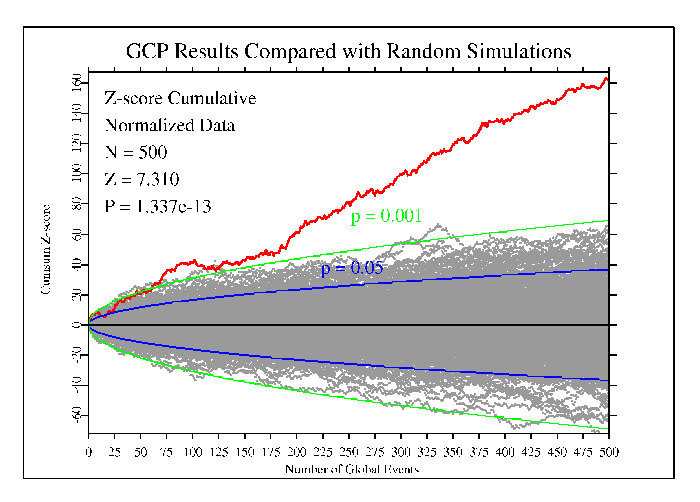
Figure 1. Project results over a 17-year period.
The First Events Observed
The first global event testing the study hypothesis was the bombings of US embassies in East Africa on 7 August 1998, the type that could potentially engage a strong response by huge numbers of people. An analysis of data gathered from a few minutes before the bombings to three hours afterwards showed strong deviations that were statistically significant at about one in a thousand against chance.6Nelson (2015), 286.
In one of the most extreme and best-known test cases, a statistically significant spike was found in data around the 11 September 2001 terrorist attacks, in which a similar protocol was used, that covered a period of four hours and ten minutes beginning just before the first plane hit. Because the emotional reactions were so powerful and long-lasting, analysis was also made of a longer time period. It showed that the strong deviations continued for more than two days, and that multiple measures indicated robust effects.7Nelson (2015), 286.

Figure 2. Anomalous fluctuations in the nine-day period around the 11 September 2001 terrorist attack.
Growing the Network
Software development and hardware construction began in 1997. In August the following year, the GCP began collecting data with three nodes running. The number quickly increased as the network grew towards its goal to cover the whole world with enough independent nodes to apply sophisticated analyses, including parallels with measures of brain activity.
By the end of 1998, there were stations in several European cities and various parts of the US, and pilot testing had confirmed the viability of the technology. Over the next year, the RNG network grew to about thirty nodes, with a continuous flow of samples every second transmitted over the internet from India, New Zealand, South Africa, Brazil, Fiji, Indonesia and sites in the US and Europe.
All the data were sent to a dedicated server in Princeton, New Jersey, for archiving and processing. The network continued to increase in coverage, in 2004 reaching a plateau of sixty-five to seventy RNGs reporting data.
Friends and colleagues around the world were the first participants. As the project became widely known, people with interest in a scientific assessment of global consciousness volunteered to set up a computer to host a node – an RNG connected to a computer running the GCP’s custom data acquisition software, continuously 24/7. The network ran largely without intervention, thanks to well-designed computer programs running at the host sites, and the sophisticated program written to collect and archive all the data on the main server in Princeton.8The software was designed by Greg Nelson and refined by John Walker. It was ported to Windows by Paul Bethke. Originally the central server was hosted at Princeton University’s School of Engineering, at http://noosphere.princeton.edu, but in 2011, the hosting was shifted to a cloud server at http://global-mind.org.
Although it was relatively low maintenance, the large size and complexity of the network created issues that required attention. Special software reached out to ‘timeserver’ computers on the internet to get the correct time and adjust the local computer clocks so that the data would remain synchronised. This generally worked, but occasionally a node would go out of synchrony and need correction. When the electricity supply was interrupted, or the Internet connection lost for some reason, the data flow might stop for a node. All data were stored on the local computer, so nothing was lost, but intervention was needed to restore and maintain the data flow. To keep watch on such things, the server had automated functions to manage the data, construct daily tables and graphs, and allow various activities to be monitored.
Server and Website
The repository for documentation, and the primary communication interface for the project is a comprehensive website at http://noosphere.princeton.edu or http://global-mind.org. It was originally designed by Rick Berger; several people have contributed updates to accommodate two decades of Internet development. The present version is the work of Marjorie Simmons; its purpose is to provide complete public access to all aspects of the project.
The website tells the story of the project, shows historical and current results, and provides links to documentaries from TV, YouTube videos, interviews, articles and reports. The GCP is an open access project, using the GPL license for software. It provides free download access to the raw data and processing algorithms. This makes the project – and the scientific evidence it accumulates for global consciousness – completely public and transparent, so that all analyses and interpretations can be checked at any time, by anyone in the world.
The website menu points to articles on the project’s background and development, and descriptions of methods and procedures. It links to detailed tables of results accompanied by the prediction registry that identifies and specifies each formal test of the general hypothesis. There is a full history of the project, and detailed explanations of the technology and the network architecture. The menu provides access to the data in various forms, as tables and graphical displays, and via functions to download raw data for people wishing to do their own analysis.
The website includes regularly updated displays of the network status and the accumulated experimental results. The ‘BasketStatus’ table provides current performance indicators and other information for each of the network nodes. An ‘Eggsummary’ page gives access to scores and trends for every day since the beginning of the project. The main ‘Results’ page provides information about each formal event analysis, and an up-to-date bottom line for the full database.
In addition to automatically generated data tables and graphs, the website offers displays that visualise the data in aesthetically interesting formats. A real-time visual display of momentary scores is accompanied by a heartbeat rhythm and gongs to signal large deviations. Another live display uses a Google map with all the RNG locations as dots coloured to show second-by-second deviation levels, with arcs connecting RNGs that are correlated. There are movies of each day’s data as the pattern changes around the world over the course of 24 hours. Some early movies are complete with data-driven music reminiscent of John Cage, courtesy of John Walker. An especially popular display is the GCP Dot, which shows the momentary state of network coherence using colour coding; it can be added to personal websites by means of a code snippet on the explanatory page.
Implications
Over the history of the project, independent analysts delved deeply into the data, teasing out the factors that matter, and this educates attempts to develop explanatory models and theories. This was necessary because the suggestion of ‘global consciousness’ does not fit with normal science. Beyond the fact that the data deviations are related to human interests, there are challenging questions about how the observed structure could possibly arise in random data where there should be no patterning at all. Because the unexpected correlations manifest reliably during global events that have deep meaning for humans, and not otherwise, there is reason to take seriously the idea of mental interactions that have a real presence in the physical world.
In this model, the data deviations occur because the random system is encompassed by mass consciousness, which contains and expresses the necessary information and somehow impresses it on the environment. Humans apparently create a tiny increment of order in the world by embodying structured information.
GCP director Roger Nelson has written:
Though we may have differing interpretations of the data, there is good reason to speak of a global consciousness, and I think even better reason to act as if a melding of humans to form a global intelligence is not only in progress, but amenable to our intention to foster it. What this means, assuming it is true, is that we can consciously evolve; we do have a say in how humanity grows into its future. We can take control of our destiny – and the time for that is ripe.
There is growing interest in deepening human interconnections, and in shared activities aimed directly at creating a better world. Many of these are practical and political, as in groups working to influence government and businesses to pay more attention to ecosystems and to understand the effects of present decisions on the future health of people and planet.
In addition to these pragmatic movements, people are organizing worldwide meditations and using technology to synchronise concerts and dancing and participation in virtual choirs. There are groups and websites and social media gatherings for shared prayer and focused intention based often on esoteric understandings – for example, Valentine’s Day, a Solstice, or the ‘end of the Mayan calendar.’ These shared moments of future focus may create a kind of global consciousness, and if so, there should be signs of it in data collected with this question in mind.9Nelson (2018).
Alternative Models
Nonetheless, Nelson is clear that, although descriptively persuasive, this is a speculative model. In alternative models, the biases in the data could originate in sources closer to hand than global consciousness. One is the experimenters’ own intentions – the so-called ‘experimenter effect’ that has been found within parapsychology. Another is ‘data augmentation theory’, according to which we precognise the future outcome of the experiment and choose a starting point that will produce that outcome by selecting deviant segments from a random sequence.10Bancel (2017); Nelson (2017).
Criticisms
Sceptics have argued that the fluctuations, if they exist at all, are too slight to support the claim of global consciousness. It has been suggested that the theory lacks consistent claims that are specific enough to be tested, for instance in selecting a type of event as significant without defined criteria, and in what type of effect constitutes a result.11Dunning (2007). Nelson responds that the accumulated evidence for anomalous fluctuations in the formal experiment stands at more than 7 sigma from expectation. And the GCP has a well-defined criterion for event selection: Widely shared, deep engagement in the event.
Specific criticisms have been directed at claims regarding the September 11 attacks. An analysis by Edwin May and James Spottiswoode of the data gathered during and immediately after the September 11 terrorist attacks in the US concluded that, had the chosen time period been a few minutes shorter or thirty minutes longer, the data would have been consistent with mean chance.12May & Spottiswoode (2002).
In reply, Nelson argues that this criticism rests on ‘unacceptable post hoc data selection’ and is in any case contradicted by the yet more significant exploratory result associated with the two-day time period following the attacks.13Nelson (2015), 286.
End of the Project
The formal GCP experiment ended in December 2015, but data collection and public access continued until April 2026, when the GCP hosting servers suffered a catastrophic failure. The dynamic and live displays were no longer available as of April 2026. However, the restored website and archival data will be maintained indefinitely.
GCP 2.0
In 2021, Nelson invited Rollin McCraty, director of the Global Coherence Initiative (GCI), to take over the Project as the basis for a new version called GCP 2.0, built to continue and extend the research of the original GCP. Rollin agreed, and assembled a team from Heartmath Institute, Institute of Noetic Sciences, the original GCP, and a number of independent scientists. The new version has a website at www.GCP2.net. For more information about it, see here.
Roger Nelson
Works Cited
Bancel, P.A. (2017). Searching for global consciousness: A 17-year exploration. [Full text.] EXPLORE: The Journal of Science and Healing 13/2, 94-101.
Bancel, P.A., & Nelson, R.D. (2008). The GCP event experiment: Design, analytical methods, results. [Downloadable PDF.] Journal of Scientific Exploration 22/3, 309-33.
Cardeña, E., Palmer, J. & Marcusson-Clavertz, D. (eds.). (2015). Parapsychology: A Handbook for the 21st Century. Jefferson, North Carolina, USA: McFarland.
Dunning, B. (2007). Unconscious research of global consciousness. [Full text.] Web page.
Jahn, R., & Dunne, J. (1987). Margins of Reality: The Role of Consciousness in the Physical World. San Diego, CA: Harcourt Brace Jovanovich.
May, E.C, & Spottiswoode, S.J.P. (2002). Global Consciousness Project: An independent analysis of the 11 September 2001 events. [Full text.] Web page.
Nelson, R.D. (1997). Multiple field REG/RNG recordings during a global event. [Full text]. The electronic Journal for Anomalous Phenomena (eJAP) 97/2. Web page.
Nelson, R.D. (2015). Implicit physical psi: The global consciousness project. In Parapsychology: A Handbook for the 21st Century, ed. by E. Cardeña, J. Palmer, & D. Marcusson-Clavertz. Jefferson, North Carolina, USA: McFarland.
Nelson, R.D. (2017). Weighting the parameters, a response to Bancel’s “Searching for global consciousness: A seventeen-year exploration“. Explore: The Journal of Science and Healing 13/2, 102-5.
Nelson, R.D. (2018). We are all connected: The emergence of global consciousness. In Der Welt-Geist: Wie wir alle miteinander verbunden sind, ed. by R.D. Nelson & G. Kindel. Vienna, Austria: edition a.
Nelson, R.D., Bradish, G.J., Dobyns, Y.J., Dunne, B.J., & Jahn, R.G. (2007). FieldREG Anomalies in group situations. [Full text.] EXPLORE: The Journal of Science and Healing 3/3, 278.
Nelson, R.D., Jahn, R.G., Dunne, B.J., Dobyns, Y.H., & Bradish, G.J. (1998). FieldREG II: Consciousness field effects: Replications and explorations. [Full text.] Journal of Scientific Exploration 12/3, 425-54.