
The Global Consciousness Project has reported correlations between major world events and deviations in random number generator data. This article examines two interpretations: Roger Nelson’s field model, in which collective attention produces informational structure, and Peter Bancel’s selection hypothesis, in which unconscious psi shapes experimental choices and outcomes.
- Bancel proposes a goal-oriented selection effect, in which unconscious psi influences experimental choices.
- The GCP has reported strong cumulative deviations in RNG data during global events.
- Nelson argues for a consciousness field operating at an informational rather than classical physical level.
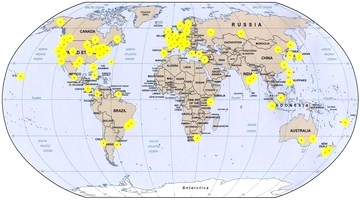
The Global Consciousness Project (GCP) is a long-running experiment that began in 1998. The project maintained a worldwide network of random number generators (RNGs), from its heyday of seventy-five in the early 2000s to the current skeletal network of ten (as of April 2026). These devices record parallel sequences of random data. The data are collected continuously from sites around the world.
The GCP tests a specific hypothesis. Global events that engage widespread attention or emotion will correlate with deviations in the RNG network.1Bancel & Nelson (2008). Over seventeen years, from 1998 to 2015, the project tested this hypothesis over five hundred formal events. These included terrorist attacks, natural disasters, and major celebrations. The cumulative result revealed statistical deviations that Nelson reported as rejecting the null hypothesis by seven standard deviations (p ≈ 10-12).2Bancel (2017). This represents a colossally significant result.
The interpretation of these deviations remains contested, however.3Nelson (2015). The central debate concerns not whether an effect exists – the statistical robustness of the cumulative result is not seriously disputed – but what might cause any observed deviations. Critics have raised questions about the appropriate statistical framework for evaluating the evidence and about the nature of the underlying mechanism, rather than about the existence of the deviations themselves. Two competing interpretations have emerged from detailed analysis of the GCP database, leading to fundamentally different understandings of the phenomenon.
The Field Model
Roger Nelson, who directed the Global Consciousness Project, proposed a field model to explain the data.4Nelson (2017a). This model is based on the concept of global consciousness. The model suggests that human minds are not isolated within individual bodies. Instead, consciousness may extend into the surrounding environment as a kind of field effect, or with its structure defined in information fields.5Jahn & Dunne (1987).
The field model draws on earlier research from the Princeton Engineering Anomalies Research (PEAR) laboratory. PEAR experiments showed that human intentions could influence RNG output.6Nelson et al. (1998). Individual consciousness appeared to affect random systems weakly but measurably. Field experiments extended this to group situations. RNGs placed at concerts, rituals, and sports events showed deviations during moments of group coherence.7Nelson et al. (2007).
Nelson’s interpretation scales this effect to a global level. When millions of people experience the same emotions during major events, their individual consciousness fields may become coherent. This creates a structured global field. The field interacts with physical systems, producing small but detectable deviations in the RNG network.8Nelson (2015). It is important to note that this interaction should not be construed as physical in a classical sense, but rather as a modification of informational structure in the ongoing random process. Conceptually, it is as if the random system were integrated into the coherent field embracing the human population.
The field model makes specific predictions. Correlations between RNGs should decrease with distance, because field effects typically weaken over space.9Bancel & Nelson (2008). The effect should be stronger when populations are awake and engaged, and weaker at night when people are asleep.
Nelson points to several findings that support the field interpretation. The GCP data show distance-dependent correlations: RNG pairs separated by less than 8,000 kilometres show stronger correlations than more distant pairs.10Nelson & Bancel (2011). The effect appears to have temporal structure, with deviation periods lasting approximately two hours on average.11Nelson (2009). These patterns are consistent with a field-like phenomenon.
The field model also appeals to philosophical and spiritual traditions. Many cultures have described a unified field of consciousness. Pierre Teilhard de Chardin proposed the concept of a ‘noosphere’ – a sphere of human thought enveloping the Earth.12Teilhard de Chardin (1976). The GCP might provide empirical evidence for such concepts, giving the field model theoretical and cultural resonance beyond the immediate data.
The Selection Hypothesis
Peter Bancel is a physicist who has analysed the GCP data extensively. He proposes an alternative interpretation. Bancel calls this the goal-oriented (GO) effect or selection hypothesis.13Bancel (2017). This model suggests the anomalies are not due to global consciousness. Instead, they result from psychically enhanced decisions made by the experimental team.
The selection hypothesis operates through precognition or intuition. Experimenters must choose which events to analyse. They must specify event start and end times. They must select analysis parameters. According to Bancel’s model, experimenters may use unconscious psi to make these choices.14Bancel (2017). They intuitively select time periods when natural statistical fluctuations happen to favour positive results.
It is important to emphasise that this is not conscious fraud. The experimenters act in good faith during the selection of appropriate events following scientifically reasonable criteria, but their unconscious precognitive abilities may bias selections towards confirmatory outcomes. This creates the appearance of an effect without requiring a global consciousness field. It should also be noted, however, that this model applies only to the originally specified hypothesis test, and not to the broader data structure revealed by secondary and independent analyses.
The goal-oriented GCP model has precedent in parapsychology. Edwin May developed his Decision Augmentation Theory (DAT) for explaining RNG-Psychokinesis results, which is broadly similar to the GCP goal-oriented hypothesis in that it maintains ‘successful’ PK scoring is a result of psychically well-timed experimental selections by subjects and investigators alike.15May et al. (1995). In both models, experimental outcomes conform to experimenter intentions through a teleological mechanism not limited by physical constraints, making it a parsimonious explanation for the GCP results.
Bancel’s model predicts different patterns than the field model. The selection hypothesis predicts that correlations should not depend on geographic distance, since precognitive selection works regardless of spatial separation. The hypothesis predicts no difference between day and night, because the experimenters’ psi operates when they make decisions, not when events occur. Most importantly, the selection model predicts that technical factors like XOR processing should not matter.
The XOR Processing Problem
Bancel identifies a critical technical issue that he argues challenges the field model directly.16Bancel (2017). The RNGs employed in the GCP network use XOR (exclusive or) processing. XOR is a logical operation that eliminates first-order bias from physical causes. Each RNG XORs its raw bit-stream against a fixed pattern to ensure the output has a mean of 0.5.
Bancel argues the XOR process creates a fundamental problem for a purely physical version of the field model. If global consciousness acts directly on the raw RNG bits as a classical physical field, the XOR should eliminate this effect, since the XOR transformation would randomise any structured physical input. Nelson’s position, however, is that this argument rests on an incorrect assumption: the field model does not propose a classical physical interaction with bits as material entities, but an interaction with bits as information. It is the informational structure of the random process that is modified, not the physical substrate. On this view the XOR problem dissolves, since information fields are not subject to the same constraints as classical physical forces.17Nelson (2024).
The network uses two types of RNGs. Orion devices use one XOR algorithm. Mindsong devices use a different XOR algorithm.18Bancel (2017). These algorithms are incompatible. Bancel contends that for a global consciousness field to affect both device types simultaneously, the effect would need to accommodate both XOR processes at once, which seems implausible on a physical account. Nelson disputes this interpretation on the same informational grounds.
Bancel analysed correlations between different device pairings. Orion-Orion pairs, Mindsong-Mindsong pairs, and mixed Orion-Mindsong pairs all show positive correlations.19Bancel (2017). The mixed-device correlation exceeds zero by 5.6 standard deviations. Bancel argues this cannot be explained by a simple field effect acting on pre-XOR bits. Nelson strongly disputes this interpretation, noting that Bancel’s argument depends entirely on treating bits as physical entities rather than informational ones, which is the assumption he regards as the primary weakness of the goal-oriented model.
The Synchronisation Problem
Bancel raises a second technical objection concerning network synchronisation.20Bancel (2017). He argues that for a classical field effect to produce correlations, the RNGs must be tightly synchronised, since the correlation requires that consciousness affects specific bits at specific times across the network.
The Orion RNGs produce approximately 8,000 bits per second. Bancel calculates this means the network timing would need accuracy of about 100 microseconds for bits to be aligned for XOR-compatible correlations.21Bancel (2017). The GCP uses standard internet time protocols, which cannot achieve sub-millisecond synchronisation globally. Bancel verified that most data trial timestamps are in error by a full second or more – orders of magnitude below the required precision.
Bancel contends this suggests the effect does not require precise timing and therefore points towards a goal-oriented rather than a field mechanism. Nelson’s counter-argument is that this objection, like the XOR problem, is a consequence of assuming the effect operates through classical physical fields. An information-based field operating at the level of meaning rather than individual bits would not be subject to the synchronisation constraints that apply to classical physical correlations. The correlations observed across the network, including across incompatible device types and despite timing errors, are in fact consistent with a field operating at a higher level of organisation than individual bit sequences.22Nelson (2024). This interpretation remains disputed.
Empirical Tests
Bancel designed tests to distinguish between the models, examining predictions that differ between field and selection hypotheses.23Bancel (2017). It should be noted, however, that in an earlier analysis published in Broderick and Goertzel’s edited collection, Bancel found a statistically significant edge of more than three sigma favouring the field model – a result that sits awkwardly alongside his later conclusions and which he himself has not fully resolved.24Bancel (2015).
The distance test examines whether correlation strength decreases with RNG separation. The field model predicts such a decrease; the selection model predicts no distance effect.25Bancel (2017). Bancel found correlations do decline with distance, which initially appears to support the field model, though he argues the decline is not as steep as a classical field would predict.
The local time test examines whether effects depend on whether populations are awake or asleep. The field model predicts stronger effects during waking hours; the selection model predicts no time-of-day effect.26Bancel (2017). Bancel found no significant difference between day and night and contends this contradicts the field model. It should be noted, however, that Bancel’s own earlier analysis produced the opposite finding with a z score of 3 (p = 0.001), and Nelson regards the assumption that a consciousness field should simply track sleep-wake cycles as an oversimplification – one that imposes physical field assumptions on a phenomenon that may operate through different principles entirely.27Nelson (2024).
The event duration test examines whether longer events produce larger effects. The field model is sometimes taken to predict this relationship, but Nelson disputes the premise. The GCP data and broader research on attention and coherence indicate that the relevant dynamic is not simply proportional to duration but follows a characteristic arc: coherence rises, peaks, and then falls as attention is sustained and gradually dispersed. An event duration test that measures only total effect size, without accounting for this temporal structure, is not a fair test of the field model.28Nelson (2017a). On this basis, the absence of a simple duration correlation does not count against the field model in the way Bancel suggests.
The covariance analysis examines patterns across multiple statistical measures.29Bancel (2017). Bancel contends these patterns are inconsistent with a simple field effect and consistent with goal-oriented selection. It is important to emphasise that these interpretations remain hotly disputed between Bancel and Nelson and will most likely necessitate refined analyses of the GCP 2.0 data to finally resolve.
Nelson’s Response
Nelson acknowledges Bancel’s technical arguments and agrees they present important challenges for classical physical accounts of the field model.30Nelson (2017a). Despite the technical fluency of Bancel’s approach, Nelson does not accept the conclusions, arguing that both the XOR problem and the synchronisation problem dissolve once the assumption of a classical physical field is replaced by an informational account. In this view, the GCP network registers deviations not because a physical force acts on individual bits, but because a coherent information field – a structured modification of the probability space – influences the statistical behaviour of the network as a whole.31Nelson (2024).
Nelson points to several factors that Bancel’s analysis does not fully address. The GCP data reveal parametric structure that cannot easily be attributed to selection.32Nelson (2017a). Event categories show different effect sizes: Terrorist events produce stronger deviations than celebrations, and natural disasters show intermediate effects. This categorical structure suggests the content of events matter, not just the experimenter’s selection of them.
The response curves around major events show characteristic patterns that are difficult to explain through selection bias alone.33Nelson (2017a). Effects sometimes appear to anticipate events by minutes or hours and often extend beyond the formal event period. Moreover, predictable events such as New Year’s Eve and other repeating global occasions demonstrate similar effect sizes to unpredictable events, which is difficult to reconcile with a goal-oriented model – experimenter psi cannot operate in the same way for events known well in advance as for sudden crises.
Nelson argues for a more nuanced understanding. The experimenter sets the stage and asks the questions, creating a kind of contract between experimenter and phenomenon.34Nelson (2017a). But this does not preclude the existence of a field effect. Both mechanisms might operate simultaneously, and the reality may be more complex than either pure model suggests.
The Nature of Consciousness
The debate has important theoretical implications. The field model, if correct, would suggest consciousness has extended effects operating at an informational rather than physical level. It would support various philosophical and spiritual traditions and might point towards new frameworks that incorporate consciousness as a fundamental aspect of reality.35Nelson (2015).
The selection hypothesis, if correct, would demonstrate robust precognitive or intuitive abilities in experimenters, suggesting that experimenter effects are more pervasive in psi research than commonly acknowledged – a finding with important implications for experimental methodology across the field.36Bancel (2017).
Overall Assessment
The debate between Nelson’s field model and Bancel’s selection hypothesis reveals deep challenges in interpreting the GCP data. Both interpretations have strengths but face significant objections.
Bancel’s technical arguments about XOR processing and synchronisation raise important questions.37Bancel (2017). These arguments are most powerful if one assumes the GCP effect operates through a classical physical field acting on individual bits. Nelson’s informational account of the field model, however, sidesteps both objections by relocating the effect from the physical to the informational level – a move that Bancel has not yet fully addressed.
Bancel’s empirical tests suggest patterns he interprets as favouring selection over field effects. The lack of local time effects and absence of simple event duration correlations diverge from what Bancel takes to be field model predictions.38Bancel (2017). As noted above, Nelson disputes whether Bancel’s predictions accurately represent the field model in its informational formulation, and several of the patterns Bancel identifies as supportive of selection were found to favour the field model in his own earlier analysis.
The field model predictions that appear confirmed – such as distance effects – show patterns Bancel argues are weaker than a classical physical field would produce.39Bancel (2017). This could reflect residual correlations in the selection process, but it is also consistent with an information field that does not fall off with distance in the same way as physical force fields.
Nelson’s points about categorical differences and temporal patterns deserve serious consideration.40Nelson (2017a). The parametric structure in the GCP data – the differences between event types, the characteristic temporal arcs of deviation, the consistent results for predictable events – is difficult to explain purely through experimenter selection. It suggests the content and character of events genuinely matters.
The strongest argument against pure selection is replication by independent analysts. If effects persist when others analyse the data using independent methods, this suggests something beyond the original experimenters’ psi.41Nelson (2017a). Ulf Holmberg’s independent analyses, finding correlations between GCP network behaviour and stock market movements and internet search trends, represent precisely this kind of independent replication, and tend to support the existence of a genuine anomaly that is not easily reducible to the original team’s goal-oriented choices.42Nelson (2024).
A hybrid model may ultimately prove most accurate. Both field effects and selection effects might operate, with the relative contributions of each mechanism remaining unclear.43Nelson (2017a). The technical constraints identified by Bancel limit what the current GCP network can reveal about pure field effects on a classical physical account. With the recent establishment of GCP 2.0 — the second generation of the Global Consciousness Project, which as of March 2026 boasts nearly four hundred devices (each containing four RNGs and several environmental detectors) situated in fifteen clusters — the conditions exist for experiments that may provide greater clarity on this question.
Conclusions
The interpretation of Global Consciousness Project data remains contested. Roger Nelson’s field model proposes that global events create coherent consciousness fields – operating at the level of information rather than classical physics – that affect physical systems. Peter Bancel’s selection hypothesis proposes that experimenters use unconscious psi to select events and parameters that produce confirmatory results.
Both interpretations face significant challenges. Bancel’s technical arguments about XOR processing and synchronisation raise important questions about classical field models, though Nelson’s informational reformulation of the field model challenges the premises on which those arguments rest. His empirical analyses suggest patterns consistent with selection effects, but the picture is complicated by the finding in his own earlier analysis of a significant statistical edge favouring the field model, and by the parametric data structure that resists a simple selection account.
The debate centres on competing explanations of observed patterns rather than the existence of patterns themselves. The correlations between global events and RNG deviations have been documented over seventeen years of data collection, and their statistical robustness is not in serious dispute.44Bancel (2017). Importantly, both interpretations assume some form of psi operates in the GCP data.
A hybrid model combining both mechanisms may ultimately prove necessary.45Nelson (2017a). The debate has advanced parapsychological theorising by identifying specific testable predictions and technical constraints. Future research, particularly that afforded by the GCP 2.0 network, should focus on experimental designs that can more clearly distinguish between field and selection mechanisms – designs that may require novel protocols controlling for precognitive selection and network architectures that avoid the technical limitations Bancel has identified.46Bancel (2017).
Michael Duggan
Works Cited
Bancel, P.A. (2015). An analysis of the Global Consciousness Project. [Full text.] In Evidence for Psi: Thirteen Empirical Research Reports, ed. by D. Broderick & B. Goertzel, 255-77. Jefferson, North Carolina, USA: McFarland.
Bancel, P.A. (2017). Searching for global consciousness: A 17-year exploration. [Full text.] EXPLORE: The Journal of Science and Healing 13, 94-101.
Bancel, P.A., & Nelson, R.D. (2008). The GCP Event Experiment: Design, Analytical Methods, Results. [Full text.] Journal of Scientific Exploration 22, 309-33.
Jahn, R.G., & Dunne, B.J. (1987). Margins of Reality: The Role of Consciousness in the Physical World. San Diego, California, USA: Harcourt Brace Jovanovich.
May, E.C., Utts, J., & Spottiswoode, S.J.P. (1995). Decision augmentation theory: Applications to the random number generator database. [Full text.] Journal of Scientific Exploration 9, 453-88.
Nelson, R.D. (2009). Blog archive 2009. [Full text.] Global Consciousness Project. Web site.
Nelson, R.D. (2015). Implicit physical psi: The global consciousness project. In Parapsychology: A Handbook for the 21st Century, ed. by E. Cardeña, J. Palmer & D. Marcusson-Clavertz, 282-92. Jefferson, North Carolina, USA: McFarland.
Nelson, R.D. (2017a). Weighting the parameters, a response to Bancel’s “Searching for global consciousness: a seventeen-year exploration”. [Full text.] EXPLORE: The Journal of Science and Healing 13, 102-5.
Nelson, R.D. (2024). Global consciousness: Manifesting meaningful structure in random data. [Download PDF.] Journal of Anomalous Experience and Cognition 4, 149-73.
Nelson, R.D., & Bancel, P.A. (2011). Effects of mass consciousness: Changes in random data during global events. [Full text.] EXPLORE: The Journal of Science and Healing 7, 373-83.
Nelson, R.D., Bradish, G.J., Dobyns, Y.H., Dunne, B.J., & Jahn, R.G. (2007). FieldREG anomalies in group situations. [Abstract.] EXPLORE: The Journal of Science and Healing 3, 278.
Nelson, R.D., Jahn, R.G., Dunne, B.J., Dobyns, Y.H., & Bradish, G.J. (1998). FieldREG II consciousness field effects: Replications and explorations. [Full text.] Journal of Scientific Exploration 12, 425-54.
Teilhard de Chardin, P. (1976). The Phenomenon of Man. New York: Harper Perennial. (Originally published in French, 1955.)