
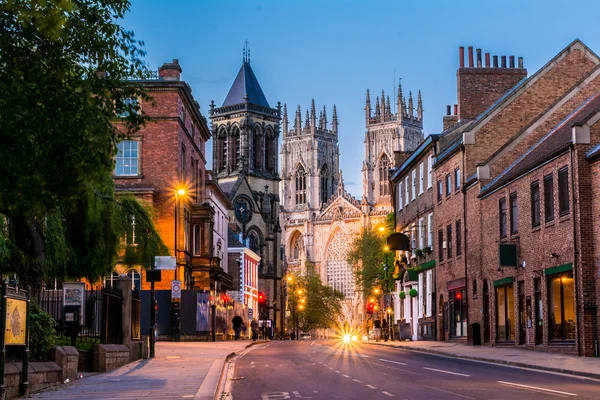
York’s reputation as Britain’s most haunted city rests on a long history of reported apparitions, poltergeists and other anomalies. This article surveys notable cases, from Harry Martindale’s Roman soldiers to haunted churches, pubs and theatres, distinguishing weakly sourced tales from incidents that remain difficult to explain.
- The best-known York case is Harry Martindale’s 1953 sighting of Roman soldiers whose appearance and walking level later appeared consistent with archaeological findings.
- Other reports involve apparitions, poltergeist activity and unexplained sounds at York Minster, Holy Trinity Church, the Theatre Royal, public houses and other historic sites.
- The article distinguishes commercial ghost lore and poorly sourced stories from a smaller number of cases considered sufficiently documented to merit psychical research interest.
Introduction
York, England, has long been described as the most haunted city in the United Kingdom. It has given rise to numerous well-attended ghost walks and many stories of anomalous events ranging through myth and legend to fraudulent claims to phenomena which are very hard to explain within the reining scientific paradigm.
The city of York dates to the beginning of the first millennium AD but archaeological evidence for the presence of people in the region goes back much further, to between 8000 and 7000 BCE. York is recorded as an important town in Roman times, when it was called Eboracum or Eburacum, followed by the Angles who referred to it as Eoforwīc or Eoforīc. When the Vikings took over the area from the Angles, they called it Jórvík. York suffered after the Norman conquest of 1066 but became prosperous in the medieval period. During the English Civil War from 1642 to 1651, it was a Royalist stronghold, but despite its loss to the Parliamentary forces, by 1660 it was the third-largest city in England, after London and Norwich. In more recent times, it has become a major railway centre. Its famous medieval street, the Shambles; its Gothic cathedral, the Minster; performances of mystery plays; and regular festivals and events attract many thousands of tourists every year.
Anomalous Events in York
The alleged instances of haunting phenomena generally regarded as outside current understanding can be classed into different categories, those falling under the headings of apparitions and poltergeists, with other activity which fits firmly in the world of legends, such as spectral hounds. Accounts of the latter type are not covered in this article, but interested readers will find them treated by local historian John Mitchell in Ghosts of an Ancient City.1Mitchell (1996).
The evidence for phenomena that are less clearly folkloric legends has been provided by a wide range of different witnesses and researched by amateur ghost hunters as well as by academically oriented scholars. Investigations have been conducted via anecdotal accounts and professional scrutiny. In terms of quantity, reportedly there have been ‘recorded over a hundred and forty sightings of ghosts within [York’s] walls in recent years.’2Linahan (1997), 195.
Case of the Roman Soldiers
The most famous example of an alleged paranormal sighting occurred in the Treasurer’s House cellar in Minster Yard in 1953. An eighteen-year-old apprentice heating engineer named Harry Martindale (1935–2014) witnessed what has become known as the Case of the Roman Soldiers. Martindale kept quiet about his experience for many years, being wary of the effect it might have on his career and his subsequent job as a policeman. He eventually gave an account to John Mitchell, who was intrigued because Martindale’s sightings were consistent with what had been learned about the setting and appearance of the soldiers, details of which were not known at the time of Martindale’s experience.
The following lightly edited account of the episode in an audio-recorded interview of Martindale made by Melvyn Willin on location in the Minster Yard cellar circa 1976 was provided to Mitchell.
I was an eighteen-year-old apprentice doing some work on the central heating in the cellar. On my second day working there, I was a few steps up a ladder when I suddenly heard a note on what sounded like a trumpet getting louder and coming from a wall. I then saw what looked like a Roman soldier, followed by a horse and numerous other soldiers come through the wall and through the cellar. They were all cut-off at about the knees, about eighteen inches above the ground. I fell off the ladder and scrambled into a corner terrified that they might see me, but they showed no signs of my being there. They wore green skirts and a metal helmet and carried short swords and round shields. They didn’t speak and looked nothing like Romans soldiers I had seen at the cinema. When I eventually fled the cellar, the curator said to me ‘You’ve seen the Roman soldiers, haven’t you.’
The recording of a lecture given by Mitchell and Martindale at the SPR annual conference in 1998 is preserved in the audio-visual archive of the Society for Psychical Research. Mitchell reports that Martindale informed him that ‘He was surprised by their small stature, and shabby appearance … the rough, home-made clothes they were wearing. The sandals, cross-gartered to the knees … but were later seen to be walking on the level of the Roman road itself.’3Mitchell (1996), 70. Archaeological excavation revealed that the ancient Roman Via Decumana passed through the site of the house, approximately eighteen inches below the surface.4Evans (2006), 133. The Roman soldiers Martindale saw have been seen by others since.5See Mitchell (1996, 70-73) and Underwood (1984, 233-38).
York Arms
A curious, previously undescribed incident happened at the York Arms in 1975 with a small group of interested researchers, including Willin. The public house was noted for a female apparition and some poltergeist activity. A séance was instigated using a Ouija board in the form of a table, with an upturned glass and surrounding letters with ‘yes’ and ‘no’.
Willin did not participate in the session, but observed the various movements of the glass, with no obvious ‘messages’. Willin moved away from the table and with a small piece of paper wrote down a capital letter ‘G’, out of sight of the participants. As far as he knew, the letter was not significant to any of the people assembled, nor to himself. However, when he then asked whether the ‘spirits’ could move to the letter he had written down, the glass immediately and quickly slid across the table, knocking the letter ‘G’ to the floor. Willin was shocked – as were the participants when he showed them the letter he had written down surreptitiously. This may have been a case of unconscious telepathy by one of the people present, Willin’s own psychokinesis, or simply a rather meaningful coincidence, rather than spirit agency. No other anomalous events occurred at the session
Rebecca and Livonia
There are two apparently veridical past life regression accounts that are of interest to psychical researchers investigating phenomena in York. One is the story of ‘Rebecca’, a murdered Jewess in the twelfth century. Rebecca presented as a past-life personality of Jane Evans in an age regressions conducted by Arnall Bloxham and described by Jeffrey Iverson in More Lives than One.6Iverson (1977). Under regression, Evans also took on a previous life as ‘Livonia’, a Roman living in York in the third century. Archaeological later confirmed some of Evans memory claims, notably as ‘Rebecca’.7For details, see here.
Other Apparitions and Poltergeists
Listed below are other documented cases of anonymous phenomena in York, with references for readers who wish to pursue specific cases in more detail. These represent the tip of a very large iceberg.8For overviews, see Danks (2018); Kirkup (2023); Matthews (1992); Mitchell (1996).
- The Yorkshire Museum was the scene of a ghostly figure in 1953 that was seen and heard by the caretaker and his wife. They provided a detailed account of their experience, which was scrutinized by the researchers Eric Dingwall and Trevor Hall.9Dingwall & Hall (1958), 27-45 and cited in Fontana (2004), 31-32
- York Minster is the scene of the ghost of Dean Gale, a senior clergyman who died in 1702. There is also documentation concerning the return of a soldier who had died during World War I. He appeared there to his siter and her friend.10Brooks (1990), 146; O’Donnell (1939), 82-83.
- Holy Trinity church is haunted by several ghosts, including three distinct figures seen in daylight, and in 1957, a local school teacher reported a sudden change of atmosphere described as ‘earthy and cold, a very charnel house atmosphere of death and decay’.11Mitchell (1996), 4-5.
- St Crux church was identified by a local York policeman, who heard the organ being played when the church was empty. People have also seen a shrouded female figure and heard the rustling of a dress when no one was present there.12O’Donnell (1939), 87-88; Willin (2021), 215-16.
- The Theatre Royal had a chanting ‘Grey Lady’. She was seen so frequently that a committee arranged for an exorcism to be held, after which the phantom did not return for a while.13Brooks (1990), 147. Prior to this, multiple witnesses recorded the appearance of a ghostly nun. The ruins of St Leonard’s Hospital, which was operated by religious orders, form part of the present theatre.14Pearse (2007), 186-87. The Grey Lady’s alleged visitation returned around 1981 according to the theatre company, including Miss Evelyn Laye.15Mitchell (1996), 14-16.
- The dancing school held at the Church of St Mary, Bishophill Junior, was the scene of several allegedly paranormal sound disturbances and poltergeist activities as well as appearances of an unknown ‘figure’, many of which were corroborated by several reliable witnesses.16Mitchell (1996), 44-47.
- There are various public houses with stories of apparitions and poltergeist activity including the Cock & Bottle, the Black Swan, the Golden Fleece, and the York Arms. The Cock & Bottle lays claim to the appearance of a figure believed to be the ghost of George Villiers, the 2nd Duke of Buckingham, who may have frequented the establishment when it was previously called the Plumber’s Arms. There have also been claims of poltergeist activity with kitchen utensils moving of their own accord and doors mysteriously locking from their inside when no one was present.17Linahan (1997), 199-200; Playfair (1985), 229-30.
- The older parts of York have had experiences reported from the Shambles and the Bedern area. The latter consisted of a square in the sixteenth century that acted as a poorhouse and then a workhouse from 1847, where children were said to have been treated very harshly and even died there. The area, now modernised, has been cited as the location for unknown children’s voices and other manifestations.18Mitchell (1996), 48-49.
Conclusion
Is York ‘the most haunted city in Europe’?19Underwood (1993), 76. The rise of the commercially based and sensationalised ghost walks since Mitchell and Martindale inaugurated them in 197320Willin has observed that actors are sometimes hired to jump out at participants on these ghost walks. have provided interest and entertainment, although have not increased the veracity of the experiences that various people have reported. However, there are a few examples that may at least provide food for thought concerning the phenomena that does not fit the current scientific paradigm. An alternative to apparitional sightings and poltergeist phenomena as evidence for post-mortem survival is the concept of ‘time slips’,21Bardens (1991); MacKenzie (1997). all the more given recent connections made to quantum mechanics.22e.g., by O’Dierno (2018) and Sterling-Vete & Wuorio (2025).
Melvyn Willin
Works Cited
Bardens, D. (1991). Ahead of Time. London: Hale.
Brooks, J.A. (1990). Britain’s Haunted Heritage. London: Jarrold Publishing/BTA.
Danks, V. (2018). Haunted York. Wellington, Somerset, UK: Halsgrove.
Dingwall, E.J., & Hall, T.H. (1958). Four Modern Ghosts. London: Gerald Duckworth & Co.
Evans, S. (2006). Ghosts: Mysterious Tales from the National Trust. London: National Trust Books.
Fontana, D. (2004). Is There an Afterlife? A Comprehensive Overview of the Evidence. Ropley, Hampshire, UK: O Books.
Iverson, J. (1977). More Lives Than One? The Evidence of the Remarkable Bloxham Tapes. London: Pan Books.
Kirkup, R. (2012). Ghosts of York. Stroud, UK: Amberley.
Linahan, L. (1997). The North of England Ghost Trail. London: Constable & Company Ltd.
MacKenzie, A. (1997). Adventures in Time. London: Athlone Press.
Matthews, R. (1992). Haunted York. Andover, UK: Pitkin.
Mitchell, J.V. (1996). Ghosts of an Ancient City: Stories of Haunted York. York: Archives Department, St Peter’s School.
O’Dierno, E. (2023). Einstein, Quantum Physics, and the Pursuit of the Paranormal (Annotated ed). Privately published.
O’Donnell, E. (1939). Haunted Churches. London: Quality Press Ltd.
Pearse, B. (2008). Ghost-Hunter’s Casebook: The Investigations of Andrew Green Revisited. Stroud: Tempus Publishing.
Playfair, G.L. (1985). The Haunted Pub Guide. London: Harrap.
Sterling-Vete, B., & Wuorio, H.R. (2025). Quantum Paranormal: Quantum Physics Explaining Paranormal Phenomena. Independently published.
Underwood, P. (1984). This Haunted Isle: The Ghosts and Legends of Britain’s Historic Buildings. London: Harrap.
Underwood, P. (1993). Ghosts and How to See Them. London: BCA.
Willin, M. (2016). Past life regression (PLR). Psi Encyclopedia. Web page.
Willin, M.J. (2022). Music and the Paranormal: An Encyclopedic Dictionary. Jefferson, North Carolina, USA: McFarland & Company.