
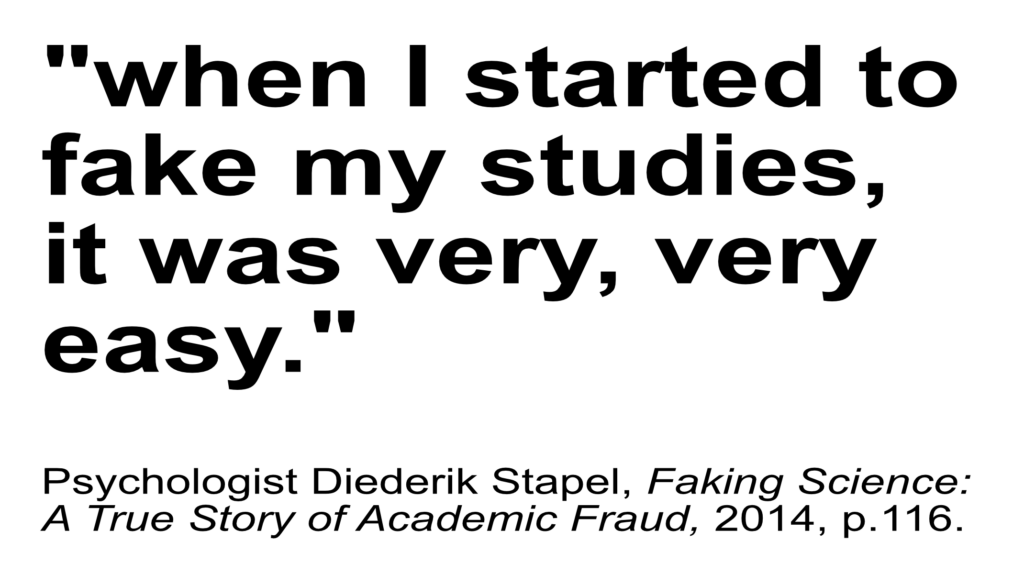
Researcher fraud poses a persistent problem for experimental parapsychology. This article reviews established, suspected and potentially undetected cases, including W Jay Levy, Samuel Soal and Alejandro Parra, and argues that research methods designed to prevent fraud are more reliable than retrospective investigations and retractions.
- JB Rhine treated researcher fraud as a serious methodological threat and advocated procedures designed to prevent any single researcher from manipulating results undetected.
- Established cases include W Jay Levy and Samuel Soal, while other researchers have been suspected without evidence strong enough to establish fraud conclusively.
- The article argues that preventing fraud through research design, transparent data management and shared control is more effective than relying mainly on retrospective investigation and retraction.
Introduction
A fundamental goal for science is to apply research methods that neutralize biases resulting from human frailties, expectations and ambitions. The biases can include fraud by researchers to obtain prominence and/or as a shortcut in providing evidence for a proposed theory the researcher believes is true.
Historically, experimental parapsychology was significantly ahead of psychology and other areas of science in addressing the problem of researcher fraud. In the 1930s, JB Rhine began advocating and attempting to implement experimental designs and research practices in parapsychology that prevented fraud by any one researcher acting alone. This was by far the most common situation for researcher fraud. For the rest of his professional life, Rhine remained outspoken that this should be a central goal in planning and conducting research.1J.B. Rhine (1974).
However, in recent decades parapsychologists have generally followed psychologists in ignoring the problem of researcher fraud when planning and conducting research. Perhaps not surprisingly, cases of extensive researcher fraud in psychology were a major factor motivating the replication crisis that began about 2012.2Nelson et al. (2018); Strobe et al. (2012). The dramatic changes in research methodology in response to the replication crisis have not included the types of systematic measures advocated by Rhine that prevent easy and tempting researcher fraud.3Kennedy (2024).
The present article provides a summary of the past and current state of researcher fraud in experimental parapsychology. It is not intended to be a detailed academic review of each case. Rather the key points and lessons that will be of interest and practical value to scientists and others interested in parapsychology are concisely described.
The term researcher fraud is used in this article to mean intentional falsification or fabrication of data or findings to misrepresent scientific evidence. Fraud is distinguished from unintentional mistakes during the conduct of research. Researcher fraud is a type or subcategory of researcher misconduct. Plagiarism is another type of researcher misconduct that is typically not considered fraud. Fraud produces invalid or misrepresented scientific evidence whereas plagiarism misrepresents someone else’s writing and ideas as your own. Fraud by the subjects or participants in research is not discussed in this article.
JB Rhine on Researcher Fraud
JB Rhine’s many experiences with researcher fraud over sixty years of diverse investigations of psychic phenomena provides a useful background and frame of reference. Rhine’s initial investigations were with spiritualism and mediums in the 1920s. He concluded that the frequent unreliability and attempted deceptions of the mediums were almost matched by the biases of many of the investigators.4Brian (1982), 39-41, 49, 68. This made finding and distinguishing valid psychic phenomena very difficult.
MacFarland, 1938
Rhine’s research interests shifted to experimental research on ESP with the hope of better control and more reliable findings. He received much attention after publishing his first book, Extra-Sensory Perception, in 1934. In 1938, the American Psychological Association held a symposium to discuss critically the evidence for ESP. Rhine planned to give a presentation with recent studies by James MacFarland published in the Journal of Parapsychology as a centrepiece for the emerging evidence.5L.E. Rhine (1983), 221-27.
A few days before the meeting, Rhine’s lab received some of MacFarland’s research data sheets and after careful study concluded that the findings were based on fraud.6L.E. Rhine (1983), 223, 225. Rhine had to change his presentation at the last minute, which resulted in him not sleeping well and being very nervous during the presentation.
The apparent fraud was not publicly described until the last book by Rhine’s wife Louisa E. Rhine in 1983.7L.E. Rhine (1983), 221-27. She did not give MacFarland’s last name, but he can be identified from information in her book. Sceptic Martin Gardner8Gardner (1991). published MacFarland’s name in 1991. The possibility of a lawsuit for defamation may have influenced the decision not to present the evidence of fraud earlier. MacFarland’s two articles in the Journal of Parapsychology were referenced over the years without awareness of the fraud, including by the present writer.9Kennedy & Taddonio (1976).
This case almost certainly increased Rhine’s already unusual vigilance about researcher fraud. Some who worked with him considered him almost paranoid about the possibility of fraud.10Brian (1982), 49, 225, 265. His staff spent much time looking for evidence of fraud in data that had been collected.
Experimenter Fraud Article, 1940s–1960s
In 1974 Rhine published an article that included ‘a dozen cases to illustrate fairly typically the problem of experimenter unreliability prevalent in the 1940’s and 1950’s.11J.B. Rhine (1974), 104. He noted, ‘Fortunately, the culprits have thus far been caught (at least in the ‘known’ cases) before serious damage has been done.’12J.B. Rhine (1974), 105. The phrase ‘before serious damage’ rather than ‘before publication’ appears to imply that some fraudulent research may have been published. However, Rhine did not give any names, which is a legally safe practice in a situation like this. He stated that after the 1950s this type of crude fraud was seldom found due to more careful selection of research personnel. He also described four other examples by more knowledgeable researchers in which the deviations from the expected procedures were less clearly identified as intentional fraud.
The most unusual aspects of Rhine’s 1974 paper were that so much effort had been made to check for researcher fraud and that Rhine openly acknowledged that many instances of fraud had been detected. To my knowledge, no comparable effort has been made in another area of science – although there are recent cases that may indicate multiple instances of independent fraud associated with certain laboratories or projects, which suggests that there may be a surprising rate of researcher fraud in other sciences.13Kennedy (2024).
Rhine’s 1974 paper repeated his oft-stated goal that parapsychological research methods can and should eliminate the possibility of fraud by any one researcher acting alone. He considered this part of ‘a fuller sharing, controlling, and accounting of the entire research operation’.14J.B. Rhine (1974), 119. He also advocated for greater attention to formal prespecified confirmatory research. The replication crisis 38 years later also produced recommendations for greater accounting, sharing, and attention to confirmation.
Suspicions by young researchers, 1967
The need to manage possible researcher fraud in his lab continued throughout Rhine’s career. In 1967, a group of young researchers – including Charles Honorton, Rex Stanford, Robert Morris, and a few others – expressed to Rhine their belief that another researcher at the lab, Robert Brier, was misrepresenting and manipulating data.15Brian (1982), 272-80. However, they did not have direct convincing evidence of fraud. Others who had worked with Brier, including Rhine’s wife Louisa, did not share their concerns. When Rhine did not fire the accused researcher, the situation escalated with increasing resistance to Rhine’s leadership until the group of young people abruptly left the lab.16Brian (1982), 276-77. Interpersonal rivalries and dislikes among young people were suspected as having a role in this case.
The Levy Fraud, 1974
The most significant case of researcher fraud at Rhine’s lab occurred in 1974, shortly after Rhine’s 1974 article about fraud was published. W Jay Levy had been very interested in parapsychological research during medical school and upon graduating began working full-time at Rhine’s lab. He was extremely devoted to psi research, had an exceptional rapport with Rhine, and produced consistently positive results with very innovative automated psi experiments with animals. In 1973, when Levy was in his mid-20s, Rhine made him Director of the lab.17Brian (1982), 291. Rhine had his own office in a nearby building rather than at the lab.
In May 1974, coworker Jerry Levin observed Levy in a position that could allow him to bias the outcome of a precognition experiment with gerbils.18Kennedy, Davis, & Levin (1974). Levin did not see actual data manipulation but suspected that manipulation was occurring. He soon told colleagues James Davis and James Kennedy. Kennedy initially found Levin’s suspicions unconvincing and dismissed them.19Kennedy (2017). However, in June, Kennedy observed Levy with his hands in the equipment for a psychokinesis experiment with rats and found that long strings of hits occurred during the time Levy had his hands in the equipment.
Kennedy, Davis, and Levin realized they would need compelling evidence of fraud before approaching Rhine with any accusations.20Kennedy (2017). The apparent fraud in the rat experiments produced long strings of sequential hits. This pattern had been recognized in this and other experiments with animals at the lab and Levy had presented these as psi effects. Arguing that this pattern in the data indicated fraud rather than psi would not itself be persuasive at the parapsychology lab, particularly given Levy’s established rapport with Rhine.
The coworkers covertly set up a recording system before the point in the electronics that Levy was manipulating.21Kennedy, Davis, & Levin (1974). This allowed direct comparison of the output of the random generator with the record of the results after Levy’s manipulation. They also planned for Davis to covertly observe the equipment while Levy was near it. In essence, they implemented a sting operation during an actual experiment.
The results were as expected and provided indisputable evidence for Rhine and then for Levy, who resigned when confronted.22Brian (1982), 293). Levy claimed the fraud occurred only in this one experiment and all his other research was valid. The investigation of the extent of the fraud took about a year, which is common for cases of researcher fraud.23 Kennedy (2017).
The investigation revealed evidence of fraud in all of Levy’s research. The fraud had reached the point of becoming irrational. For example, Levy completely fabricated the published results for a computerized game experiment with human participants, even though the fraud would be obvious if anyone looked at the electronic data.24Kennedy (1975, 2017). Rhine reported the results of the investigation in 1975.25J.B. Rhine (1975). Kennedy later posted online the original summaries for three of Levy’s four lines of research and noted some inaccurate published descriptions of the Levy case.26Kennedy (2026a).
The Soal Case
Samuel Soal (1889–1975) is the other widely publicized case of researcher fraud in parapsychology. Soal was a lecturer in mathematics in London who carried out extensive ESP experiments with cards in the late 1920s and 1930s. He consistently failed to obtain evidence for ESP and became sceptical and critical of Rhine’s research. However, when a colleague proposed that he look for displacement hits (a hit on the next or previous target) in his data, Soal found evidence for consistent displacement effects in the data for two participants, Basil Shackleton and Gloria Stewart.27Beloff (1993), 146.
Soal subsequently conducted many tests with Shackleton from 1941 to 1943 and with Stewart for five years after World War II ended. These experiments were very successful and were widely considered some of the best evidence for ESP.
Evidence of Soal’s fraud emerged over many years. According to Beloff, ‘even while his investigation of Shackleton was still in progress, one of his collaborators had accused him of altering figures on the score-sheet, but he promptly silenced her with threats of legal action’.28Beloff (1993), 147. Several writers discussed possible evidence of data alterations for the work with Shackleton, but a consensus was not reached until a paper by Betty Markwick in 197829Markwick (1978). provided strong evidence of fraud. In 2018, another paper provided similar strong evidence of fraud for the work with Stewart.30West & Markwick (2018).
Soal’s motivations are difficult to fathom. His initial unsuccessful research and subsequent scepticism and criticism of Rhine’s research do not seem consistent with motivation for prolonged fraud and writing books based on fraudulent research.
Institutional Mishandling of Researcher Fraud
Historically, universities and other research institutions often have denied or mishandled researcher fraud because it damages the reputation of the institutions, challenges an idealistic view of science, and can provoke potential legal actions for defamation. As Judson noted in his book about scientific fraud: ‘The motives to downplay the charges, cover up the misconduct, are strong—inevitable, almost universal.’31Judson (2004), 373.
The experience of Robert Van de Castle is an example. Van de Castle was interested in parapsychology and corresponded with Rhine. When Van de Castle graduated with a master’s degree in the mid-1950s, Rhine facilitated a position in Florida with a researcher who had reported successful ESP experiments and a possible breakthrough in cancer research. Van de Castle discovered that the professor was ‘promoting a phony cure for cancer, and reporting success in ESP experiments with fake scores’.32Brian (1982), 231.
Van de Castle made copies of documents revealing the bogus cancer cure and took them to the college president. The president called in the professor and they together treated Van de Castle as if he were a criminal. Van de Castle contacted Rhine and Rhine offered him a job at his lab.
Van de Castle expected Rhine to support him in exposing the fraudulent professor, but Rhine encouraged him not to pursue the matter.33Brian (1982), 232. Rhine wanted to focus on his own research and not divert time and resources to publicizing and debating about fraudulent ESP results in other labs. Rhine did take steps to prevent the professor from any subsequent publications in a parapsychology journal.
By the 1980s, the deficient handling of researcher fraud in the United States resulted in political recognition that government action was needed for research funded by public money.34Kennedy (2024). The scientific community was not adequately self-policing. Regulatory programmes were subsequently developed that required any institution that received government research grants to have policies and programmes for addressing researcher fraud. The programmes must include investigating any suspicions of fraud and protecting whistleblowers from retaliation.
These regulatory programmes changed the research culture with regard to whistleblowers in the US. The strengths, weaknesses, and alternatives to these regulatory programmes have been discussed by Kennedy.35Kennedy (2024).
Rhine’s decisions not to disclose specific cases of fraud publicly were consistent with common practices at the time. The potential for lawsuits may have been a factor. However, Rhine’s efforts to prevent and detect researcher fraud associated with his own lab went far beyond the common practices. Unfortunately, his efforts have not been continued by his successors.
Classification of Researcher Fraud
Researcher fraud can be placed into three categories: established, suspected, and undetected.
Established fraud
In cases of established fraud, initially suspected or observed fraud is investigated and sufficient evidence is obtained to form a consensus that researcher fraud occurred. Levy and Soal are the most well-known cases of established fraud in parapsychology. The other cases discussed above that apparently reached a consensus among the staff at Rhine’s laboratory also appear to be in this category.
Suspected fraud
In cases of suspected fraud, a consensus has not been reached about whether researcher fraud occurred. This includes cases that were not investigated and remain at the level of rumour and cases that were investigated but had inadequate evidence to determine whether fraud did or did not occur. The amount of evidence varies in these cases.
Range of evidence
The strongest evidence occurs when a specific mechanism of possible researcher fraud is identified from observation or from the experimental design and the fraud would leave a pattern in the data. The data is examined and the pattern is found. This is the situation with the Pratt-Woodruff experiment36Medhurst & Scott (1974); Pratt (1974). and with Tart’s training study.37Kennedy (1980a, 1980b); Tart (1980). The Banerjee case is similar in that an effect was found to be concentrated in the first two trials of each run. A record sheet of calls recorded by the experimenter was subsequently observed with the first call for one run left blank, which could have been filled in after the experimenter knew the target.38Banerjee (1964); Rao (1964). Example 3 in Rhine’s 1974 paper was Banerjee or a very similar case.
In all three cases, the researchers who analysed the patterns stated that the patterns could not provide convincing evidence that fraud occurred. The patterns could have been a result of unintentional errors or unintentional biases combined with psi effects. As noted for the Levy case above, if psi is considered possible, patterns in the data usually cannot be used to distinguish between psi and fraud. A sting operation or other direct evidence of fraud is required.
A related situation occurs when deviations from the planned procedure are found that could possibly be associated with fraud but the experimenter refuses to provide the data for independent analysis and does not cooperate with an investigation. This is the situation with Carl Sargent, who did not cooperate with an investigation by the professional Parapsychological Association and left parapsychological research.39Blackmore (1987); Harley & Matthews (1987); Sargent (1987).
As Beloff noted, the initial speculations were unconvincing but Sargent’s subsequent behaviour had the effect of ‘damaging his reputation far more than any critic could have done’. 40Beloff (1993), 284. Rhine’s 1974 article described sharing data as an essential step in good research practice and open (publicly available) data is increasingly required as a result of the replication crisis.
Example 2 in Rhine’s 1974 article was another case in which a researcher left rather than participate in an investigation of his research. In that case the experimenter consistently obtained positive results under conditions that would make fraud easy, but not when the procedure eliminated that possibility. Example 1 in Rhine’s 1974 article similarly had serious repeated inexplicable deviations from the experimental plan that could easily have compromised the results intentionally or unintentionally, but there was no way to obtain evidence about whether the results were compromised.
Another situation is when fraud has been established in some of an experimenter’s research but the extent of fraud in other research is not known. This is the dilemma with the Parra case described below.
Much weaker evidence occurs when speculations about researcher fraud are based on impressions about a researcher’s character without tangible evidence of compromising impropriety in the conduct of an experiment or predicted data patterns that would result from data manipulation. This appears to have been the situation in Rhine’s lab in 1967 with the suspicions by the young people.
The weakest evidence occurs when a person argues that researcher fraud is always more plausible than psi so long as parapsychology does not have either an experiment that is reliably replicable upon demand or a reliable practical application of psi. This perspective becomes counterproductive for science when it fails to recognize and attempts to negate the initial exploratory or discovery stage of research.
Rejection of research
Rejection of research may be appropriate even if convincing evidence of researcher fraud is not established. This was argued for Sargent,41Parker & Wiklund (1987). Banerjee,42Rao (1964). and Examples 1 and 2 in Rhine’s 1974 article. In these cases, it was argued that the carelessness and/or significant deviations from the planned procedure made the research findings not credible, even if fraud did not occur. Rhine declined to publish the research in Examples 1 and 2 and stopped financially supporting Banerjee.
By the accepted research practices in science today (2026), the errors and deviations in procedure combined with Sargent’s refusal to provide copies of the data for independent analysis would provide grounds for journals to retract his research. The retraction notices would not make specific accusations of researcher fraud but probably would note his failure to cooperate with an investigation. However, journal retractions, open data, and transparent research did not have the roles in science in the 1980s that they have today.
Undetected researcher fraud
Undetected frauds are cases that do not reach the point of suspicion by colleagues. These cases are problematic for science because obtaining reasonably objective empirical evidence about the amount of undetected fraud is not possible. Guilty researchers cannot be expected to admit fraud in surveys. As discussed below, opinions about undetected fraud tend to be based on personal beliefs about the integrity of scientific researchers.
The Current State of Researcher Fraud
The Parra Case
Alejandro Parra was a highly productive parapsychological researcher based in Argentina who was active in the Parapsychological Association. He was president in 2011–13 and on the Board of Directors several other years.
In 2021, the Journal of Scientific Exploration (JSE) retracted a paper with Parra as first author based on plagiarism.43Erickson (2021). The editor, Stephen Braude, noted that another paper by Parra had been carefully checked and did not contain plagiarism.44Braude (2021). Later that year, however, Michael Nahm published a paper in the JSE that described extensive plagiarism in 22 publications with Parra as first author, going back to 2006.45Nahm (2021).
Some of the plagiarism was for interviews that were falsely presented as new original research data and thus constituted research fraud. As noted above, research fraud results in invalid or misrepresented scientific evidence whereas plagiarism typically involves misrepresenting someone else’s writing and ideas as one’s own.
Lance Storm, Editor of the Australian Journal of Parapsychology, then investigated thirteen articles published in that journal that had Parra as an author. Two of these were included in Nahm’s article. The investigation found that one article was free of plagiarism, seven articles had minor plagiarism, and five articles had moderate to major plagiarism. After seeking the views of the most plagiarized researchers, Storm concluded that retraction was not warranted for any of the articles.46Storm (2021a, 2021b).
Storm also said ‘after conducting some statistical tests, and conferring with Parra’s co-authors, J. C. Argibay and J. Villanueva, I found no reason to be suspicious of the empirical findings in those 13 articles’.47Storm (2021b), 208. The coauthors said that one of them had collected the data for eight of the articles and Argibay conducted all statistical analyses.48Storm (2021a). Parra wrote the final reports.
The Parra case presents an unresolved dilemma for parapsychology. Nahm argued that any study with original data reported by Parra should not be trusted until a thorough investigation had been conducted, including examination of the original data records49Nahm (2021). That seems appropriate when researcher fraud has been clearly established and this was the approach taken by Rhine’s lab with the Levy case. The Levy investigation was a major effort for about a year. However, an investigation of Parra would require greater effort due to the larger number of studies and diverse publications in different languages. Such an undertaking has not been done.
The tentative available evidence is that some and possibly most of the research did not involve fraud, but specific information has not been reported for each study about whether Parra could have accessed the data and made undetected alterations. This leaves parapsychology in need of a time-consuming investigation and final report that does not seem likely to occur and arguably may not be worth the effort.
Retrospective Retractions
Retraction of published papers by journals is currently the foundation for addressing researcher fraud in academic and nonprofit science.50Kennedy (2024). The increasing preregistration of studies and open data allow much more detailed scrutiny of research, although the scrutiny remains sporadic rather than systematic. A retraction may result from a decision by the editors of the journal when presented with evidence or from a recommendation by the research centre where the research was conducted. Academic and nonprofit research centres, particularly large ones, increasingly address researcher fraud by conducting an investigation when suspicions of fraud are raised, whether or not the research involved public funds.
The number of scientific retractions has dramatically increased in recent years51Brainard (2023); Oransky (2022); Van Noorden (2023). and is tracked by the Retraction Watch website.52Oransky (2022). Not all retractions are due to researcher fraud. Some are due to unintentional errors, plagiarism, or inconsistencies in the data or report that were unresolved as to whether fraud occurred.
Oransky53Oransky (2022). said that the number of articles retracted remains far short of the number that should be retracted and is hindered by legal threats and institutional resistance. In addition, retractions have limited effectiveness. As Kennedy noted:
The invalid findings remain persistent even for detected fraud. An article can be retracted, but making corrections and qualifications to all the publications that referenced the article is not feasible.54Kennedy (2024), 2.
Because of the difficulty in distinguishing between symptoms of fraud and psi effects, retrospective investigations are much less effective in psi research than in other areas of science that do not consider psi as a viable explanation for patterns in the data. The retrospective approach also often relies on post hoc statistical analysis and therefore has the well-known limitations of post hoc analysis in science.55Kennedy (2024). And, retrospective investigations can take months to years of effort that divert time and resources from more productive scientific work.
The threat of legal action for defamation remains a significant factor.56Kennedy (2024). Anyone contemplating making allegations of fraud that may damage a scientist’s career based on post hoc statistical analyses or other debatable evidence should carefully consider the possibility of a lawsuit and perhaps seek legal advice.
Incorrect allegations of fraud (false positives) can be expected to occur sometimes with the retrospective approach, particularly with post hoc analysis. The dilemmas when this happens have been discussed by Kennedy.57Kennedy (2024).
A sting operation that provides indisputable evidence of fraud as it occurs essentially eliminates the threats of lawsuits and false-positive allegations and makes public disclosure safe – as with the Levy case. However, sting operations have been rare in science and are often not feasible. The challenges in conducting a sting operation have been described by Kennedy.58Kennedy (2024).
Paper Mills and AI
Even more unfortunately, scientific fraud has become a profit-making business. ‘Paper mills’ create sophisticated fabricated scientific papers and offer them for sale to unethical researchers.59Brainard (2023); Van Noorden (2023). Many thousands of scientific papers from paper mills have been retracted. The detected fraud from paper mills so far has focused on certain journals and researchers in certain countries.60Van Noorden (2023). However, consumers of fabricated studies seem likely to become more diverse as the studies become more sophisticated and difficult to detect.
AI will likely make fabrication of papers easier and more difficult to detect. An AI technology race between those generating fraud and those attempting to detect fraud seems plausible. As Kennedy noted: ‘The detectors will inevitably lag behind the producers because the strategy is based on reacting rather than preventing’.61Kennedy (2024), 13.
Parapsychology might not be expected to be a target of paper mills due to a lack of financial incentives; however, the Levy and Soal cases demonstrate that fraud can occur in parapsychology without significant financial incentives and that the motivations involved sometimes appear to be essentially impossible to understand or predict. In general, increasingly sophisticated researcher fraud that is difficult to detect retrospectively can be expected.
Fraud Prevention
A strategy of preventing researcher fraud similar to the goal that JB Rhine advocated is implemented for clinical trials regulated by government agencies.62Kennedy (2024). This is an alternative to the strategy in academic and nonprofit research of relying on retrospective investigations and retractions after suspicions of fraud have been raised. Guidelines for data management procedures that prevent fraud have been developed for clinical trials and are well established. Kennedy63Kennedy (2024). has described the guidelines for researchers outside of clinical trials and a shorter encyclopaedia-level discussion is also available.64Kennedy (2026b). The basic goal is to make undetected fraud by one researcher acting alone very difficult or impossible rather than easy and tempting.
Data management practices that prevent fraud avoid the time-consuming controversies associated with retrospective investigations and also prevent unintentional errors.65Kennedy (2024). Research without these quality control practices has lower quality in general. The Transparent Psi Project was a recent psi experiment that incorporated these practices to prevent intentional and unintentional errors.66Kekecs et al. (2023).
The Dilemma of Research without Fraud Prevention
Most research in parapsychology and psychology in recent decades has been conducted without considering the possibility of researcher fraud. In effect, the research conclusions have the implied stipulation ‘assuming that the problem of potential researcher fraud can be ignored’.
This implied assumption has debatable implications. Doug Stokes wrote insightfully about psi research for several decades. He concluded that researcher fraud throughout science was much more common than was generally realized. In 2015, he proposed that fraud combined with other research biases was the most plausible explanation for the enduring inability to obtain convincingly reliable experimental evidence of psi.67Stokes (2015).
John Palmer responded by arguing that there was no convincing evidence for researcher fraud in parapsychology other than Levy and Soal and thus no convincing evidence for Stokes’s view.68Palmer (2016). Palmer’s paper did not mention the other cases of established and suspected fraud noted above and did not make clear that there was also no convincing evidence that Stokes was wrong. However, Palmer later clarified that he recognized that there was no evidence about the amount of undetected fraud and thus Stokes’s view may be correct but at that time was a speculation without convincing evidence.69Kennedy (2017). Palmer also advocated sting operations as occurred in the Levy case as a straightforward way to address researcher fraud without noting the rarity of the Levy case and the challenges in conducting a sting operation.
The debate about the amount of undetected researcher fraud has a larger context. Those who have devoted substantial efforts to investigating and summarizing cases of researcher fraud in science tend to believe that the amount of undetected fraud is much greater than the amount of detected fraud. They usually also acknowledge that this is their informed opinion and not based on convincing evidence.
For example, Broad and Wade acknowledged that the actual rate of experimenter fraud is unknown, but, ‘We would expect that for every case of major fraud that comes to light, a hundred or so go undetected.’70Broad & Wade (1982), 87. They considered it well established that the occurrence of researcher fraud was far from negligible in science. Stroebe et al. similarly thought that cases of detected fraud ‘are likely to be the tip of an iceberg of fraudsters’.71 Strobe et al. (2012), 682. L.D. Nelson and colleagues 72Nelson et al. (2018). made a similar point.
On the other side are those who have an optimistic view about the integrity of science. Broad and Wade noted the extreme case: ‘for the ideologists of science, fraud is taboo, a scandal whose significance must be ritually denied on every occasion’.73Broad & Wade (1982), 142. Here, too, the arguments are based on ideology and speculation more than on evidence. Alternatively, the strategy of preventing fraud can provide evidence that fraud did not occur.
The traditional view in science is that replication is the ultimate defence against researcher fraud. This is applicable when research can be reliably replicated. However, in cases when research cannot be replicated upon demand such as in parapsychology, ignoring the possibility of researcher fraud can be expected to make the inconsistent research findings more controversial, and particularly given the long history of experimenter differences in obtaining evidence of psi.74Kennedy & Taddonio (1976); Palmer & Millar (2015).
The controversy and uncertainty may hinder progress in understanding psi, detract from the credibility of psi research, and inhibit research funding. High-quality research is appropriate in this situation, including standard practices that prevent intentional and unintentional errors by researchers.
James E Kennedy
Note: The author thanks Professor Emeritus Caroline Watt for making valuable comments on a draft of this article. The present publication constitutes a slight revision of a preprint version that originally appeared on the author’s personal web site and he retains copyright for it.
Works Cited
Banerjee, H.N. (1964). Letter to the Editors. Journal of Parapsychology 28/4, 261-64.
Beloff, J. (1993). Parapsychology: A Concise History. London: Athlone Press.
Blackmore, S. (1987). A report of a visit to Carl Sargent’s laboratory [Full text.]. Journal of the Society for Psychical Research 54/808, 186-198.
Brainard, J. (2023). Fake scientific papers are alarmingly common. [Full text.] Science 380, 568-69.
Braude, S.E. (2021). Editorial: JSE‘s first retraction. [Download PDF.] Journal of Scientific Exploration 35/1, 5-12.
Brian, D. (1982). The Enchanted Voyager: The Life of J. B. Rhine. Englewood Cliffs, New Jersey, USA: Prentice-Hall.
Broad, W., and Wade, N. (1982). Betrayers of the Truth. New York: Simon and Schuster
Erickson, K.E (2021). Retraction of: Parra, A., & Giménez Amarilla, P. (2017). Anomalous/paranormal experiences reported by nurses in relation to their patients in hospitals. [Download PDF.] Journal of Scientific Exploration 31/1, 11-28.
Gardner, M. (1991). The obligation to disclose fraud. In The Hundredth Monkey and Other Paradigms of the Paranormal, ed. by K. Frazier, 167-70. Buffalo, New York, USA: Prometheus Books.
Harley, T., & Matthews, G. (1987). Cheating, psi, and the appliance of science: A reply to Blackmore. Journal of the Society for Psychical Research 54/808, 199-207.
Judson, H.F. (2004). The Great Betrayal: Fraud in Science. New York: Houghton Mifflin Harcourt.
Kekecs, Z., Palfi, B., Szaszi, B., Szecsi, P., Zrubka, M., & Kovacs, M., et al. (2023). Raising the value of research studies in psychological science by increasing the credibility of research reports: The transparent Psi project. [Full text.] Royal Society Open Science 10/2, art. 191375.
Kennedy, J.E. (1975). Memo to J.B.R. Re: Maze. [Full text.] Web page.
Kennedy, J.E. (1980a). Learning to use ESP: Do the calls match the targets or do the targets match the calls? [Full text.] Journal of the American Society for Psychical Research 74/2, 191-222.
Kennedy, J.E. (1980b). Ambiguous data result in ambiguous conclusions: A reply to Charles T. Tart. [Full text.] Journal of the American Society for Psychical Research 74/3, 349-56.
Kennedy, J.E. (2017). Experimenter fraud: What are appropriate methodological standards? [Full text.] Journal of Parapsychology 81/1, 63-72.
Kennedy, J.E. (2024). Addressing researcher fraud: Retrospective, real-time, and preventive strategies—including legal points and data management that prevents fraud. [Full text.] Frontiers in Research Metrics and Analytics 9, art. 1397649.
Kennedy, J.E. (2026a). Notes on a case of scientific fraud in parapsychology. [Full text.] Web page.
Kennedy, J.E (2026b). Preventing researcher fraud. [Full text.] Psi Encyclopedia.
Kennedy, J.E., Davis, J.W., & Levin, J. (1974). Chronology of events in exposing W.J. Levy. [Full text.] Web site.
Kennedy, J.E. & Taddonio, J.L. (1976). Experimenter effects in parapsychological research. [Full text.] Web site. Journal of Parapsychology 40/1, 1-33.
Markwick, B. (1978). The Soal-Goldney experiments with Basil Shackleton: New evidence of data manipulation. Proceedings of the Society for Psychical Research 56, 250-81.
Medhurst, R.G. & Scott, C. (1974). A Re-examination of C. E. M. Hansel’s criticism of the Pratt-Woodruff experiment. Journal of Parapsychology 38/2, 163-84.
Nahm, M. (2021). A new case of scientific dishonesty in the field of parapsychology.[Download PDF.] Journal of Scientific Exploration 35/3, 623-38.
Nelson, L.D., Simmons, J., & Simonsohn, U. (2018). Psychology’s renaissance. [Full text.] Annual Review of Psychology 69/1, 511-34.
Oransky, I. (2022). Retractions are increasing, but not enough. [Full text.] Nature 608/9.
Palmer, J. (2016). Editorial: Hansel’s ghost: Resurrection of the experimenter fraud hypothesis in parapsychology. [Full text.] Journal of Parapsychology 80/1, 5-16.
Palmer, J., & Millar, B. (2015). Experimenter effects in parapsychology research. In Parapsychology: A Handbook for the 21st Century, ed. by E. Cardeña, J. Palmer, & D. Marcusson-Clavertz, 293-300. Jefferson, North Carolina, USA: McFarland.
Parker, A., & Wiklund, N. (1987). The ganzfeld experiments: Towards an assessment. Journal of the Society for Psychical Research 54/809, 261-65.
Pratt, J.G. (1974). Comments on the Medhurst-Scott criticism of the Pratt-Woodruff experiment. Journal of Parapsychology 38, 185-201.
Rao, K.R. (1964). Letter to the Editor [regarding H.N. Banerjee]. [Full text.] Journal of Parapsychology 28/4, 265-273.
Rhine, J.B. (1974). Comments: Security versus deception in parapsychology. [Full text.] Journal of Parapsychology 38/1, 99-121.
Rhine, J.B. (1975). Second report on a case of experimenter fraud. Journal of Parapsychology, 39/4, 306-25
Rhine, L.E. (1983). Something Hidden. Jefferson, North Carolina, USA: McFarland.
Sargent, C. (1987). Sceptical fairytales from Bristol. Journal of the Society for Psychical Research 54/808, 208-18.
Strobe, W., Postmes, T., & Spears, R. (2012). Scientific misconduct and the myth of self-correction in science. [Full text.] Perspectives on Psychological Science 7, 670-88.
Stokes, D.M. (2015). The case against psi. In Parapsychology: A Handbook for the 21st Century, ed. by E. Cardeña, J. Palmer, & D. Marcusson-Clavertz, 42-48. Jefferson, North Carolina, USA: McFarland.
Storm, L. (2021a). Corrigendum: Plagiarism in articles by Alejandro Parra. Australian Journal of Parapsychology 21/1, 95-115.
Storm, L. (2021b). Corrigendum: Plagiarism in articles by Alejandro Parra (Cont’d). Australian Journal of Parapsychology 21/2, 208-19.
Tart, C.T. (1980). Are we interested in making ESP function strongly and reliably? A response to J. E. Kennedy. Journal of the American Society for Psychical Research 74/3, 210-22.
Van Noorden, R. (2023). More than 10,000 research papers were retracted in 2023—a new record. [Abstract.] Nature 624, 479-81.
West, D.J., & Markwick, B. (2018). Dr Soal: A psychic enigma. Proceedings of the Society for Psychical Research 60/224, 1-172.