
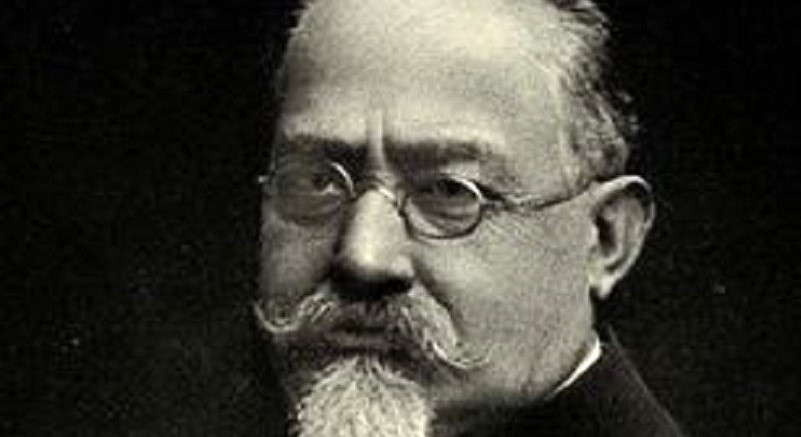
Cesare Lombroso (1835–1909) was an Italian criminologist, physician and psychiatrist. Additionally, he was an active and influential early researcher of claimed paranormal phenomena, notably with regard to the Italian medium Eusapia Palladino, and helped draw the attention of Continental science to the possibility of postmortem survival.
- His investigations of Eusapia Palladino helped convert a former atheist into a public supporter of spiritistic interpretations.
- He argued that scientific controls, physiological monitoring and instruments could be brought to bear on mediumship.
- He also reported hauntings and poltergeist phenomena, including a Turin tavern case that ceased when a young employee left.
Life and Career
Ezechia Marco ‘Cesare’ Lombroso was born in Verona on 6 November 1835 into a wealthy Jewish family. He studied widely at several universities in Europe before completing a medical degree at the University of Pavia in 1858. In 1859 he worked as an army surgeon, which provided him with his first experiences of the clinically insane. This led him to develop physical measurements to predict criminality in soldiers.
During the following years he worked in an asylum in Pesaro and took up posts at the University of Turin as a professor of medicine and hygiene, psychiatry and finally, in 1906, criminal anthropology. It was in this field that he became firmly established, arguing that criminal behaviour was a throwback to an earlier evolutionary form of behaviour, was inheritable, and could be discovered in the shape of a person’s head.1Lombroso. https://www.bl.uk/collection-items/luomo-delinquente His most important book on this subject, L’uomo delinquente, was published in 1876 and widely translated. Also notable was his book Genio e Follia, which proposed that genius is an evolutionary form of insanity emanating from the same psychobiological root as other mental illnesses.2Carrà & Barale (2004), 624.
Lombroso died on 19 October 1919 in Turin, Italy.
Psychical Research
Lombroso’s experiments with hypnotism met with limited success but aroused his interest in abnormal mental phenomena.3Myers (1889–90). He joined the Society for Psychical Research (SPR) in the early 1890s and subsequently contributed articles to the Archivio di Psichiatria on mediumship, hauntings, telepathy, psychic photography, premonitions and other related subjects.4Bozzano (1906), 5./fn] In 1891, Lombroso joined a group of notable Italian academics investigating the mediumship of Eusapia Palladino, a Neapolitan medium reputed to produce powerful phenomena.4Fodor (1934), 205.
Eusapia Palladino
Haunted Houses
Lombroso also contributed to the literature of hauntings.7Lombroso (1909b), 188. One incident concerned a poltergeist-type case in a Turin tavern, where objects were being thrown apparently without cause. Lombroso made a visit and witnessed wine bottles crashing to the floor and breaking of their own volition. He checked for evidence of fraudulent activity but found none. The departure of a thirteen-year-old employee eventually brought an end to the disturbances.8Lombroso (1909b), 189-192.
Legacy
A brief obituary in the British Medical Journal, republished by the SPR in its journal, credited Lombroso with having been a ‘pioneer in a new region of scientific thought’, and added, ‘though much of his work was fantastic and inaccurate, he gave a stimulus to other investigators, which will probably lead to fruitful results’.9Anon (1909), 158-59.
For lists of Lombroso’s works on criminology see here.
Works
Selected Books
L’uomo delinquente (1876). Milan: Ulrico Hoepli.
Genio e Follia (1894). Torino, Italy, Bocca.
After Death – What? Spiritistic Phenomena and their Interpretation (1909). Boston, Massachusetts, USA: Small, Maynard & Co.
Hypnotisme et Spiritisme (1911). Paris: Ernest Flammarion.
Articles
L’influenza della civiltà e dell’occasione sul Genio (1888). Fanfulla della Domenica, 15 July.
Innovation and inertia in the world of psychology (1890). The Monist 1/3.
Eusapia Paladino and Spiritism (1908). Annals of Psychical Science 7, 167-80.
Haunted houses (1909). Annals of Psychical Science 8, 187-206.
Melvyn Willin
Works Cited
Alvarado, C. (1993). Gifted subjects’ contributions to psychical research: The case of Eusapia Palladino. Journal of the Society for Psychical Research 59, 269-92.
Anon (1890). Thought-transference in Italy. Journal of the Society for Psychical Research 4, 303-4.
Anon (1909). Obituary: Cesare Lombroso. Journal of the Society for Psychical Research 14, 158-59.
Bozzano, E. (1906). Caesar [sic] Lombroso and supernormal psychology. Annals of Psychical Science (4 July), 1-9.
Carrà, G., & Barale, F. (2004). Cesare Lombroso. American Journal of Psychiatry 161/4.
Fodor, N. (1934). Encyclopedia of Psychic Science. London: Arthurs Press Limited.
Lombroso, C. (1888). L’influenza della civiltà e dell’occasione sul Genio. Fanfulla della Domenica, 15 July.
Lombroso, C. (1892). Cited in Bozzano, E. (1906). The Annals of Psychical Science 4 (July), 6-7.
Lombroso, C. (1908). Eusapia Paladino and Spiritism. The Annals of Psychical Science 7, 167-80.
Lombroso, C. (1909a). After Death – What? Spiritistic Phenomena and their Interpretation. Boston, Massachusetts, USA: Small, Maynard & Co.
Lombroso, C. (1909b). Haunted houses. The Annals of Psychical Science 8, 187-206.
Myers, A.T. (1889–90). International Congress of Experimental Psychology. Proceedings of the Society for Psychical Research 6, 180.