

Chris Robinson (b 1951) is a well-known British psychic whose specialty is precognition in dreams. He is credited with having provided UK police, military and intelligence authorities actionable information on terrorist bombings, air crashes, murders and other disasters. He has appeared frequently on television and radio and has been the subject of news and feature stories.
Background
Christopher (Chris) Robinson was born in Bushey, Hertfordshire, UK, and continues to live in suburbs of London. Since childhood he has had a heart condition, mitral stenosis, uncured by several surgeries; he was also afflicted with multiple sclerosis. After the loss of a video and television business, he made his living by doing odd jobs and lived with his second wife Bessie and his two young children in a mobile home park in Bedfordshire.1Robinson (1996), 9. All information in this and the next two sections is drawn from this source unless otherwise noted.
In 1986, Robinson suffered a heart attack, and he attributes the emergence of his gift to the resulting near-death experience (NDE):
I have been a psychic intuitive since a child but the powers developed fully after a heart attack when I was 35. I found myself floating out of my body talking to angels who wanted me to go with them. I said NO … I made a deal with them if they sent me back to earth that I would live and work in both worlds. That changed my life forever.2Robinson (n.d.).
Early Years
Alex Hall, a senior police detective, was assigned to monitor Robinson’s dreams for about seven years. According to Hall, Robinson first contacted police in 1988 with information about a planned Irish Republican Army (IRA) attack, though Hall does not say with what result.3Hall, A., in the Foreword in Robinson (1996).
In a 1989 incident, Robinson claimed to have helped police by giving them information he received in a precognitive dream about an IRA plot to bomb a military installation in Cheltenham. About a week later, several suspected IRA terrorists were arrested in a hotel in Cheltenham with a cache of guns and explosives. Police did not tell Robinson whether they had used his information.
Robinson began a dream diary in late 1989, sharing entries with two police friends, a reporter and a priest. He also consulted with parapsychologist Keith Hearne. Hearne’s description of his experience with Robinson in 1991 was paraphrased as ‘frustrating and uncompleted, but he remains convinced that Robinson, despite considerable practical and personality problems, does have psychic powers worth investigating’.4Keen (1995.)
Robinson has continued to share information with police forces, secret services and intelligence agencies ever since, he writes, including a parliamentary assistant to then-Prime Minister John Major who was impressed at his dreamed prediction of a bomb attack on Major’s official residence.5See Robinson (1996), 241-58.
Method and Ideas
In Dream Detective, Robinson describes going to sleep with his dream diary and pen next to his bed and creates notes and drawings whenever he wakes. He states that dream messages are repeated if they are important, and for major events he becomes increasingly anxious as time passes, to the point of being sure it will happen on the day (it often does). Three consecutive nights of relevant dreams usually occur before a major event, he writes. Sometimes he clearly has out-of-body experiences (OBEs) and sees explosions, crashes and deaths in horrendous detail; other times the dreams provide symbols.
His decodings include the following:
- Dogs represent terrorists (a childhood experience caused him to be frightened of them).
- Cups represent human fatalities.
- Cake represents a prominent person.
- Chocolate, coffee or a bee indicate a Black person.
- ‘Russian’ or ‘Skoda’ means a shooting.
- Initials of words often indicate post codes and thus pinpoint places.
- Plays on words reveal names, such as ‘gown’ for Ian Gow or a car for Mike Carr prior to their sudden deaths.
- Snow means the predicted event is imminent.
Robinson claims the information is given to him by helpful spirits and that, since them seem intended to prevent death and suffering, they must come by the will of God.
Reflecting on this ability, Robinson cites Hearne in noting that prolonged anesthesia, as he had had during operations early in life, can generate out-of-body experiences, and adding that he has experienced multiple NDEs. He conceives successive universes or cycles of existence which are almost identical in the events that occur and posits either that premonitions are glimpses of happenings in the previous universe/cycle, or else that causality is accessible in every direction.6See Robinson (1996), 162-68.
Testing
Parapsychologist-turned-sceptic Susan Blackmore tested Robinson formally, as described in her brief paper.7Blackmore (1995). For six weeks, an assistant concealed a household object in a locked box, changing it twice a week. Blackmore then asked Robinson to match up each object with each half-week based on his dreams. She claimed that his results were no better than chance, although this was disputed by statistician Jessica Utts.8Utts (1996–97). Robinson protested that Blackmore had persuaded him to omit a crucial step – seeing the objects revealed after the testing period, which would allow his precognition to work – on the grounds that this was only a preliminary experiment, but then published the result as conclusive.9Robinson (2006). For another account of this experiment from Robinson’s point of view, see Robinson (1996), 335-56.
Robinson participated in an unsuccessful test of psychic detection by Richard Wiseman, Donald West and Roy Stemman.10Wiseman, West & Stemman (1996). Two professional psychics and Robinson, together with a control group of three students, were each given three objects and asked to match each one to the corresponding description of crimes to which they were related. Robinson wrote that the experimenters had led him to believe he would use his dream notes (that is, it would be a test of precognition rather than pure psychometry). ‘How would an Olympic runner feel if suddenly they were asked to ski instead of run, thirty seconds before the start of a race?’ he asked.11Robinson (2006), 12-13. For another account of this experiment from Robinson’s point of view, see Robinson (1996), 330-35.
In Dream Detective, Robinson recounts being contacted for a show hosted by the late anti-paranormal sceptic James Randi who wanted to test him on camera. At a producer’s request, he asked his dreaming mind for information on what story would be on the front page of a certain newspaper the next day. He felt he had failed as the dream produced no leads, but on subsequent nights he dreamed of a plane crash, the full name of one of the fatalities and partial names for the other two, which happened shortly thereafter. The producer reportedly told Robinson that he would not be included on the show as it was concerned only with presenting psychic failures.12Robinson (1996), 206-23.
In May 2001 Robinson contacted American parapsychologist Gary Schwartz with a request to be tested. The two devised an experiment in which Robinson would be taken to ten distinctive locations in southern Arizona each day for ten days. In the two months beforehand and then again on the night before each day, he would dream with the intent of gaining information about each location.13See Schwartz (2011) for full details of the experiment. He scored significant hits for all ten days, but as Schwartz relates himself,14Schwartz (2011), 4. the resulting paper, was rejected by a parapsychological journal (by one account the Journal of the Society for Psychical Research),15Wonderer2012 (2012). This source contains excerpts from a version of Schwartz’s paper submitted to the Journal of the Society for Psychical Research. because ‘one aspect of the data collection procedure was not completely double-blinded, and that selective attention / perceptual priming could explain the results’.16Schwartz (2011), 4.
Coincidentally, the scheduling of the experiment placed it shortly prior to the 11 September 2001 terrorist attacks in the United States. In his paper, Schwartz makes reference to dream notes and illustrations Robinson made before and during the experiment that suggest a prediction of the destruction of the World Trade Center’s twin towers.17Schwartz (2011), 34-35. The illustrations are drawn from Starstream Research Network (2014). About one page created two days before the attacks, Robinson is quoted as having written:
The notes for the year 2001 were all sent to the [American] secret service, who asked for them in the U.S. … the dreams were so terrible, I got up and then went back to sleep – and this was written at about four in the morning on Sunday the 9th.
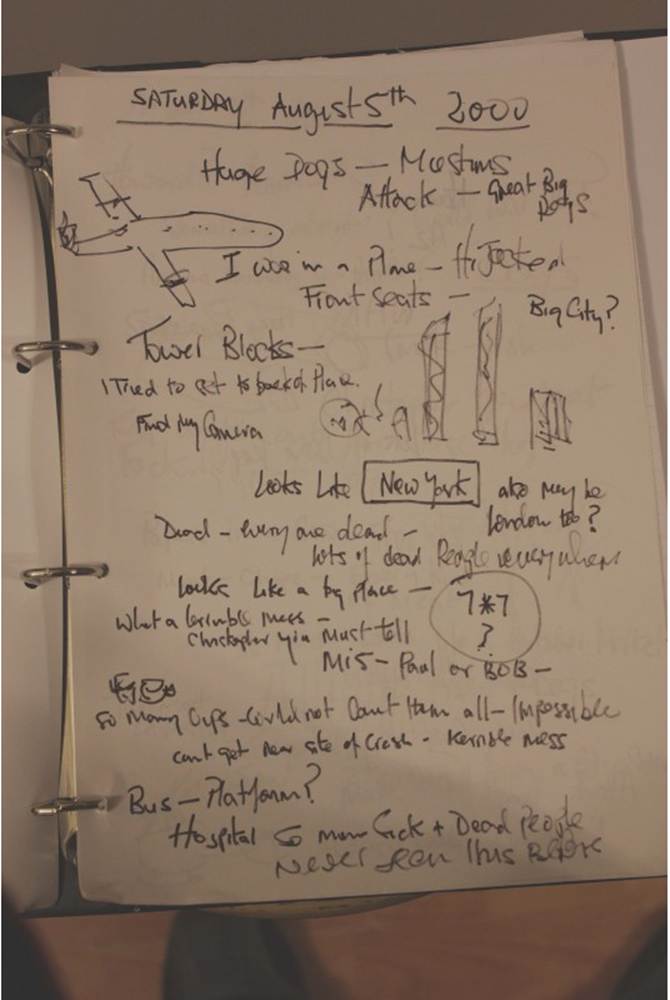
Figure 1. Robinson’s dream notes for 5 August 2000.
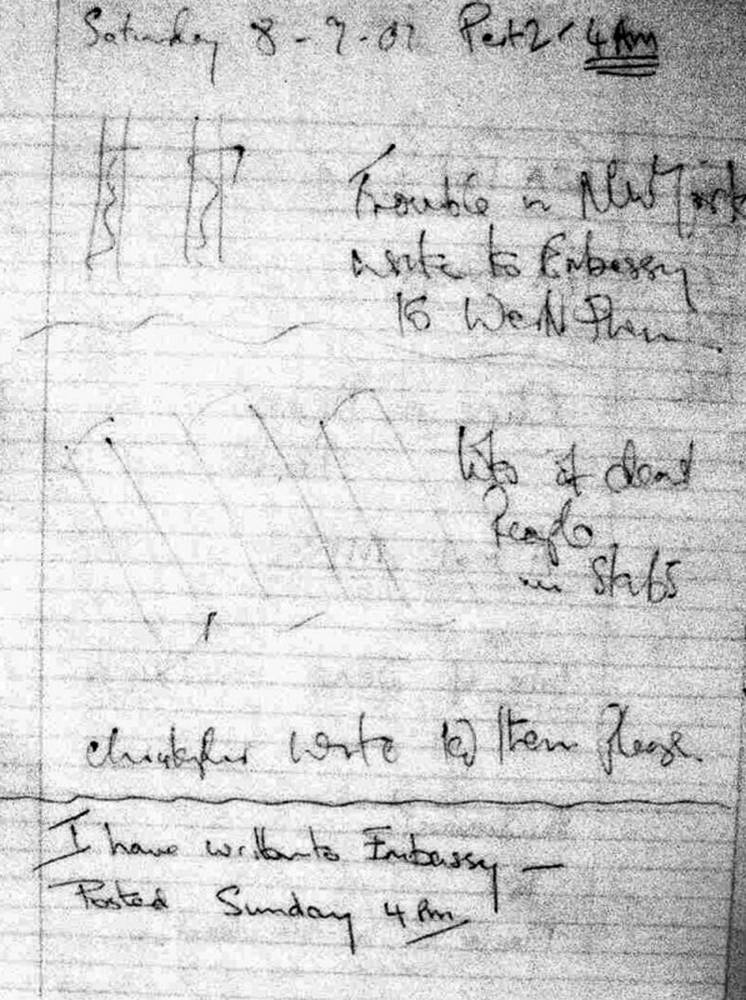
Figure 2. Robinson’s dream notes for 8–9 September 2001.
Video
Robinson has by his own count made more than one hundred television appearances, many of which are to be found on YouTube. He has a collection on his own YouTube channel. Searching ‘dreamdetective51’ on YouTube turns up more.
The BBC documentary Premonition Man can be partially seen here in five parts. Part 1 relates the IRA bombing attempt in the English town of St Albans on 15 November 1991,18See Robinson (1996), 289-305. continuing in Part 2, which also relates Robinson’s apparent premonition of the death of Princess Diana on 31 August 1997. Part 3 and into Part 4 describe Robinson’s seeming premonition on 1 July 2005 of commuter bombings that happened in London six days later. The end of Part 4 begins an account of the Schwartz experiments which takes up all of Part 5.
The portion of an episode of the British TV series Strange But True devoted to Chris Robinson may be viewed here. It covers the Stanford Royal Air Force base bombing described in Dream Detective,19See Robinson (1996), 99-113. the predicted death of a young photographer in Mogadishu, Robinson’s mediumistic communications with his mother, and a two-plane crash at an air show whose timing Robinson pinpointed with sufficient accuracy to enable him to travel to the show and witness the accident himself.
Robinson was interviewed twice by parapsychologist Jeffrey Mishlove for his New Thinking Allowed YouTube channel; see the videos here.
KM Wehrstein
Literature
Blackmore, S. (1995). What’s in the box? An ESP test with Chris Robinson. Journal of the Society for Psychical Research 60/840, 322-24.
Irving, R. (1996). Watching the dream detectives. Fortean Times 86, 23-28.
Keen, M. (1995). Media: Television and the paranormal. Psi Researcher 16 (Spring), 25.
Poynton, J.C., cited by ‘Dreamdetective51’ (Chris Robinson) (2009). Premonition Man, Part 4, 7.32. [YouTube video.]
Robinson, C. (2006). Psi experiments and how to make sure they fail. Paranormal Review 39 (July), 12-16.
Robinson, C. (n.d.). Chris Robinson (UK). [Web page.]
Robinson, C., with Boot, A. (1996). Dream Detective. London: Warner.
Schwartz, G. (2011). Exploratory blinded field experiment evaluating purported precognitive dreams in a highly skilled subject: Possible spiritual mediation? The Journal of Spirituality and Paranormal Studies 34/1, 2-38.
Soloman, G., & Soloman, J. with Robinson, C. (2023). The Premonition Man: UFOs, Aliens, and Spirits in the Afterlife help a Psychic to Dream the Future. Waltham Abbey, UK: Campion Books.
Starstream Research Network (2014). Psychic dreamer who predicted 9/11 warns Islamic State will access Pakistan nukes. [Web page.]
Utts, J. (1996–97). Correspondence. Journal of the Society for Psychical Research 61/842, 62.
Wiseman, R., West, D., & Stemman, R. (1996). An experimental test of psychic detection. Journal of the Society for Psychical Research 61/842, 34-45. [Also published 1997 in The Police Journal 70/1, 19-25.]
Wonderer2012 (Internet alias) (2012). The curious case of Christopher Robinson [Arizona Paper Results].