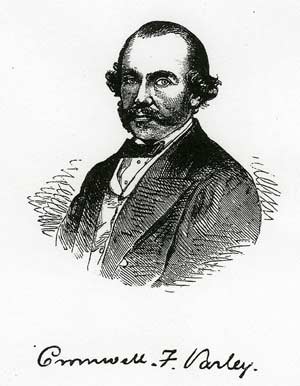
Electrical innovation and spiritualist experiment met unusually directly in Cromwell Fleetwood Varley (1828–83). A leading telegraph engineer involved in Atlantic cable work, he brought technical apparatus and scientific confidence to séances, testing mediums and arguing that some phenomena pointed beyond known physical laws.
- Varley was a Fellow of the Royal Society and a prominent telegraph engineer linked with the Atlantic cable project.
- He investigated DD Home, Kate Fox and Florence Cook, using both mental requests and electrical apparatus in séance tests.
- His Spiritualist views treated consciousness as independent of the body and framed mediumistic phenomena as evidence for a future state.
Life and Career
Varley was born in the parish of Westminster on 6 April 1828, the second son of Cornelius Varley, a professional artist. In 1844, after finishing school at St Saviour’s, Southwark, England, he began his lifelong studies and research in electricity, chemistry, natural philosophy and telegraphy. In 1846 he became employed by the Electric and International Telegraph Company, where he worked until his retirement in 1868. He also worked as consulting electrician for the Atlantic Telegraph Company.1This section is based on Anon. (1870); Varley (1872); Anon. (1883); and Boase (n.d.).
When the first Atlantic telegraphic cable failed in 1858, Varley used his skills as an inventor to make a new one. He experimented with an artificial line that represented the working conditions of a submarine cable; then he created a signalling condenser to sharpen the electric pulses of the transmission and boost the speed of operation. Eventually this proposal proved successful and public confidence in Atlantic telegraphy was restored. William Thomson and other notable engineers collaborated with him on the venture. After this, Varley’s recognition as an expert in telegraphy increased, as did his personal wealth.
In 1865, Varley was elected a member of the Institution of Civil Engineers. Six years later, he became a Fellow of the Royal Society. The final establishment of the Society of Telegraph Engineers (later the Institution of Electrical Engineers) in 1871 owed much to his efforts; he was made a member of the council. In that year he also theorised about the electric nature of cathodic radiation; his contention was that such rays should carry an electric charge. However, he was never able to prove this.
Varley published several papers, notes, letters and testimonies on electrical and telegraphic subjects, and was also a regular contributor to journals on Spiritualism and psychical research.
Varley died at his home, Cromwell House, Bexley Heath, Kent, on 2 September 1883, at age 55.2Anon. (1883).
Psychical Research
Overview
Varley became interested in paranormal phenomena such as mediumship, raps and table-turning, telepathy, clairvoyance, premonitions in dreams, and the efficacy of prayer in the early 1850s. He claimed that on some occasions, in his sleep, he could ‘transcend’ his own ‘material body’ and use his own spirit as an ‘agent of his will’ to perform various deeds. Thus, he became convinced that ‘we are not our bodies’ and that our spirit can act as an independent force.3Noakes (1999), 437-39.
Varley’s wife Ada was apparently a medium. Spirits claimed to read his mind and she channelled their messages to him, convincing Varley of the existence of ‘invisible beings’. He stated once that on one occasion the ‘invisibles’ (ie, the spirits) had helped him predict the exact timing of a serious change in Ada’s health.4London Dialectical Society (1871), 157-59.
Early in the 1860s, Varley began to carry out experiments with professional and amateur mediums. This research programme lasted several years. The séances took place in different locations in Great Britain and the United States. Varley’s basic goal was to test his belief that spiritualist phenomena do not depend on the brain or any other material source. As he stated before the Spiritualist Committee of the London Dialectical Society on 25 May 1869, ‘the thinking part of man forms in the next life the body … we are thought beings, and … those ideas which we originate in this life, are permanent realities in the next’.5London Dialectical Society (1871), 170.
Varley spent seven months in the United States, applying ‘mechanical and mental tests’ in order to compare the ‘active forces’ he witnessed with the effects of electricity and magnetism. In the end he concluded that such forces ‘were not due to … any of the recognised physical laws of nature, and that there [had] been present … some intelligence other than that of the medium and observers’. ‘The phenomena’, he added, ‘can neither be accounted for by magnetism nor electricity’. These two terms, in his opinion, should not be applied to any ‘unknown forces’.6London Dialectical Society (1871), 170.
Experiences with DD Home
In a letter to John Tyndall on 19 May 1868, Varley described in considerable detail three sittings he had with the famous medium Daniel Dunglas Home. The first two took place in 1860 at Home’s apartments in London. They were arranged by Varley on his own initiative. There were eight sitters, including Ada Varley, and before each sitting Cromwell made a thorough examination of the whole building to make sure that there were no hidden instruments of deceit.7Anon. (1868), 273-74; Anon. (1870), 96; Noakes (1999), 436-37.
About twenty minutes after the beginning of the first séance, the first raps were signalled. These early raps were to be understood according to a ‘telegraphic alphabet’: One sound or movement would mean no, three sounds or movements would mean yes, and so on, with other cryptographic conventions. It was, of course, a very slow system of communication.
Next the table would move in various ways. There was no evidence of exertion of any muscular force by the sitters. Varley would ask mentally for the ‘invisibles’ to create some ‘effect’, and when this happened, other sitters made similar mental requests. Then ‘the raps were produced on the walls, on the ceiling, on our chairs, which latter were distinctly shaken by them’. Other more spectacular movements and sounds followed.8Anon. (1868), 274-76.
The third séance took place at Varley’s house at Beckenham, Kent, in the summer of 1864. Home had never been in that residence. Several phenomena of the kind witnessed four years earlier were registered again. At one point, Home, visibly alarmed, exclaimed: ‘Oh! Look behind you’, and then, writes Varley:
[Home] put both his legs over my left knee, and at his request I held both his legs between my legs, and grasped both his hands in my own. We all of us looked in the direction, which he indicated — there was a small side table close to the conservatory window, seven feet behind Mr Home’s back, Mr Home and I being the nearest to it. We were seated thus:
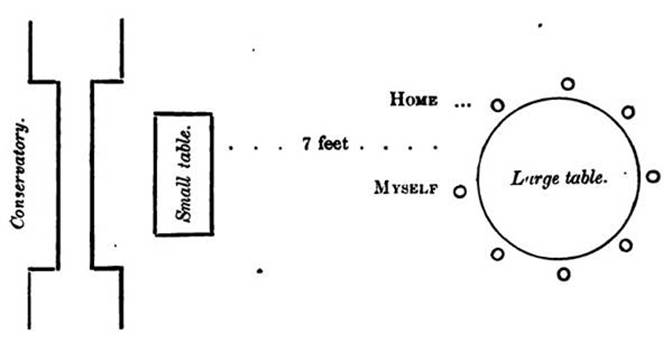
Shortly afterwards the side table began to move, and it was driven up to Varley by some ‘invisible means’, and the large table … was moved and driven up to the pianoforte.9Anon. (1870), 271.
Varley, in the same letter to Tyndall, concluded that the possibility of imposture was out of the question. The nature of the agent or ‘force’, however, could hardly be asserted, but Varley thought that probably ‘the source of the manifestations was a combination of the vital systems of the sitters and the medium’.
Experiments with Catherine (Kate) Fox
The tests with Catherine (Kate) Fox were carried out in New York in 1867. Varley prepared ‘five cells of Grove’s nitric-acid battery, two helices, an electromagnet, key, switches, and wires’. A battery was on a side table connected to a switch from which eight wires ran to the table of the sitters. Only Varley was acquainted with the ‘laws of electricity’.10Harrison (1880), 35-36.
Some tests were conducted in the dark, some in broad daylight. On one occasion, Varley observed that whenever he took hold of a wire through which the current was passing, the ‘invisibles’ recognised the direction of the electric flow, but this never happened whenever he placed the helix around his head, in the dark. When he pressed down the key and the current flowed, loud raps were heard and ‘the table rocked violently’. Then Fox involuntarily wrote down a message saying that Varley ought not to place his head inside the helix, for that made the ‘invisibles’ uneasy.11London Dialectical Society (1871), 165-66; Gauld (1968), 26n.
Experiments with Florence Cook
In 1874 Varley was involved in two experiments with Florence Cook. In the first, he was the conductor. William Crookes, the distinguished scientist best remembered in the history of parapsychology for his connection with Cook’s alleged mediumistic materialisations, was present.12Varley was a good friend of Crookes. He defended Crookes’s positions during a controversy regarding an alleged ‘new force’ which Crookes sustained against WB Carpenter in 1870–71. See Harrison (1880), 38-39. The second test occurred under Crookes’s guidance and in his house, but in the absence of Varley. Nevertheless, it was developed according to Varley’s methods and objectives, and with the use of his technical equipment.
Varley’s basic plan was to ensure that Florence Cook would remain inside a cabinet in the event that ‘Katie King’ would materialise outside. He decided to treat the medium, to use his own words, as a ‘telegraph cable’, sending ‘a current from her right wrist along her right and left arms to her left wrist’. This created a steady circuit signalled by a reflecting galvanometer. The breaking of the circuit would be automatic proof that Cook left the cabinet in order to impersonate King. The key to the test, then, was ‘continuity and resistance’.
In his report of the first séance, Varley wrote that King indeed showed up, but only partially. There was no signal of the circuit breaking. He remarked to King that she looked exactly like Cook, and the strange answer was ‘Yeth! Yeth!’. Later on, when the darkness in the room increased, Varley approached King, touched her hands, and realised that they were quite different from Cook’s. Then, in nearly complete darkness, King told Varley to awaken Cook.13Varley (1874); Harrison (1880), 37. This was done with ‘cross-passes’. The wires seemed to be completely in their original positions.
Curiously, in 1880 Varley wrote that the materialised woman’s name was ‘Annie Morgan’ and not Katie King.14Harrison (1880), 37.
Varley was prone to suffer from a serious loss of energy after such dramatic experiences.15Harrison (1880), 37-38; Morton (2020), 122. This was why he could not attend the second séance. However, at Crookes’s house the medium was not Florence Cook, but a son of Crookes who was not even a medium. This may be explained by saying that Varley merely wanted Crookes to familiarise himself with the galvanometer, regardless of the subject. In any case, the precise part played by Crookes in the whole case has been a matter of debate among some critics.16Broad (1964), 170-71; Morton (2020), 151.
General Assessment of Modern Spiritualism
In Varley’s view, Spiritualism was an ‘introduction to an extensive field of mental and physical knowledge which will in a great measure explain and reconcile the beliefs of all ages and nations’ and also awaken ‘the perception of the purest and loftiest truths and principles’.17Anon. (1870), 96. This awakening should help us transcend ‘the state of our present knowledge’.18Anon. (1868), 278.
Roberto R Narváez
Works Cited
Anon. (1868). Lyon v Home. The Spiritual Magazine 3 (June), 241-88. [Google Books. Download PDF.]
Anon. (1870). Facts for non-Spiritualists. The Spiritualist 1/12 (15 August), 96. [IAPSOP. Download PDF.]
Anon. (1883). Cromwell F. Varley (1828–1883). The Telegraphic Journal and Electrical Review (8 September). [Web [page. Full text.]
Boase, G.C. (n.d.). Varley, Cromwell Fleetwood. In Dictionary of National Biography, 1885–1900, vol. 58. [Web page. Full text.]
Broad, C.D. (1964). Cromwell Varley’s electrical tests with Florence Cook. Proceedings of the Society for Psychical Research 54/195, 158-72.
Gauld, A. (1968). The Founders of Psychical Research. London: Routledge & Kegan Paul.
Harrison, W.H. (ed.) (1880). Psychic Facts: A Selection from the Writings of Various Authors on Physical Phenomena. London: W.H. Harrison. [Web page. Full text.]
London Dialectical Society. (1871). Report on Spiritualism of the Committee of the London Dialectical Society. London: Longmans, Green, Reader and Dyer. [Wikimedia. Full text.]
Morton, L. (2021). Calling the Spirits: A History of Séances. London: Reaktion Books.
Noakes, R. (1999). Telegraphy is an occult art: Cromwell Fleetwood Varley and the diffusion of electricity to the other world. British Journal for the History of Science 32/4, 421-59. [Web page. Abstract.]
Varley, C.F. (1872). The efficacy of prayer. The Spiritualist 1/30 (15 February), 12. [IAPSOP. Embedded in PDF.]
Varley, C.F. (1874). Electrical experiments with Miss Cook when entranced. The Spiritualist 4 (20 March), 134-35. [IAPSOP. Embedded in PDF.]