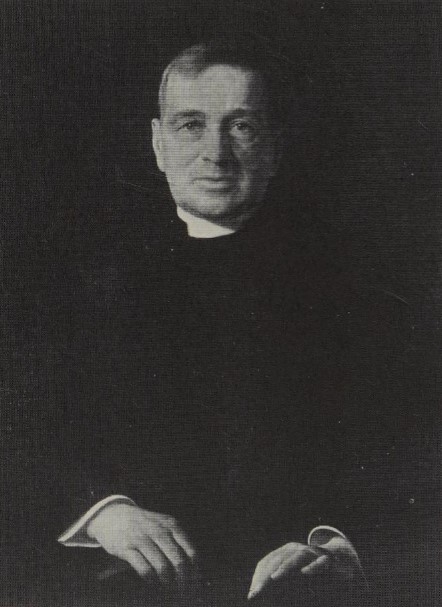
Elwood Worcester (1862–1940) was an Episcopal clergyman, psychologist and psychical researcher who founded Boston’s Emmanuel movement and later the Boston Society for Psychic Research. Combining religious conviction with empirical inquiry, he investigated mediumship and argued that survival after death deserved scientific study.
- The Emmanuel movement was an early attempt to combine medicine and psychotherapy with religious guidance in treating physical and psychological problems.
- Worcester’s involvement in psychical research led him from the American Society for Psychical Research to the Boston Society for Psychic Research, where he worked closely with Walter Franklin Prince.
- Worcester considered mediumistic evidence strongly suggestive of survival after death, while acknowledging subconscious explanations for some phenomena and ultimately grounding his belief in immortality in religious faith.
Life and Career
Elwood Worcester was born in Massillon, Ohio, on 16 May 1862, into a family with a long tradition of ministers and clergymen. His ancestors were deeply influenced by the ideas of Swedish mystic and scientist Emannuel Swedenborg and his father was much interested in psychic phenomena and psychic research. His father-in-law was as well.1Sources for this section include Worcester (1932); Gifford (1997), ch. 1; Pleasants (1964); Bruce (1941); Parker White (1949); and Berger & Berger (1991).
Worcester grew up in Rochester, New York. In his later teenage years, he experienced a religious awakening: As he was working in the shipping-room of the local railroad, he suddenly perceived that a wall was suddenly brighter. This was a recurring phenomenon, and one day came accompanied by a voice that said: ‘Be faithful to me and I will be faithful to you’. This incident changed his whole existence and inspired him to go into the ministry.
Worcester graduated from Columbia College in 1887. During these years, he was influenced by skeptical attitudes toward psychic phenomena and came to think that, after all, there was nothing to them. From 1888 to 1890 he studied at the General Theological Seminary and was superintendent of Sunday School at St. Ann’s, Brooklyn. He was ordained as a deacon on 6 February 1890 and as a priest on 23 May 1891.
Worcester also studied at the University of Leipzig, Germany, where he focused on experimental psychology and psychosomatic relationships and became familiar with the work of Gustav Fechner. Worcester was awarded a PhD by the University of Leipzig in 1889. After his return to the United States, he became chaplain and professor of philosophy, psychology and Christian evidences at Lehigh University, Bethlehem, Pennsylvania, from 1890 to 1896. In his later years, he was also appointed rector of St. Stephen’s Church, Philadelphia.
From 1904 to 1929, Worcester was rector of Emmanuel Church in Boston. In 1906, he founded the so-called Emmanuel Movement along with the Reverand Samuel McComb and two doctors, Richard Cabot and Isador Coriat. The Emanuel Movement was an early attempt to combine medicine, psychotherapy, and religious guidance to help people with physical or mental conditions. In the history of the Episcopal Church, it is remembered as a major effort to reinforce the spiritual ways of healing with therapies derived from scientific investigations.
Worcester authored several books, including Religion and Medine with McComb and Cariot,2Worcester, McComb, & Coriat (1908). dealing with theological and psychical matters and the relations between medicine, spirit, and life. He died in Kennebunkport, Maine, on 19 July 1940.
Involvement in Psychical Research
Hyslop’s Influence
James Hervey Hyslop, the industrious psychologist and parapsychologist who took over directorship of the American Society for Psychical Research (ASPR) after the sudden death of Richard Hodgson in 1905, became aware of the Emmanuel Movement soon after its inception and was a regular visitor at Worcester’s church when he was in Boston for sittings with Minnie Meserve Soule (Mrs Chenoweth, as she was called at the time). Hyslop spoke eloquently of his findings with Soule, along with general philosophical matters, and Worcester’s attitude toward psychical research began to change.3Worcester (1932), 329.
When Hyslop learned that Worcester and company had to treat a number of people that were apparently possessed by spirits, he suggested that, in order to deal with such cases, the attitude of a psychical researcher might serve them well. Worcester recognized that psychical inquiries could establish facts useful to prove the existence of a spiritual order of our world and, hence, that religion could cooperate with science to the benefit of human life.
In this, Worcester also felt the influence of Fechner, who emphasized that faith and knowledge, spiritual intuition and empirical observation, soul and mind, could not be regarded as antagonists for any purpose. All the material and spiritual facts in this world are in harmony and give reason to the universe. And he agreed with Wilhelm Wundt that a full appreciation of psychology is a matter of method more than of any specific are of scientific study (chemistry, biology, physics, etc.), a crucial view to counteract the general tendency – in his time – to favour ‘materialistic hypotheses’ over any others to explain the facts of life.4Bruce (1941), 146-50.
The Boston Society for Psychic Research
Worcester joined the ASPR under Hyslop. When Hyslop died in 1920, he carried on his membership under William McDougall, then just arrived from Great Britain to assume a post at Harvard. However, the ASPR during this period was being taken over by a populist faction that ousted McDougall as director in 1923. Walter Franklin Prince, an ex-clergyman who shared similar interests and values to Worcester, sought to uphold the standards by which Hyslop had operated, but he found his role more and more restricted and in 1925 bowed to pressure from Worcester and McDougall to move to Boston to head a new Boston Society for Psychic Research. Prince was Research Officer of the Boston Society until his death in 1934 and Worcester served as President until his death in 1940.5Berger (1988); Berger & Berger; Bruce (1941), 147; Worcester (1932), 331-32.
In his Boston Society Presidential Address for 1926, Worcester remarked:
The objects we propose to ourselves, if attained, would cause the most the most radical changes in all man’s estimates of his nature and destiny and of the laws which govern this universe … What is incumbent on us is to make our advance so certain that it will not have to be made again. To be part of a movement which … will never cease and … in time may mark a new phase of human evolution, that of the spiritual man.6Worcester (1926), 6.
Views on Psychical Research and Psychology
Worcester believed that psychical research was destined to ‘enrich and enlarge many other sciences and specially to modify the philosophy of life which springs from science’. During the 1920s he became highly critical of what he called orthodox psychology, a science ‘deficient in objective facts’ that tried to compensate such deficiency ‘by introspection, by the study of the nervous system, and by theory’, while paying little or no attention to ‘psychic occurrences.’ For him, in contrast, ‘as far as such occurrences are verifiable … represent capacities of the soul which profoundly affect our estimates of it and which must be included in the psychology of the future’. This would not happen if the ‘mechanistic hypotheses’ were correct.7Worcester (1926), 7-8; Worcester (1933), 18-19.
The appeal to fact should be regarded as ‘the only thing which can heal the dissociation between mind and spirit and give to us a faith supported by reason and confirmed by science’, Worcester held. This justified the hope of finding more and more scientific men willing to explore the psychical field. A model of such scientific man was the philosopher Immanuel Kant. Kant’s approach to psychic phenomena (which basically started with his studies of Swedenborg’s claims) ‘is an example [but] also a reproach to the unwillingness of men of science today to divest themselves of their prejudices and to investigate supernormal occurrences when the opportunity is given’.8Worcester (1926), 9-10.
Something similar could be said regarding John S Mill’s negative point of view, Worcester thought. Mill argued that the fact of death was merely a historic and scientific, not philosophical, question, and in consequence can only be decided by evidence, a posteriori. This dogmatism was challenged by the scholars and scientist gathered in the English Society for Psychical Research (SPR), whose general objective was to promote the use of scientific method to study ‘debatable’ or ‘supernormal phenomena’.9 Worcester (1933), 12, 232-34.
Worcester emphasized the role of experience in bring about the conviction that unusual happenings take place. The first requisite is ‘to admit that there is a large field of human life which we dare not investigate … these experiences, with their implications in regard to human faculty and human destiny, demand the consideration of … truth-loving men and women’. There can be no place for the excuse that everything in this domain is probably fraudulent or the creation of ‘disordered minds.’10Worcester (1933), 235.
But the major requisite is that science is not conceived as physics exclusively, for physics, again, ‘owes its existence … to the fact that it states its principles and formulates its interpretation of Nature in mechanical terms’. Science is not synonymous with physical reality, and whoever believes it ‘is obliged to deny many of the facts of this universe which it is our business [that is, the Boston Society’s business] to bring to light’.11Worcester (1926), 10.
Position on Postmortem Survival
Worcester’s interest in complementing the study of the physical with considerations of spiritual, immaterial events, which lead his healing efforts and his psychical investigations, meant for him, in the end, to ‘gather evidence pointing to man’s survival of bodily death’. In psychical research, a fundamental assumption is that ‘the spiritual world is so invisible that a man may live a long time and have many experiences without consciously coming into contact with it’, just as a man can live normally without ever sensing any contact with electricity.12Quoted in Gifford (1997), 16.
Immortality is basically a philosophical problem, Worcester thought. To be effective and secure, every system of idealistic philosophy should place that issue at its core. In his Boston Society presidential address of 1926, he maintained that ‘philosophy is something only when it takes up the great problems of life… when it declines to do this and becomes merely technical and recondite, humanity ignores it and goes on its way without it. It is largely due to its bankruptcy on the subject of immortality that idealistic philosophy plays so small a role … today’.13Worcester (1926), 8.
If philosophy manages one day to solve the problem of death, the belief in immortality will be ‘reasonable and glorious’ for every thinking person. Such solution would give to it the right tools to ‘answer the objections and denials of materialism and other forms of unbelief by arguments that are, at least, as keen and not easily answered’. Still, it will not be in the position to prove or disprove the fact, for the reason that it deals only with ideas.
Worcester reached these conclusions not only by reading books and discussing with psychical researchers or students of philosophy, but through his own experiments.14Worcester (1933), 229. A good example is his long exposition of supposed communications with the spirit of a ‘Richard D. Erskine’, in several sittings with a female medium. Such activities are worthy because they ‘offer evidence of the preservation of our memories and affections … of spiritual perceptions in this world, far exceeding those recognized by [the orthodox] physiology and psychology [of his time]’.15Worcester (1933), 237-241. What the spirits may say are never trifles, because, as he wrote:
The importance we attach to small events known to the departed, and in some instances to no one else, are the best means offered us to identify them and to assure us of their continued existence … this humble, honest, patient search of ours is bearing its fruits and as time passes it will bear greater and richer fruits. It is the only appliable instrument which educated men have fashioned capable of resisting the overwhelming materialism which is sapping our spiritual life today.16Worcester (1933), 242-43.
This explains why Worcester could not trust in the telepathy hypothesis to account ‘for veridical statements concerning matters known only to the dead’, as obtained in a séance. The ‘spiritualist hypothesis, on the contrary, was to him ‘nearly proved’ by the analyses (especially those of WF Prince) of the differences between the results of telepathic experiments among the living and the communications through mediums.17Worcester (1926), 13. He did not, however, embrace this alternative hypothesis dogmatically, for he accepted that ‘many of these automatic writings in deep trance, of which the medium remembers nothing on waking, present evidence of subconscious activity covering a wide range of topics, which cannot be questioned by anyone who takes the trouble to examine it.’ And he adds:
To students of psychic research the existence of a subconscious element in mind is no longer an open question, as intelligent communication in trance is among its most familiar experiences. It is not easy to assign this facility of expression in trance to dissociation, in a pathological sense … I am about equally familiar with the outstanding works on psychiatry and with those on psychic research, and I have no hesitation in saying that the psychic researchers are far more interested than psychiatrists in the scientific aspects of their work, and more difficult to please in the matter of evidence, in addition to being more willing to experiment and more open-minded in weighing alternative hypothesis.18Worcester & McComb (1931), 33.
However, in the end, it is religious faith, charity and love that must guide us to define, once and for all, our idea of immortality, Worcester believed. To survive death should be conceived, ultimately, as a victory of man, just like the man Jesus triumphed after his darkest hour. Jesus proved immortality as a fact by raising from the dead and ‘showing himself alive in a recognizable form to those who knew and loved him’.
Whoever believes this as a fact of divine history can rest assured that, no matter all the great contributions of the best men and women of science and theologians, ‘any great book or passage of the Scriptures is of greater value to us than all the acute comment which criticism can bestow upon it …; our hope of immortality does not rest upon veridical statements of mediums …, but on our general philosophy of life and our trust in the wisdom, power and goodness of God.19Worcester & McComb (1931), 244.
Roberto R Narváez
Selected Works
The following books are in addition to those by Worcester listed under Works Cited.
Worcester, E. (1908, with S. McComb, & I.H. Coriat). Religion and Medicine. The Moral Control of Moral Disorders. [Full text.] New York: Moffat, Yard.
Worcester, E. (1926). Presidential address. In Addresses by Drs. Worcester and McDougall (Bulletin 3 of the Boston Society for Psychic Research).
Worcester, E. (1929). The Allies of Religion. London: Skeffington & Son, Ltd.
Works Cited
Berger, A.S. (1988). Lives and Letters in American Parapsychology: A Biographical History, 1850–1987. Jefferson, North Carolina, USA: McFarland.
Berger, A.S., & Berger, J. (1991). Worcester, Elwood, 1862–1940. In The Encyclopedia of Parapsychology and Psychical Research, 468. New York: Paragon House.
Bruce, H.A. (1941). In memoriam: Elwood Worcester. [Embedded in PDF.] Journal of the American Society for Psychical Research 35, 144-62.
Gifford, S. (1997). The Emmanuel Movement (Boston, 1904–1929): The Origins of Group Treatment and the Assault on Lay Psychotherapy. Boston: Francis Countway Library of Medicine; distributed by Harvard University Press.
Parker White, S. (1949). Elwood Worcester and the case for survival. [Embedded in PDF.] Journal of the American Society for Psychical Research 43, 98-107.
Pleasants, H. (1964). Worcester, Elwood. In Biographical Dictionary of Parapsychology, 362-63. New York: Garrett Publications, Helix Press.
Worcester, E. (1926). Presidential address. In Addresses by Drs. Worcester and McDougall (Bulletin 3 of the Boston Society for Psychic Research).
Worcester, E. (1932). Life’s Adventure: The Story of a Varied Career. New York: Charles Scribner’s Sons.
Worcester, E. (1933). Making Life Better. An Application of Religion and Psychology to Human Problems. [Full text.] New York and London: Charles Scribner’s Sons.
Worcester, E., & McComb, S. (1931). Body, Mind and Spirit. [Full text.] Boston, Massachusetts, USA: Marshall Jones Co.