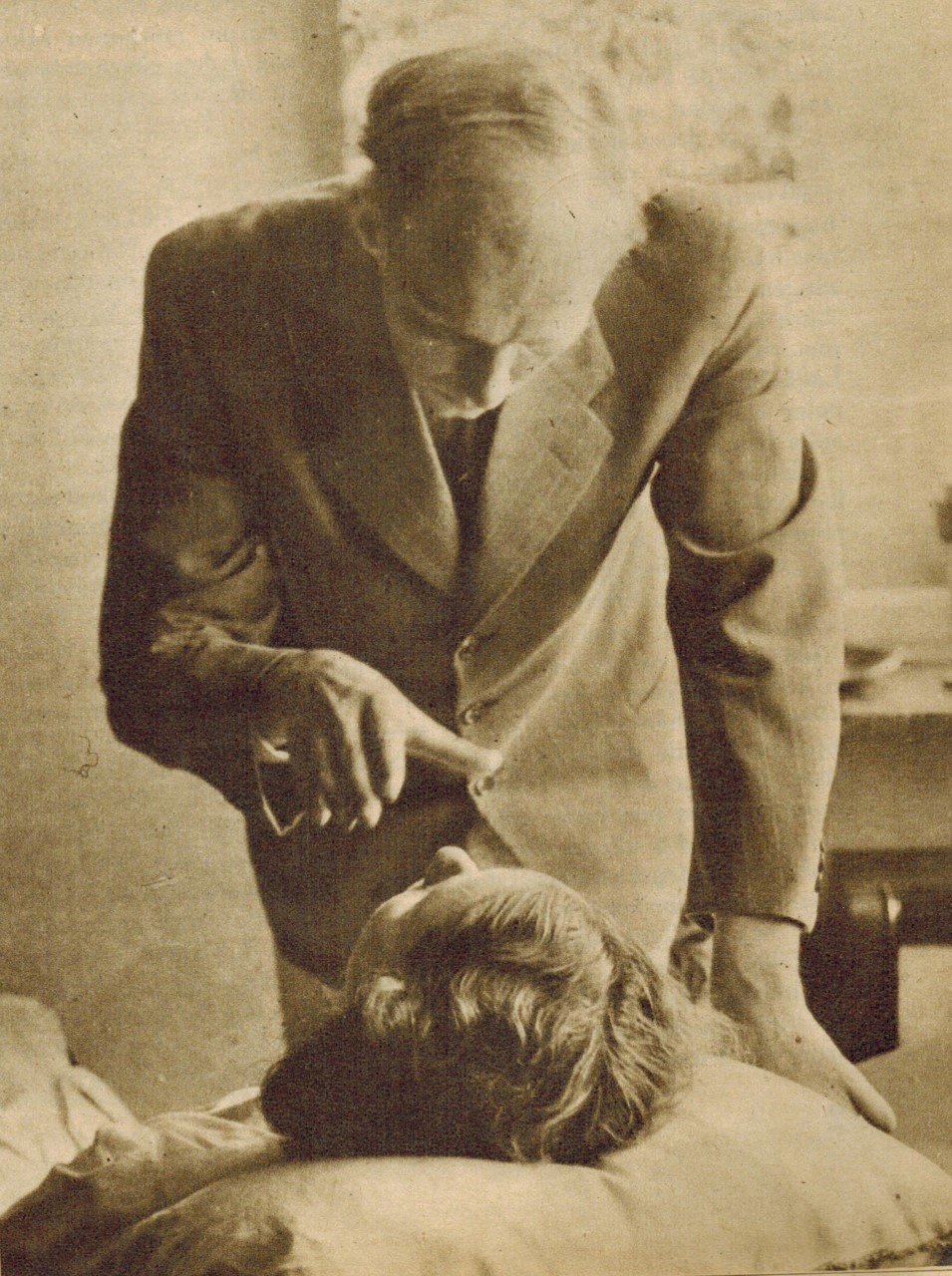
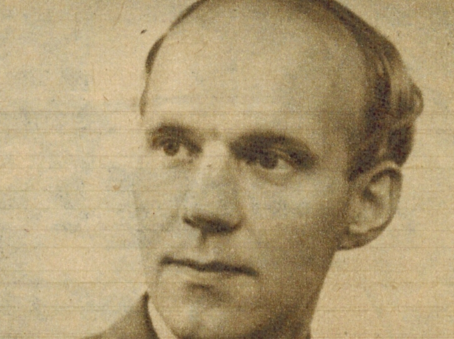
John Björkhem (1910–1963) was a Swedish priest, physician, hypnotist and psychical researcher. Best known for experiments with hypnosis, psychometry and travelling clairvoyance, he helped establish Swedish parapsychology’s postwar profile and inspired the creation of the John Björkhem Memorial Foundation, which has supported research since his death.
- Combined theological, medical and philosophical training with practical hypnotic experimentation.
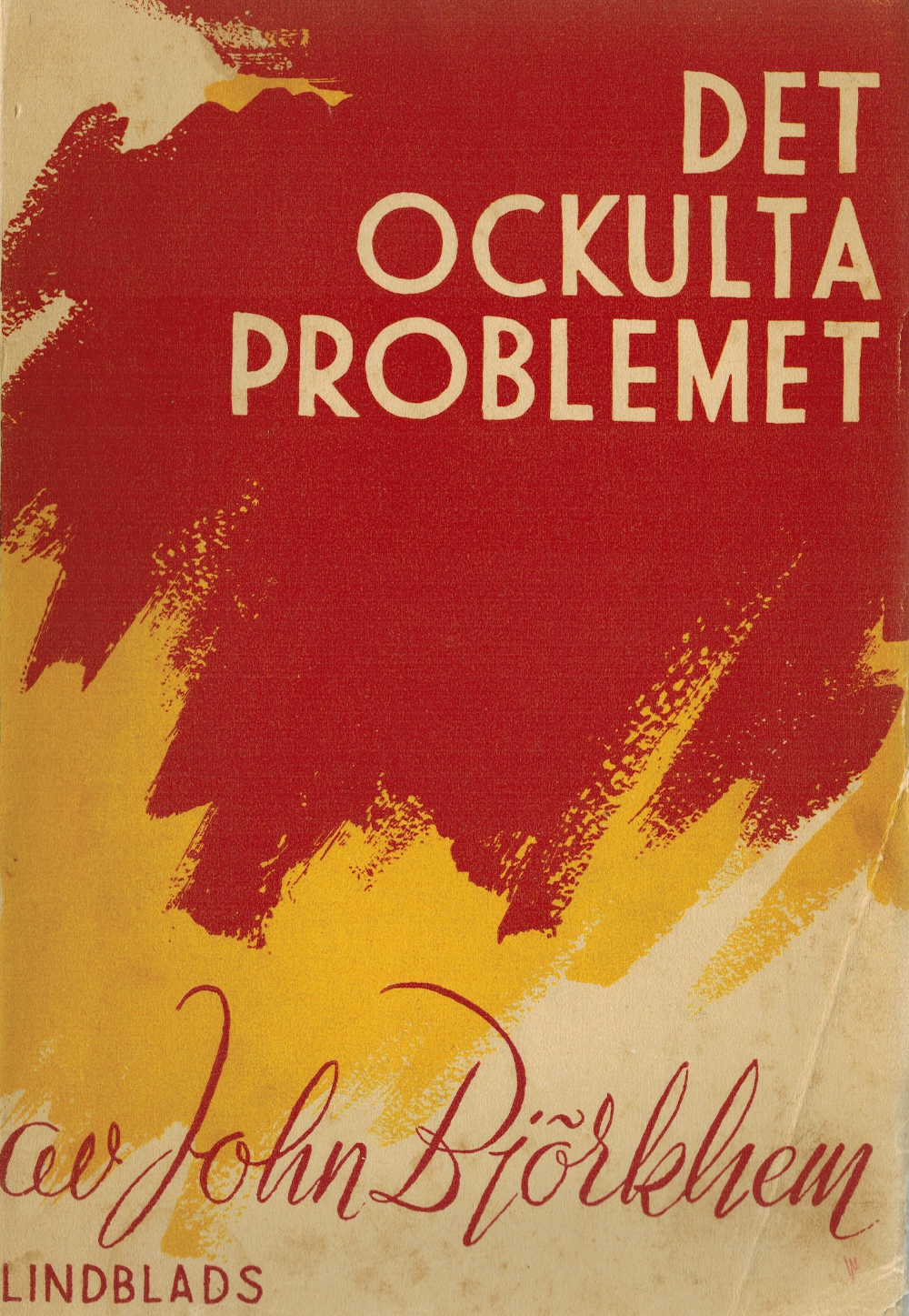
- Published books and articles on psychical research and hypnosis, including Det Ockulta Problemet.
- Wrote three PhD dissertations and demonstrated hypnosis for JB Rhine in the USA.
Life and Career
John Björkhem was born in Kärrabol, close to Jämshög in southern Sweden, on 20 July 1910. He had eight siblings, six of whom lived to become adults. They grew up on a farm, to which Björkhem would return when he could to help with the work. A preserved notebook by him covers the years 1925 to 1927. It shows that Björkhem was already interested in psychical research and hypnosis. He also documented personal experiences and appears to have been a psychic.1Stolt & Björkhem-Bergen (2004), 195). This is the most obscure aspect of his life, but a few accounts relate that he had psychic abilities as an adult too.2Lange-Olivecrona (1972); Löwenmo (1991). After his initial education, Björkhem underwent military service in 1931 and developed a heart condition that would affect him throughout his life.
Early in life, Björkhem noticed that people liked to share their personal problems with him. The number of people seeking his counsel grew with his fame. Björkhem was interested and empathetic. He went to Uppsala, Sweden, to study theology, to become a priest. His friends said that Björkhem never appeared to have doubted that there was a God. He used to have a sentence framed on his desk – ‘What we live for is to make the world less difficult for others’ – which appears to have been his life philosophy.3Ahlberg (1966); Bejmar (2006).
Björkhem was productive and in addition to studying theology he began to experiment with hypnosis in the 1930s. He wanted to follow up on earlier work by Sydney Alrutz. Björkhem’s initial results were published in January 1940. However, his dissertation in theology was devoted to the mystic Antoinette Bourignon. (During his studies, Björkhem had to travel in Europe to get access to some of the writings by and about her.) When he was going to defend his dissertation in 1940, it was first necessary to change to a new venue since the room was too packed. Björkhem had become famous. He defended his dissertation for six hours against five opponents. Today the dissertation would be regarded as a work within the psychology of religion.4Anon. (1940).
Björkhem’s interest in psychical research had become known prior to his dissertation defence and he had written a book, Det Ockulta Problemet [The Occult Problem], first published in 1939. His interest and the psychology in his dissertation made priests uneasy. There was an unusual delay before he finally underwent the ceremony and formally became a priest in June 1940. In July of that year he married Dagny, with whom he had five children: Ingemar, Birgitta, Gudrun, Örjan, and Eva.
Björkhem only worked as a priest for about half a year before he began to study again, this time in Lund, Sweden. His second doctoral dissertation in philosophy, which he defended in 1942, concerns experiments with hypnosis and would be regarded as psychological work today. As before, his defence attracted a large audience, and Björkhem had to face five opponents for six hours. Some of them seemed opposed to him and his research, but the dissertation was accepted.5Teol. d:r hypnotiserar fram tuppar och getter i rummet (1942).
Soon Björkhem began to study again, this time in medicine, and he formally became a physician in 1949. The same year Björkhem moved to Saltsjö-Duvnäs, close to Stockholm, Sweden, and opened his own practice. In the 1950s he began working on a third dissertation, about curing alcoholism with hypnosis, which he almost finished, but never defended.6Stolt & Björkhem-Bergen (2004).
Opposition to Björkhem
Throughout his life Björkhem faced opposition and some claimed that it was due to jealousy. One person in particular, Torsten Lindner, a physician, tried to cause Björkhem trouble and criticised him in print.7Stolt & Björkhem-Bergen (2004). Lindner argued that Björkhem used hypnosis irresponsibly and had violated the law. Lindner was also bothered by the fact that Björkhem allowed the hypnotised to travel back in time to before they were born. (Björkhem did not regard these age regression experiments as providing evidence for past lives.)
In one response, from 1948, Björkhem wrote that Lindner had been after him for close to ten years, but that he felt that no proper responses were necessary.8Anon. (1948). A friend remembered that Björkhem felt that it was not worthwhile to fight, since the truth would eventually prevail.9Svensson (1966).
Boris Beltzikoff, a librarian, recalled in an interview that you could have heard a pin drop when Björkhem gave a lecture about psychical research. After the lecture, Björkhem said that the public part of the evening was over and that people could leave. However, Björkhem then said that he would like to perform some simple experiments for those who remained – nobody left and Björkhem hypnotised members of the audience. Afterwards, the librarian ended up having to pay a fee for having allowed this.10Svensson (1966).
Björkhem’s Research
Björkhem wrote several books, two of which appeared in several editions. One of them concerned pastoral care, Livet och Människan [Life and Man], and the other was on psychical research, Det Ockulta Problemet [The Occult Problem]. The latter book has been translated into Danish, Finnish, Norwegian, and German (an English version was planned but was never published). The revised and expanded edition of Björkhem’s book was reviewed by CD Broad, Karlis Osis, and WG Roll.11Broad (1953); Osis (1957); Roll (1952). Notable were his psychometry experiments, age regression experiments, and experiments with travelling clairvoyance.
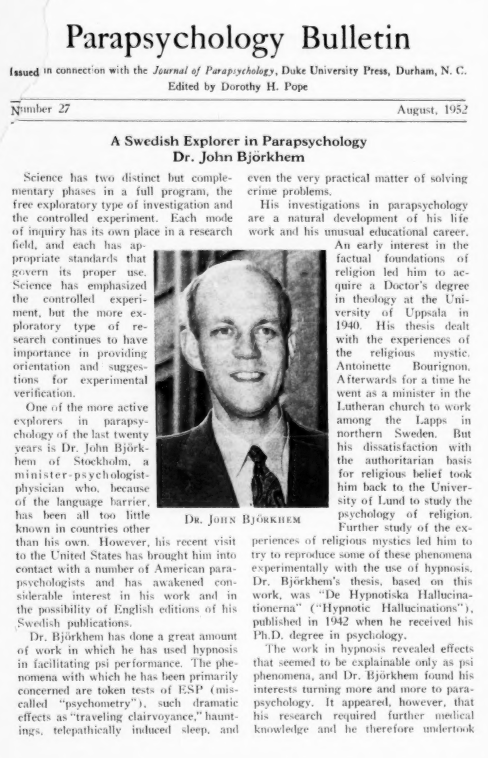
Björkhem was involved in the Swedish Society for Psychical Research, founded in 1948, but could not always participate in meetings due to his health and workload.12Lagerfelt-Lienhard (1998). He visited the USA in 1952 and spent three months there, demonstrating hypnosis for JB Rhine at the Parapsychology Laboratory at Duke University13See Rhine Research Center. in North Carolina. Unfortunately, the result of his time there was not properly documented, but in conversation with the American parapsychologists, Björkhem emphasised that his work was exploratory.14Anon. (1952). He also presented in 1953 at the first international conference arranged by the Parapsychology Foundation.15Björkhem (1955a, 1955b). However, Björkhem appears to have focused on his work as a physician.
Legacy
Due to his heart condition, Björkhem died on 29 March 1963, at the age of 52. After his death, the John Björkhem Memorial Foundation was founded on 20 May 1963. It has supported much psychical research since then. It is impossible to estimate the number of people who were affected or inspired by Björkhem. One of his sons, Örjan, walked in his father’s footsteps, conducted psychical research, and published several popular books in Swedish.
Selected Publications
Det ockulta problemet [The Occult Problem] (1939). Uppsala, Sweden: J.A. Lindblads Förlag.
Nervstrålningens problem [The Problem of Nerve Radiation] (1940). Stockholm, Sweden: Natur & Kultur.
De hypnotiska hallucinationerna (2nd ed.) [The Hypnotic Hallucinations] (1943). Stockholm, Sweden: Litteraturförlaget.
The Esarp tragedy: A psychometric experiment (1948). Journal of the Society for Psychical Research 34/648, 263-67.
Psychological problems concerning hypnosis, hysteria, and the hysterical type of reaction (1953). British Journal of Medical Hypnotism 4/4, 2-19. [Embedded PDF.]
Alcoholism and hypnotic therapy (1956). British Journal of Medical Hypnotism 7/4, 23-32. [Embedded PDF.]
Hypnosis and personality change (1961). In Knut Lundmark and Man’s March into Space, ed. by M. Johnson, 97-117. Göteborg, Sweden: Värld & Vetande Förlag.
Nemo C. Mörck
Works Cited
Ahlberg, A. (1966). Inledning. In Människan och makterna [Man and the Powers], by J. Björkhem, 7-21. Stockholm, Sweden: Verbum.
Anon. (1940, 31 March). Fem opponenter vid disputation [Five opponents at disputation]. Dagens Nyheter, 7.
Anon. (1942, 23 May). Teol. d:r hypnotiserar fram tuppar och getter i rummet [Teol. Dr hypnotises forth roosters and goats in the room]. Dagens Nyheter, 5.
Anon. (1948, 16 April). Björkhem-Lindner om hypnosen [Björkhem-Lindner about hypnosis]. Dagens Nyheter, 18.
Anon. (1952). A Swedish explorer in parapsychology: Dr John Björkhem. Parapsychology Bulletin No. 27, 1-3.
Anon. (1976). Intervju med Boris Beltzikoff f.d. stadsbibliotekarie i Nacka [Interview with Boris Beltzikoff, former city librarian in Nacka]. Borås, Sweden: Högskolan i Borås. [PDF.]
Bejmar, B. (2006). Minnesstenen i Jämshög [The memory stone in Jämshög]. Jämshög, Sweden: Jämshögs Hembygdsförening.
Björkhem, J. (1955a). The future of parapsycholocial research. In Proceedings of the First International Conference on Parapsychological Studies, 84-85. New York, USA: Parapsychology Foundation. [PDF.]
Björkhem, J. (1955b). The twenty-year experiments at Uppsala and Lund. In Proceedings of the First International Conference on Parapsychological Studies, 86-87. New York, USA: Parapsychology Foundation. [PDF.]
Broad, C.D. (1953). Review of Det ockulta problemet by J. Björkhem. Journal of the Society for Psychical Research 37/673, 35-38.
Lagerfelt-Lienhard, M. (1998). Glimtar från SPF:s tidiga historia. In Svensk parapsykologi [Swedish Parapsychology], ed. by N.-O. Jacobson, 75-77. Stockholm, Sweden: John Björkhem Memorial Foundation.
Lange-Olivecrona, B. (1972). Några glimtar av John Björkhem. In På väg mot en världsbild? (2nd ed.) [Towards a Worldview?], ed. by P. Ragnar, 141-50. Stockholm, Sweden: Forum.
Löwenmo, R. (1991). Kanske övernaturligt – men ändå verkligt. In Genier å kloge i Skåne [Geniuses and Wise in Skåne], ed. by H. Lång, 122-28. Höganäs, Sweden: Wiken.
Osis, K. (1957). Review of Die verborgene Kraft [The Hidden Power] by J. Björkhem. Tomorrow 5/2, 84-88.
Roll, W.G. (1952). Review of Det ockulta problemet by J. Björkhem. Journal of Parapsychology 16/1, 68-71.
Stolt, C.-M., & Björkhem-Bergen, L. (2004). Hypnosis in Sweden during the twentieth century – The life and work of John Björkhem. History of Psychiatry 15/2, 193-200. PubMed. [Abstract.]
Svensson, A. (1966). Vänporträtt. In Människan och makterna [Man and the Powers], by J. Björkhem, 132-35. Stockholm, Sweden: Verbum.