
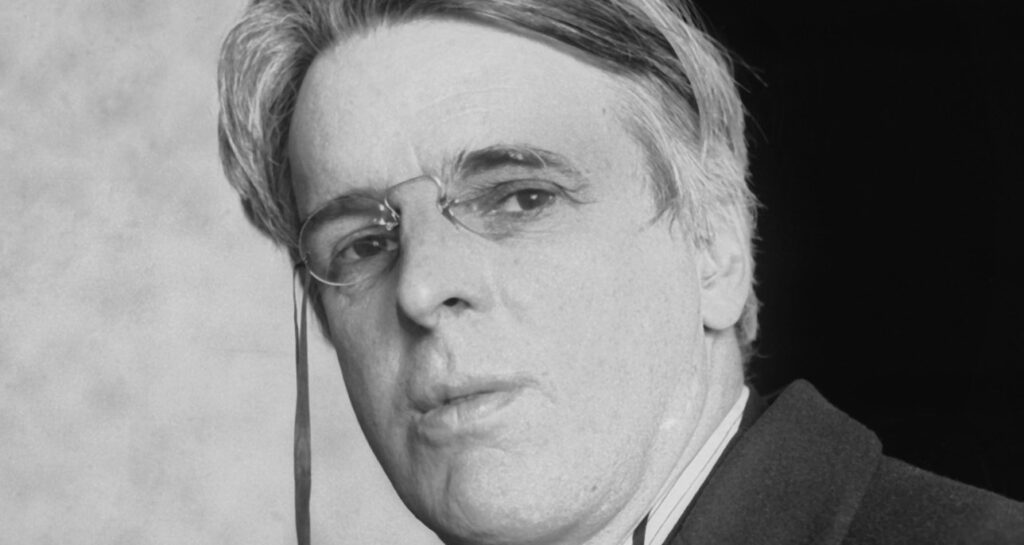
The Irish poet WB Yeats (1865–1939) held a lifelong interest in mysticism, Theosophy and Spiritualism, and pursued activities in mediumship and psychical research. For Yeats, séances, automatic writing, Swedenborgian ideas and organised psychical research were not side interests, but living sources of symbolism, speculation and poetic method across much of his mature work.
- Yeats joined William Barrett’s Dublin circle, later the Ghost Club and the Society for Psychical Research.
- Georgie Hyde-Lees’s automatic writing fed the elaborate spiritual-historical system later developed in A Vision.
- Yeats saw psychical research as a way to test occult ideas while enriching poetry, philosophy and biography.
Life and Career
Born in Sandymount, County Dublin, Ireland, WB Yeats belonged to protestant family with strong artistic interests.1This section is based on Hone (1962), chaps. I and II.
He received his early education in Dublin and London. In the late 1860s he moved with his family to England, where he continued his schooling at home. In 1881 the family returned to Dublin where William attended the Erasmus Smith High School and, later, the Metropolitan School of Art. He now mixed with artists and writers and began to publish poems in the Dublin University Review.
From early youth Yeats was a serious student of Irish folklore and occultism, interests that are evident in most of the poems, essays, short stories, and some plays. He was also preoccupied with political and nationalist concerns, influenced by Maud Gonne, an English heiress and Irish nationalist, for whom he held a lifelong obsession, and Lady Gregory, a cofounder of the Irish Literary Theatre movement.
In 1917 he married Georgie Hyde-Lees; the couple had two children. He now became active in politics, serving as a Senator for the Irish Free State. In December 1923 he was awarded the Nobel Prize in Literature.
Yeats’s religious development went through four phases: involvement with the Theosophical Society and the Order of the Golden Dawn, then activities within psychical research and spiritualism (see below). These influences are codified in his ambitious and somewhat obscure poetic essay A Vision (1925, 1937).2Hough (1984), 33-34.
In the 1930s he became a supporter of dictatorial and nationalist leaderships and antagonistic towards liberal democracy, arguing that fascism was necessary to ensure public order. He maintained such views until his death, which occurred on Roquebrune-Cap-Martin, Menton, France, 28 January 1939.
Theosophy and Magic
Yeats held a lifelong interest in mysticism, theosophy, magic, occultism, Hinduism and astrology. In 1885 in Dublin, he was introduced to theosophy by AP Sinnet’s text Esoteric Buddhism (1883). He and Charles Johnston then formed the Dublin Hermetic Society. He was initiated into a secret society, ‘The Hermetic Students’, in 1887.3Graf (2015), 18-19.
In 1888 he joined the ‘Esoteric Section’ of the Theosophical Society, in spite of disagreements with its founder Helen Blavatsky.4Donoghue (1973), 281-82. In those years he also became acquainted with the philosophy and theology of Emanuel Swedenborg.
At the end of the 1880s he joined the Hermetic Order of the Golden Dawn, a secret organization for the study and practice of occult themes and rites. Its members believed that occultism was an effective tool for understanding life, effecting change, and making contact with the ‘divine spark’, a Holy Guardian Angel or the ‘divine higher self’ that resides in all humans.5Graf (2015), 7.
For Yeats, imagination was the crucial factor of magic. In an essay titled ‘Magic’ (1901) he wrote that he always believed in ‘the evocation of spirits’, though he did not know ‘what they are’ but considered them instrumental to create ‘magical illusions … in the visions of truth in the depth of the mind when the eyes are closed. He added that our minds ‘are ever shifting’, and … that ‘many minds create or reveal in conjunction a single mind, and … our memories are a part of one great memory, and … this great mind and great memory can be evoked by symbols’.6Yeats (1914), 29-30.
Psychical Research
Around 1909, Yeats became interested in psychical research,7Donoghue (1973), 185. joining William Barrett’s circle in Dublin. An early experience was spending a night at a haunted house. He later joined the Ghost Club (1911) and the Society for Psychical Reseach (1913). Hitherto he had been unenthusiastic about mediumship, but in 1911 he started attending séances given by Mrs Chenoweth and other mediums in the US, and was influenced by the spiritualist wing of the American Society for Psychical Research led by JH Hyslop.
In 1917 Yeats’s wife Georgie began producing automatic writing, channelling ‘spirits’ who offered him ‘metaphors for poetry’, along with a complex, esoteric system of philosophy and history which he later developed into a set of formulae based on geometrical shapes.8Cf. Yeats (1966), Book III.
He said that her trances were often ‘illustrated or accompanied by strange phenomena’, such as sudden flashes of light, movement of tables, and smells. He wrote: ‘I can discover no apparent difference between a natural and a supernatural smell, except that the natural smell comes and goes gradually while the other is suddenly there and then as suddenly gone’. Georgie’s ‘communicators’, he stated, also encouraged him to ‘read history in relation to their historical logic, and biography in relation to their twenty-eight typical incarnations, that I might give concrete expression to their abstract thought’.9Yeats (1966), 8-17.
Yeats incorporated much of this material into his poetical prose essay A Vision (1925), arguably the best summary of his occult writings. Around 1912, during a séance with the American medium Etta Wriedt, Yeats contacted a spirit control ‘Leo Africanus’, who communicated in ‘an exceedingly loud voice’ through a long tin trumpet standing on its broad end, stating that he had been with Yeats since childhood.10Harper (1975), 115-21.
In 1914 Yeats accompanied Everard Feilding to investigate a ‘bleeding’ print (oleograph) in possession of the priest Abbé Vachiere (details can be seen here). In correspondence with Yeats, Feilding also discussed mediumship and the Eusapia Palladino affair.11Finnerman, Harper, & Murphy (1977), 553-55.
Yeats shared with William Barrett a deep interest in the writings of Swedenborg. His 1914 essay ‘Swedenborg, Mediums, and the Desolate Places’ sheds light on the mystical roots of his beliefs in magic, spirits, and the supernatural under normal everyday conditions, and in trance. There he wrote: ‘Certain things had happened to me when alone in my own room which had convinced me that there are spiritual intelligences which can warn us and advise us…’.12Yeats (1962), 31. Yeats and Barrett also collaborated in the ‘clairvoyant search’ for Hugh Lane’s will in 1917, along with the medium Hester Travers Smith.13McCorristine (2011), 47-48.
In Swedenborg, Yeats found a doctrine of spirits which, he thought, could be used to study trance mediumship.14Harper (1975), 121. He wrote that mediumship is an ‘unconscious, dangerous condition’ that seems to make possible ‘psychical phenomena’ and that overshadowing of the memory by some spirit memory, which Swedenborg thought an accident and unlawful.’15Yeats (1962), 50. Here he also describes in detail several phenomena related to mediums.
On the other hand, reading Henry More’s Neo-platonist works convinced him of the need to prove hypotheses in experiments and justify them philosophically. His own experiments based on the automatic writings of Elizabeth Radcliffe made him favour the more ‘scientific wing’ of the SPR and reduce his dislike for ‘materialistic’ science.16Harper (1975), 121-22. Poems related to mediumship or psychical research include ‘An Image from a Past Life’, ‘Michael Robartes Remembers Forgotten Beauty’, ‘Towards Break of Day’, and ‘The Second Coming’.
As Arnold Goldman rightly remarked, ‘psychical research … connects a number of [Yeats’s] major interests and acts as a transforming agent or catalyst, unifying our picture of the man and the poet’.17Harper (1975), 128.
Roberto R. Narváez
Works Cited
Donoghue, D. (ed.). (1973). W. B. Yeats: Memoirs. New York: Macmillan Publishing Co., Inc.
Finnerman, R.J., Harper, G.M., & Murphy, W.M. (1977). Letters to W. B. Yeats. Vol. 2. London: Macmillan.
Graf, S.J. (2015). Talking to the Gods: Occultism in the work of W. B. Yeats, Arthur Machen, Algernon Blackwood, and Dion Fortune. New York: SUNY Press.
Harper, G.M. (ed.) (1975). Yeats and the Occult. London: Macmillan.
Hone, J.M. (1962). W. B. Yeats, 1865–1939. London: Macmillan.
Hough, G.G. (1984). The Mystery Religion of W. B. Yeats. Brighton, Sussex: Harvester Press. Totowa, New Jersey, USA: Barnes & Noble.
McCorristine, S. (2011). William Fletcher Barrett, Spiritualism, and psychical research in Edwardian Dublin. Estudios Irlandeses 6, 39-53.
Moore, V. (1954). The Unicorn: William Butler Yeats’ Search for Reality. New York: Macmillan.
Yeats, W.B. (1914). Ideas of Good and Evil. London: A.H. Bullen.
Yeats, W.B. (1962). Explorations. (Selected by Mrs. WB Yeats). New York: Macmillan.
Yeats, W.B. (1966). A Vision. New York: Macmillan.