
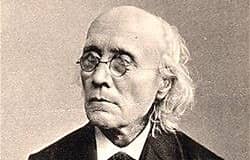
One of nineteenth-century psychology’s key founders also stood close to questions of spirit, mind and survival. A pioneer in experimental psychology, Fechner (1801–87) joined investigations of mediums, argued that consciousness permeates nature, and developed a theory of immortality that connected psychophysics, religious thought and psychical inquiry.
- Fechner helped found experimental psychology while also maintaining that the earth and cosmos are alive and psychical.
- His surviving comments on Madame Ruf and Henry Slade show a willingness to investigate controversial phenomena rather than dismiss them a priori.
- Fechner’s writings on immortality portray death not as extinction but as entry into a wider sphere of life.
Life and Career
A pioneer in experimental psychology (along with Wilhelm Wundt and Hermann von Helmholtz), Gustav Theodor Fechner (1801–87) participated in experiments with psychics in Germany and proposed an influential theory of immortality.
Fechner was born into a family of pastors on 19 April 1801 in the village of Groß Särchen, in what is now Germany. He was educated first at Sorau (now Żary, western Poland). In 1817 he studied medicine for a single semester at the Medizinische Akademie Carl Gustav Carus in Dresden, then transferred to the University of Leipzig, where he received his PhD in 1823.
Fechner never practised as a medic, although beginning in 1824 (permanently after 1834) he lectured on medical subjects, gave private lessons, and did a large amount of literary hack work (editing and translating dictionaries and encyclopedias) to support himself. Becoming interested in physics and physiology, he attended the lectures of Ernst Heinrich Weber and the mathematician Karl Mollweide.1This section is based mainly on Beiser (2024); Heidelberger (2004), Part I and Appendix; and Boring (1950), 278-79.
During the 1830s, Fechner became interested in the psychology of sense and colour perception. He made experiments tending to elucidate the connection between the objective phenomenon of light and its subjective perception. In 1833, he married Clara Maria Volkmann and in 1834, he was appointed professor of physics at Leipzig.
By 1839, Fechner’s experiments on colours and light had caused serious injury to his eyesight, leading him to abandon both teaching and investigation. In consequence, he suffered a severe mental breakdown that lasted until October 1843. His condition was so brutal that many thought it would lead him to madness and finally to death.
Fechner lost his physics chair in Leipzig to Wilhelm Weber, although he kept the title of professor and was awarded a pension by the university. Still, he survived and continued to work, write, and publish research reports and books for more than another four decades. Fechner was the first to consider his recovery ‘a miracle’. His experiences at this time and recovery were of supreme importance for the development of his later philosophical thinking about God, Christianity, and life after death.
Between 1841 and 1884, Fechner was made a member of several scientific academies in Germany, Austria, and Italy, and an honorary citizen of Leipzig. In 1873, after he was relieved of his lecture duties at the University of Leipzig, he became supernumerary professor and professor emeritus. He died in Leipzig on 18 November 1887.
Later Thinking and Activities
Panpsychism and the Soul of the Universe
As a medical student, Fechner learned to see nature mechanically, but during the 1820s his lectures on Naturphilosophie, notably Schelling and Oken, made him conceive nature as an organic whole. He gave much thought to the question of what would be the proper methodology for such philosophical inquiries. Inspired by JB Biot and other French scientists, he came to believe that the most important tools here were observation and experimentation. From such studies he developed his ideal of a unified worldview and an organic concept of nature. However, he eventually became disenchanted with such general philosophical positions and came to be more devoted to the exact, positivistic sciences.2Beiser (2024).
But the influence never faded completely. In fact, it permeated the sort of mystical revival which he experienced after his nervous breakdown. It was then that he elaborated his personal doctrine of panpsychism, which may be summed up like this: humans, the earth, and the universe are alive, have consciousness, and are psychic.
Fechner’s first systematic exposition of panpsychism was Nanna (1848), where he argued that plants are conscious and have feeling and volition. Next, in his opus magnus Zend-Avesta (1851) he contended that all components of the cosmos are psychic. His final exposition was published as Die Tagesansicht gegenüber der Nachtansicht (1879).3Beiser (2024).
Fechner’s panpsychism arose mainly from mystical experience, but its rationale was far from mystical. Indeed, it was based upon the results of the natural sciences. He never claimed total certainty for it, but declared (especially in Zend-Avesta) that, given the best findings of empirical research, it was rather plausible.
This view differs from Naturphilosophie fundamentally in the sense that it goes from the particulars of experience to the universal — the main reason it was so appealing to William James, one of Fechner’s greatest admirers outside Europe.4James (1920), Lecture IV. To prove that the cosmos must have a soul, he proceeded by analogical considerations. Earth was similar to the human body in many respects, and the exception of the nervous system only indicated that Earth’s soul was not animal or human. But it was even more likely that the earth, and not plants, has a soul, since we have souls and are part of the earth, and a soul can arise only from another soul, not from matter. And since Earth is part of the cosmos, it is reasonable to infer that the cosmos has a soul.5Beiser (2024); Woodward (1972), 367-69; Woodward (2018), 8.
Immortality
Fechner’s understanding of immortality derives fundamentally from his panpsychism. His principal writings on this subject can be found in the third part of Zend-Avesta. According to the ‘Daylight view’, the universe is a theocratic system. The human spirit is the offspring of God’s. ‘Our present existence’, he writes, ‘is itself only a part of our whole existence [i.e. of everything that lives] as it is comprised in God’ and seeks its continuation in Him.6Lowrie (1946), 247. For,
If … the earth, and in a wider sense the whole world round about us, is alive, then we are now already participants of its life without being resolved into it or being lost in it, and so death appears at once only as an eruption out of a lower and narrower into a higher and broader life-sphere of the spirit-body whose members we already are, and our narrow and lowly life here and now is itself only the seed of the higher and broader life hereafter.7Lowrie (1946), 251-52.
Besides,
No man’s life is without consequences that remain always and eternally. Everything in the world that was changed because he was there, and would not be so if he had not been there, is a part of these consequences, and their whole wide circle remains, for each human being, quite as closely linked together as was the narrow circle of life at the beginning.8Fechner (1943), 103.
Involvement in Psychical Research
In 1867, in Leipzig, Fechner participated in a series of experiments which Baron Karl von Reichenbach conducted with a sensitive known as Madame Ruf. The project had to do basically with the sensitive’s influence on a magnetic needle and was connected to Reichenbach’s researches into what he called the ‘Od’ universal force. The tests took place from 4 to 14 July 1867.9According to JCF Zöllner, Fechner had asked his colleagues at the University of Leipzig to obtain a commission to examine the same phenomenon, but failed. Zöllner (1880), 24.
Here are some excerpts of Fechner’s registers:
A common box-compass, with a needle some inches long, under glass, was placed on the table. [Reichenbach] caused [Ruf] to move a finger to and fro before one of the poles (not over the glass, but in front of the case), and thereby the needle began to oscillate, as if an iron or magnetic rod had been similarly passed before the same pole. These oscillations were not inconsiderable, and the experiment succeeded with each repetition, even when Reichenbach was in other parts of the room, and also when the finger alternately approached and removed from the pole. Trying the experiment in like manner, myself, the needle remained quite motionless.10Zöllner (1880), 25.
Fechner searched Madame Ruf to see if she was hiding any piece of iron or needles under her skin but found nothing. Nine days later more experiments were made, and their success left Fechner ‘in suspense’ and unable to find any means of deception. He was even satisfied that the woman could not have concealed any magnets under her clothes. He also took note every time of Reichenbach’s movements to make sure that he could not make any attempt at deception. In a word, he attended closely to all the possible strategies available at the time to prevent fraud. In the end, he wrote (as translated by CC Massey):
Even should the intention to deceive be presupposed either in [Reichenbach] or [M. Ruf], I am absolutely at a loss how such deception could have held out against the … conditions of the experiments… Could the experiments have been continued, doubtless yet other means of control would have been instituted; but at least, for my own part, I confess myself convinced already by that which I have been able to communicate hereupon.11Zöllner (1880), 30.
The aforementioned experiments impressed Zöllner so much that, according to his own confession, in 1877 he tried to reproduce them with the famous American medium Henry Slade.12Zöllner (1880), 32. Fechner was also involved in these experiments, but in a rather passive way, especially because of his poor eyesight. Wilhelm Wundt published severe criticisms of the Slade case, and Fechner in turn reproached him, through personal communications, for relying on hearsay and polemics instead of attempting scientific investigation. A recent examination of this intellectual exchange can be found in the Psi Encyclopedia entry on Wundt.13See Wilhelm Wundt.
In 1887, George Fullerton, a member of the Seybert Commission appointed by the University of Pennsylvania, interviewed Fechner in relation to the Zöllner-Slade sittings. The two most important statements of Fechner were (1) that Zöllner had not been mentally ill at the time, but only emotionally deranged; and (2) that he accepted Slade’s facts as an objective reality, ‘but not on the strength of his own observations, for these were unsatisfactory’ — in those days his eyesight was bad with a cataract — ‘but because he had faith in professor Zoellner [sic]’s powers of observation’.14Pepper et al. (1887), 106. Later on he wrote to Dr Hübbe-Schleiden, saying that Zöllner’s tests were all the more reliable since Wilhelm Weber and Wilhelm Scheibner aided with the controls.15Hübbe-Schleiden (1887); Heidelberger (2004), 68.
Books
Fechner wrote several pamphlets, journal articles, and books related to Naturphilosophie, the psychology of perception, panpsychism, ‘psychophysics’, and life after death.
Praemissae ad Theoriam Organismi Generalem [Preliminary Remarks on the General Theory of Organism] (1823, his PhD dissertation).
Nanna oder Über das Seelenleben der Pflanzen [Nanna or About the Soul Life of Plants] (1848). [Projekt Gutenberg. Full text.]
Zend-Avesta oder über die Dinge des Himmels und des Jenseits [Zend-Avesta or About the Things of Heaven and the Afterlife] (1851). [Internet Archive. Download PDF.]
Uber die Seelenfrage [About the Soul Question] (1861). [Internet Archive. Download PDF.]
Die drei Motive und Gründe des Glaubens [The Three Motives and Reasons for Faith] (1863). [Internet Archive. Download PDF.]
Die Tagesansicht gegenüber der Nachtansicht [The Day View Compared to the Night View] (1879). [Internet Archive. Download PDF.]
Elemente der Psychophysik [Elements of Psychophysics] (1860). [Internet Archive. Download PDF.]
Roberto R Narváez
Works Cited
Beisner, F.C. (2024). Gustav Theodor Fechner. The Stanford Encyclopedia of Philosophy (Summer 2024 ed.). [Web page. Full text.]
Boring, E.G. (1950). A History of Experimental Psychology. New York: Appleton-Century-Crofts.
Fechner, G.T. (1943). Life after Death. Prefatory note by John Erskine. Introduction by William James. New York: Pantheon Books.
Heidelberger, M. (2004). Nature from Within: Gustav Theodor Fechner and His Psychophysical Worldview. Pittsburgh, Pennsylvania, USA: University of Pittsburgh Press.
Hübbe-Schleiden, W. (1887). On the sanity of professor Zöllner. Light 7, 359.
James, W. (1920). A Pluralistic Universe. New York: Longmans, Green.
Lowrie, W. (ed.) (1946). Religion of a Scientist: Selections from Gustav Fechner. New York: Pantheon Books.
Pepper, W., Leidy, J., Koenig, G.A., Fullerton, G.S., Thompson, R.E., Furness, H.H., Sellers, C., White, J.W., Knerr, C.B., & Mitchell, S.W. (1887). Preliminary Report of the Commission Appointed by the University of Pennsylvania to Investigate Modern Spiritualism in Accordance with the Request of the Late Henry Seybert. Philadelphia, Pennsylvania, USA: J.B. Lippincott Company. [Project Gutenberg. Full text.]
Woodward, W.R. (2018). Fechner (1801–1887) in and for psychology: Part I. Archives of Psychology 2/5, 1-21. [Web page. Abstract.]
Woodward, W.R. (1972). Fechner’s panpsychism: A scientific solution to the mind-body problem. Journal of the History of the Behavioral Sciences 8, 367-86. [Web page. Download PDF.]
Zöllner, J.C.F. (1880). Transcendental Physics: An Account of Experimental Investigations, from the Scientific Treatises. London: W.H. Harrison. [Internet Archive. Download PDF.]