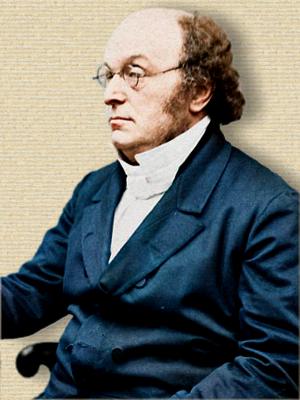
Augustus De Morgan (1806–71), a British mathematician, logician and polymath, became deeply interested in mesmerism and spiritualism. Personal experiments and séances convinced him that some reported phenomena were genuine, but he remained agnostic about their cause and urged careful, historically informed enquiry.
- De Morgan’s experiences persuaded him some phenomena were real.
- Séances with Maria Hayden tested spirit agency versus thought-reading.
- He remained agnostic about the ultimate cause.
Life and Career
A classic example of the English nineteenth century savant and polymath, Augustus De Morgan was born in Madurai, southern India, on 27 June 1806, into a British family of descendants of Huguenot refugees. His father, Colonel John De Morgan, held several military staff appointments in India. Colonel De Morgan made his final visit to that country in 1816. An illness forced him to return to England, but he died at sea on the way. Because of his Evangelical views and practices, his fellow officers knew him by the nickname ‘Bible John’, and in an obituary he was described as the ‘friend of Christianity in India’. This epithet would prove to be unexpectedly relevant four decades later during a séance Augustus attended, as we shall see.1Attar, Rice, & Stray (2024), xiii-xiv.; Stirling (1922), 24.
Colonel De Morgan settled with his family first at Worcester, later in Devonshire, and finally at Somersetshire. Around 1810, they moved to Bideford, where Augustus was privately educated by his own father. In 1812, the family moved again to Barnstaple. In the early 1820s, Augustus attended a boarding school in Redland, near Bristol. At that time, he was introduced to mathematics.
In February 1823, Augustus entered Trinity College, Cambridge, where he was deeply influenced by his teachers George Peacock (algebra) and George Airy (astronomy). He was a compulsive reader in a variety of subjects, from philosophy and theology to literature and history. Perhaps his lifelong interest in the history of science and logic was inspired by Peacock and William Whewell. In any case, these men strengthened his love for mathematical studies.2Attar, Rice, & Stray (2024), xv-xvii.
While at university, Augustus renounced the evangelical creed and became a nonconformist, although he was never an atheist. This attitude, however, determined his departure from Cambridge, because at the time it was mandatory to swear allegiance to the Church of England. He became the first mathematics professor (appointed on 23 February 1828) in the newly established London University (today, University College, London). Not before long he resigned, again exasperated by certain issue of the academic regulations, but returned in 1836 and kept his post for another thirty years.
Augustus was highly esteemed as a professor and admired by many (famously Charles S Peirce) for his contributions to formal logic and the logic of relations.3Attar, Rice, & Stray (2024), xviii-xxvi; Halsted (1897), 2. He published a number of textbooks on mathematics and thousands of reviews, short articles, surveys, and encyclopaedia entries. His writings abound with parodical anecdotes, jokes, puns, and conundrums, most of his own creation.
Augustus’s best-remembered work is the posthumous A Budget of Paradoxes (1877), a collection of reviews originally published in The Athenaeum. It is a monument of erudition about a vast range of topics, but fundamentally mathematics and astronomy. He was also a skilled bibliographer and book collector.
On 3 August 1837, Augustus married Sophia Elizabeth Frend, who would later become his first biographer. As described below, the de Morgans were among the first people in Great Britain to take an interest in Spiritualism, then recently imported from America. Augustus engaged in research with mediums, decades before the inception of the Society for Psychical Research in 1882.4On this subject, see here.
Augustus was deeply affected by the deaths of two of his children. After his retirement from London College, he suffered a stroke from which he never recovered. He died of kidney failure on 18 March 1871 and was buried at Kensal Green Cemetery in London.5Attar, Rice, & Stray (2024), xx-xxiv.
Experiments in Mesmerism and Spiritualism
Beginnings
Augustus’s views on psychical research developed as he witnessed, or heard about, his wife’s experiments on mesmerism during the 1840s and 1850s. One time, for instance, Sophia De Morgan mesmerized a young girl in a healing attempt, and the patient became, apparently, a clairvoyant (whilst in a sort of trance) who could ‘travel mentally’ and perform other feats. On one occasion, she described very accurately to Sophia the house where Augustus was with a friend. He was amazed and refused to explain away the prowess as a product of coincidence.6Stirling (1922), 108; S.E. De Morgan (1863), 47-49.
Years later, the De Morgans had a young servant girl whose mediumistic powers made her the object of several experiments. One day their son William (who would later become a famous potter and novelist) begged the ‘spirits’ to ‘transfer the rapping from the table at which they were seated to a cupboard on the other side of the room’. And he was apparently heard, for all the subsequent raps came from that cupboard.7Attar, Rice, & Stray (2024), 231ss; Stirling (1922), 108.
Regarding all these events, Augustus wrote in a letter to William Heald:
I have seen a good deal of mesmerism, and have tried it myself … for the removal of ailments which required much medicine, but which mesmerism met without medicine from the time it was employed. Of the curative powers of this agent, I have no more doubt than one has of things which he has constantly seen for years … I had frequently heard of … clairvoyance, and had been assured of the occurrence of it in my own house, but always considered it as a thing of which I had no evidence direct or personal, and which I could not admit till such evidence came.8S.E. De Morgan (1882), 206.
Sittings with Maria Hayden
In 1853, the De Morgans became acquainted with the American medium Maria Hayden, who was responsible for introducing Spiritualism to Britain.9Carmack (2020). At the time, the death of the Morgans’ daughter, Alice, had increased Sophia’s interest in Spiritualism, which she regarded as a science. It appears that, through Hayden, Sophia’s father and her sister, Harriet, communicated from the beyond. From then on, Sophia came to believe that Alice lived happily in a world of spirits, surrounded by Cupid, God, and Christ, among other highly revered characters.10Attar, Rice, & Stray (2024), 233-34; S.E. De Morgan (1863), xli ss.
Two important séances with Hayden are recorded. In both cases, Augustus tried to determine whether the events were produced by a discarnate agency or by the medium’s ‘thought-reading’ ability. On the first occasion, he insisted on asking mentally a question whose answer, as only he should know, was monosyllabic. Then he began to point to letters in a printed alphabet, and a loud rap was heard each time he hit on a right letter. Augustus had taken precautions to keep Hayden from seeing his face and the printed alphabet before him. For this reason, he ruled out the possibility of some elaborate trick and favoured the mind-reading hypothesis.11S.E. De Morgan (1863), xlii-xliii.
In another sitting, it was announced that the spirit of Colonel De Morgan was present. Augustus planned a test to corroborate that identification. Although Sophia described this experiment,12S.E. De Morgan (1863), xliii-xliv., the following is drawn from the version of Anna M Stirling.
Augustus’s first task was to select a piece of information which only father and son could know; it was the phrase alluded to in the first section above:
… ‘the friend of Christianity in India.’ Augustus … asked the supposed spirit whether he could remember a certain review published soon after Colonel De Morgan’s death, and could give the initials of a title in five words … The medium and the rest of the company … were seated at the table while [De Morgan] sat apart, where they could not see him, holding a pencil with which he pointed to each letter of the alphabet … With the words of the required phrase in his mind, he fully expected a rap to be given by the table when he arrived at the letter F. But his pencil passed the crucial letter, and by the time he came to K he had decided that the test was a failure. Someone present … [then] called out, ‘You have passed it; I heard a rap long ago.’ [De Morgan] began again; and distinct raps came first at C and then at D. He was then more [convinced of the failure] … Suddenly, however, it flashed across him that the raps had indicated correctly the letters which were the commencement of the sentence that contained the title. ‘I see what you are at,’ he remarked gravely, ‘pray go on.’ The raps then proceeded, and in turn again emphasized clearly the following letters: ‘C.D.M.T.F.O.C.I.I.’ [i.e., Colonel De Morgan The Friend…]. 13Stirling (1922), 35-36.
Sophia described these experiments with Hayden and other mediums in From Matter to Spirit,14S.E. De Morgan (1863). which she initially signed as ‘C.D.’. Augustus authored the Preface under the pseudonym ‘A.B.’. There he wrote:
I am satisfied, by the evidence of my own senses, of some of the facts narrated: of some others I have evidence as good as testimony can give. I am perfectly convinced that I have both seen, and heard in a manner which should make unbelief impossible, things called spiritual which cannot be taken by a rational being to be capable of explanation by imposture, coincidence, or mistake … But when it comes to what is the cause of these phenomena … I cannot adopt any explanation which has yet been suggested.15S.E. De Morgan (1863), v.
The Spirit Hypothesis
Augustus argues that the ‘spiritual hypothesis’ should be sufficient, if it were not ‘ponderously difficult’. He reckoned that modern Spiritualism represented an ‘epidemy’ which ‘seem[s] to be made for the advancement both of truth and of falsehood’. It demanded a universal recognition of phenomena ‘which historical inquiry shows never to have been entirely unknown’. By such phenomena Augustus meant certain appearances ‘which are to be finally knit on either to some truth or to some delusion’.16S.E. De Morgan (1863), v-vi, x. Cf. Noakes (2019), 137-38.
Regarding the question of evidence in similar matters, he reflected:
Let [it] be what it may, it is an error to suppose it ought to produce the same effect on different persons. It is nonsense to say, ‘Strip your mind of all bias, and make it equally ready for all impressions: you might as well tell a wrongly bent twig to … put itself straight, that you may then give it another bend in the proper way’. It is evidence which must both unbend and bend: it is not in the power of anyone to alter his state by will. A person ‘who finds another easier to convince than himself calls the other credulous; but when the other is the harder, the first calls him unreasonable…’17S.E. De Morgan (1863), xvi-xvii.
The historical point of view (regarding the physical sciences, philosophy and theology) had to be central in the debate about such research. The spiritualists followed the same track that had led others to improve physical science, because ‘they have the spirit and the method of the grand time when those paths were cut through the uncleared forest in which it is now the daily routine to walk’. That spirit was ‘of universal examination, wholly unchecked by fear of being detected in the investigation of nonsense’.18S.E. De Morgan (1863), xviii-xx. He added:
The spiritualists … may be divided into those who believe that the communications are spiritual, those who do not see what else they can be, and those who do not see what they can be. All who inquire further … will, if they shape their inquiries upon the spiritual hypothesis, be sound imitators of those who led the way in physical science, in the old time.19S.E. De Morgan (1863), xxv-xxvi.
In this connection, it is interesting to understand the technical and historical rigour with which Augustus defined a paradox: ‘something which is apart from general opinion, either in subject-matter, method, or conclusion’, and what he called a paradoxer: someone whose attitude ‘as to sense or nonsense, will not depend upon what he maintains, but upon whether he has or has not made a sufficient knowledge of what has been done by others, especially as to the mode of doing it, a preliminary to inventing knowledge for himself.’20A. De Morgan (1954), 4; italics in original.
In A Budget of Paradoxes, Augustus speaks of Spiritualism as ‘the great paradox of our day’,21A. De Morgan (1954), 54. examined briefly two books on Spiritualism, and included a long consideration of reviews of Sophia’s From Matter to Spirit. He stated his assurance ‘of many of the facts of spiritualism‘ but admitted that he could not ‘pretend to affirm or deny anything about their cause’. He recommended the ‘spirit hypothesis’ to give a direction to inquiry but did not rest the evidence of spiritualism ‘upon the occurrence of certain facts proving the possibility of those very facts’. He added, quite significantly: ‘Every person who knows anything of the progress of physics understands what is meant…’.22A. De Morgan (1954), 196-98; italics in original.
Sophia De Morgan was a keen believer in the spirit hypothesis, although Augustus never thought of it as more than a theoretical possibility. This, Augustus concluded, the critics had failed to see.23A. De Morgan (1954), 198, 202-3.
Archival Resources
A few reviews related to the supernatural and psychic research which Augustus published in The Athenaeum (some of them anonymously) but not collected in A Budget of Paradoxes24A. De Morgan (1954). are listed in this catalogue. Most of the corresponding issues of the journal (1830–1920) can be accessed here. For a full, detailed description of several archives and bibliographies pertaining to De Morgan’s legacy, see Augustus De Morgan, Polymath: New Perspectives on his Life and Legacy.25Attar, Rice, & Stray (2024), sec. 11.
Roberto R Narváez
Works Cited
Attar, K., Rice, A., & Stray, C. (eds.) (2024). Augustus De Morgan, Polymath: New Perspectives on His Life and Legacy. [Full text.] Cambridge, UK: Open Book Publishers.
De Morgan, A. (1877). A Budget of Paradoxes. [Full text.] London: Longmans, Green.
De Morgan, A. (1954). A Budget of Paradoxes (2nd ed., ed. by D.E. Smith; unabridged republication of the 1915 second edition, two volumes bound as one.) New York: Dover Publications.
De Morgan, S.E. [C.D.] (1863). From Matter to Spirit: The Result of Ten Years’ Experience in Spirit Manifestations. Intended as a Guide to Enquirers. [Full text.] London: Longman, Green, Longman, Roberts, & Green.
De Morgan, S.E. (1882). Memoir of Augustus De Morgan, with Selections from His Letters. [Full text.] London: Longmans, Green, and Co.
Halsted, G.B. (1897). Biography: De Morgan. The American Mathematical Monthly 4/1, 1-5.
Noakes, R. (2019). Physics and Psychics: The Occult and the Sciences in Modern Britain. Cambridge, UK: Cambridge University Press.
Stirling, A.M.W. (1922). William De Morgan and His Wife. [Full text.] London: Thornton Butterworth Ltd.