Robert A McConnell (1914–2006) was an American physicist who became a prominent experimental parapsychologist. He investigated psychokinesis and ESP, served as the first president of the Parapsychological Association, and devoted much of his career to promoting rigorous psi research and challenging its rejection by mainstream science.
- Trained as a physicist, McConnell applied ideas from physics and wartime radar research to questions about weak psi effects, causation and experimental method.
- His research included large-scale dice psychokinesis experiments, studies of placement PK and work with Gertrude Schmeidler on the influential sheep-goat effect in ESP.
- As the Parapsychological Association’s first president, McConnell promoted parapsychology through teaching materials, books and extensive outreach to scientists and libraries worldwide.
Life and Career
Robert A McConnell (1914–2006) was an American physicist who turned to parapsychology early in his career and went on to devote full time to it.
McConnell was born on 6 April 1914 in a small town near Pittsburgh, Pennsylvania. In 1935, he obtained a Bachelor of Science in Physics from what is now Carnegie Mellon University (when McConnell attended, it was the Carnegie Institute of Technology). After completing his undergraduate degree, he began working at the Philadelphia Navy Yard but left that job near the start of World War II. He then secured a position at the Massachusetts Institute of Technology (MIT) in Cambridge, the sister city to Boston. He worked in the radiation laboratory there during the war, helping to improve doppler and radar technologies. After the war, he resumed his studies at the University of Pittsburgh, from which he received a PhD in Physics in 1947, when he was 33.1R.E. Berger (2007).
McConnell became acquainted with parapsychology in the early 1930s, having heard about the ESP card-guessing experiments conducted by JB Rhine at Duke University, but it was not until 1943, when he read a Time magazine article about Rhine’s dice-throwing psychokinesis (PK) tests, that his interest in the field solidified.
Realizing the implications of PK for physics, McConnell went to the Widener Library at Harvard University and read all he could find about Rhine’s research. He ‘soon discovered that, even though at that time I did not know much about statistics, the critics of Dr. Rhine knew even less.’2McConnell (1987), 6. In the Widener Library, he discovered sixty years of the Proceedings of the Society for Psychical Research. From this reading, McConnell became convinced that psychic phenomena occurred, even though their mechanism was not yet understood. He resolved to take up psi research himself after obtaining his doctorate.3McConnell (1987); R.E. Berger (2007).
Upon completing his PhD in 1947, McConnell stayed at the University of Pittsburgh as assistant professor of physics until 1953, when he was denied tenure and moved to the new department of biophysics. He was assistant research professor there from 1953 to 1959 and associate research professor after 1959.4McConnell (1987), 8; Pleasants (1964), 201. He retired from the University of Pittsburgh as Research Professor Emeritus of Biological Sciences in 1984.5A.S. Berger & J. Berger (1991), 259.
In addition to contributing to research on both PK and ESP, McConnell was concerned with professional development in parapsychology and the promotion of parapsychology in the wider scientific community. He self-published several books which he distributed free of charge to individuals and institutions.
McConnell served as the first President of the professional Parapsychological Association when it was organized in 1957. He died on 31 July 2006 at the age of 92.6R.E. Berger (2007).
Psi Research
Theoretical Orientation
McConnell was inspired to apply his physics training and the work he had done at MIT with radar and signal fluctuations (many of which could be weak) to the study of extrasensory perception (ESP). He wondered if ESP might manifest weakly by its nature. If so, how should scientists adjust their methods to reflect this characteristic of the phenomenon?7R.E. Berger (2007).
In his first publication in Rhine’s Journal of Parapsychology, in 1947, McConnell discussed whether PK was physical or non-physical. Central to the issue was the nature of causation. He concluded:
When human thought is involved, it becomes possible to recognize correlations without regard to space and time and to recognize causation which violates causal sequence. What is more important, such correlation and causation have been experimentally shown to exist. To label these newly discovered activities as non-physical seems legitimate, but to call them psycho-physical would be more appropriate. Their failure to exist in physics is a necessary consequence of the form of physics and not a cause for surprise.8McConnell (1947), 117.
What Rhine and his colleagues started at the Parapsychology Laboratory at Duke, McConnell continued to advocate for and refine, arguing that adherence to scientific methods eventually would bring about a breakthrough in acceptance.9McConnell (1947). He discussed how physics principles can help explain PK in a 1957 article, ‘Psi Phenomena and Methodology,’ that appeared in American Scientist:
[T]he reciprocity theorems that are common in physics suggest that there may be an inverse kind of ESP. If we can have brain-to-brain and object-to-brain relationships, why not a brain-to-object effect? If there is a wish in the brain, might there not be some direct physical influence upon the object of the wish? Such an effect would be called ‘psychokinesis’ and has been looked for experimentally by analyzing the behavior of ordinary gaming dice.10McConnell (1957), 125.
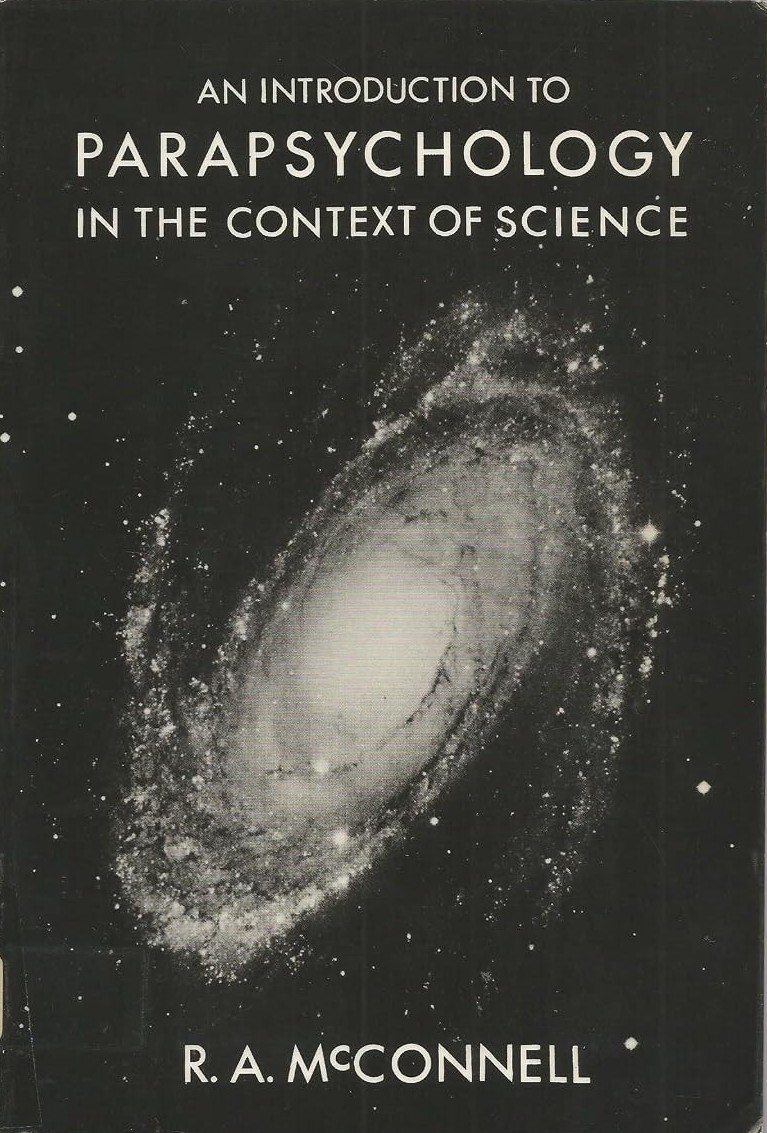
McConnell stated his position on psi clearly in his 1983 book An Introduction to Parapsychology in the Context of Science. There he tells us:
Sensorimotor interaction mechanisms have been studied in biology, psychology, and physics, and are well known in principle. … Signals into and out of the brain itself … are sent solely by electrical impulses. … It is commonly believed by scientists that there are no other modes of interaction between living organisms and their environment. The opposite opinion is held by a majority of nonscientists. I believe this is one of those rare cases where prevailing lay opinion is right and dominant scientific belief is wrong.11McConnell (1983a), 3.
Psychokinesis
For a nearly twenty-year stretch, from 1947 to 1966, McConnell conducted psychokinesis experiments at the University of Pittsburgh. Many of these studies involved throwing dice, and McConnell created his own mechanical devices for these tests in an attempt to reduce human bias and error.12McConnell (1957); R.E. Berger (2007).
One series of experiments led to an article called ‘Wishing with Dice’ McConnell co-authored and published in the Journal of Experimental Psychology in 1955.13McConnell, Snowdon, & Powell (1955). McConnell and his colleagues recruited 393 previously untested college students who together ‘threw’ about 170,000 dice while attempting to will a certain face to appear uppermost. Although the overall score was not statistically significant, there was a significant effect in the decline of scoring over time, consistent with what had been observed in other psi tests, with both PK and ESP. This effect was disputed by LG Humphreys14Humphreys (1956). on statistical grounds, which McConnell in his response15McConnell (1958). argued derived from confusion about the appropriate analysis to be employed. He had used techniques that had been used in previous studies demonstrating the decline effect in psi performance.
McConnell took a keen interest in fellow physicist Haakon Forwald’s studies of placement PK with dice in Sweden and helped him attempt to replicate his experiment at Rhine’s lab in the United States.16McConnell & Forwald (1967, 1968).
Extrasensory Perception
Although McConnell was most interested in PK due to its challenge to accepted physical laws, he appreciated the psychological dimension of psi functioning and contributed to the study of ESP as well. He assisted Getrude Schmeidler in examining the scoring differences between test participants who believed in the possibility of ESP (sheep) versus those who were sceptical of it (goats). Schmeidler and McConnell showed that sheep scored significantly on ESP tests, whereas goats scored at chance (the sheep-goat effect).17Schmeidler & McConnell (1958).
Promotion of Parapsychology
From the inception of his experimental research in 1947, McConnell was a strong advocate for parapsychology, seeking to inform the wider academic community of what had been accomplished.
From personal experience, he understood the nature and extent of scientists’ opposition to psi and wanted to reverse this by making the methods and results of the research better known. In a late work, he explained:
From the beginning of my experimental research in 1947, I spent a substantial part of my time in writing to scientists and journal editors, seeking support for the field and for my research. In the beginning, I still naively believed that scientists were what they claimed to be: open minded and always searching for truth. I was confident that they had merely overlooked the journal evidence for psi phenomena and that they would be pleased when it was properly brought to their attention. It was not until I had completed a major experiment and spent four years trying unsuccessfully to get it published in a journal of physics (before finding a sympathetic editor in the Journal of Experimental Psychology) that I realized that, with rare exceptions and except within their chosen specialty, scientists are like the rest of humanity. For peace of mind they believe what they want with little regard for evidence. Except within their own fields, reality is of little concern to them.18McConnell (2000), 7-8.
In 1971, McConnell presented an ESP Curriculum Guide for secondary school teachers wishing to incorporate parapsychology into their psychology or biology lessons. He identified what he saw as the four main educational challenges posed by ESP: ‘in the use of the scientific method, in the nature of scientific controversy, in the unknown psychological conditions necessary for the production of ESP, and in its philosophic implications’.19McConnell (1971), 9.
McConnell’s 1983 An Introduction to Parapsychology in the Context of Science20McConnell (1983a). was designed for students and teachers of science and the humanities. Among other topics, it covered the history of parapsychology in Britian and America, reviewed some of the stronger experiments suggesting psi, and sought to connect parapsychology to psychology more generally. In that book, McConnell wrote:
The scientific mystery of psi phenomena lies, not in their occurrence—they are commonplace throughout history—but in their a priori rejection by Western science. Thus, my course was set a quarter century ago: not merely to try to add to the already overwhelming evidence for psi phenomena but also to attempt to understand and to affect the belief processes of scientists. Understanding, I now feel that I have gathered in good measure. That I have affected the beliefs of many scientists seems doubtful.21McConnell (1983a), 53.
By the time he wrote this, McConnell was self-publishing his works, having met resistance from established venues. His 1982 Encounters with Parapsychology, a compilation of excerpts from the writings of researchers from William James to Robert Jahn, carries on its title page the statement that it was being self-published through the Biological Sciences Department of the University of Pittsburgh ‘regretfully, after rejection by 29 trade publishers and 32 university presses’.22McConnell (1982).
Upon its publication, McConnell offered Encounters with Parapsychology gratis to individuals and libraries around the world. He followed this with An Introduction to Parapsychology in the Context of Science and Parapsychology and Self-Deception in Science.23McConnell (1983a, 1983b). Encounters with Parapsychology was meant to ‘dispel the aura of incompetence, credulity, and fraud that parapsychology has acquired by being mis-associated with the occult’.24McConnell (1984). The other two books presented research reports and dealt with the rejection of psi by other scientists. By the time he reported on this effort in 1984, McConnell had sent out 4,800 copies of these three books to scientists and teaching libraries in sixty countries.25McConnell (1984). By 1990, he had gifted 17,800 copies of his books to scholars and libraries around the world.26R.E. Berger (2007).
Throughout his outreach efforts, McConnel tried to separate psi research from the popular conception of parapsychology, a problem he met head-on in Far Out in the New Age: The Subversion of Science by Cultural Communism,27McConnell (1995). which dealt with what he perceived as the populist take-over of the American Society for Psychical Research.
Publications
Several of McConnell’s books and some of his journal articles are listed under Works Cited, below. For a comprehensive list of his publications, see Bibliography of Works by Robert A. McConnell.
Archival Resources
See here for a finding aid to a collection of materials, spanning the years 1944–2000, that McConnell deposited in the Duke University Library. The 47.5-linear-foot collection comprises data and records from numerous psi experiments, extensive correspondence files, and copies of his journal publications.
Courtney M Block
Works Cited
Berger, A.S., & Berger, J. (1991). McConnell, Robert A., 1914–. In The Encyclopedia of Parapsychology and Psychical Research, 259. New York: Paragon House.
Berger, R.E. (2007). Robert A. McConnell: 1914–2006. [Full text.] Journal of Parapsychology 71, 172-76.
Humphreys, L.G. (1956). Note on “Wishing with dice.” Journal of Experimental Psychology 51, 290-92.
McConnell, R.A. (1947). Physical or non-physical? Journal of Parapsychology 11/2, 111-17.
McConnell, R.A. (1957). Psi phenomena and methodology. American Scientist 45/2, 125-36.
McConnell, R.A. (1958). Further comment on “Wishing with dice.” Journal of Parapsychology 22/3, 210-16.
McConnell, R.A. (1971). ESP Curriculum Guide: A Scientist Examines the Reality of Extrasensory Perception. New York: Simon & Schuster.
McConnell, R.A. (ed.) (1982). Encounters with Parapsychology. Pittsburgh, Pennsylvania, USA: Biological Sciences Department, University of Pittsburgh.
McConnell, R.A. (ed.) (1983a). An Introduction to Parapsychology in the Context of Science. Pittsburgh, Pennsylvania, USA: Biological Sciences Department, University of Pittsburgh.
McConnell, R.A. (ed.) (1983b). Parapsychology and Self-Deception in Science. Pittsburgh, Pennsylvania, USA: Biological Sciences Department, University of Pittsburgh.
McConnell, R.A. (1984). An educational effort in parapsychology. Journal of the American Society for Psychical Research 78/4, 341-54.
McConnell, R.A. (1987). Escape from boredom: An autobiographical account. In Parapsychology in Retrospect: My Search for the Unicorn, 2-10. Pittsburgh, Pennsylvania, USA: Biological Sciences Department, University of Pittsburgh.
McConnell, R.A. (1995). Far Out in the New Age: The Subversion of Science by Cultural Communism. Pittsburgh, Pennsylvania, USA: Biological Sciences Department, University of Pittsburgh.
McConnell, R.A. (2000). Joyride to Infinity: A Scientific Study of the Doomsday Literature. Pittsburgh, Pennsylvania, USA: Biological Sciences Department, University of Pittsburgh.
McConnell, R.A., & Forwald, H. (1967). Psychokinetic placement: I. A re-examination of the Forwald-Durham experiment. Journal of Parapsychology 31, 51-69.
McConnell, R.A., & Forwald, H. (1968). Psychokinetic placement: III. Cube-releasing devices. Journal of Parapsychology 32, 9-38.
McConnell, R.A., Snowdon, R.J., and Powell, K.F. (1955). Wishing with dice. Journal of Experimental Psychology 50, 269-75.
Pleasants, H. (1964). McConnell, R.A. In Biographical Dictionary of Parapsychology with Directory and Glossary, 201-2. New York: Helix Press.
Schmeidler, G.R., & McConnell, R.A. (1958). ESP and Personality Patterns. New Haven, Connecticut, USA: Yale University Press.