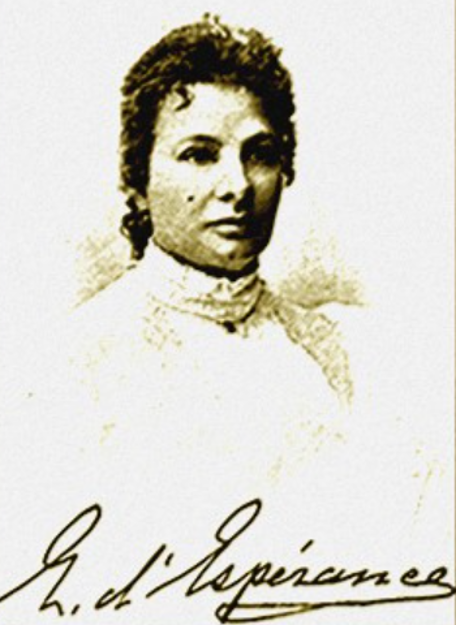
Elizabeth Jane Puttock (Madame Elizabeth d’Esperance) was a British medium famed for materialisation séances and apports. Although supported by Spiritualists and by Alexander Aksakov, her phenomena were questioned by psychical researchers at the time and more recently have been reassessed through genealogical and archival evidence.
- Puttock promoted herself under the name Madame d’Esperance and became known for séances featuring the materialised figure ‘Yolande’.
- Alexander Aksakov endorsed her mediumship, while Hereward Carrington and Frederic Myers raised serious objections.
- Recent genealogical and archival research by Adrian Parker and Elisabeth Warwood identified her as Elizabeth Jane Puttock and corrected key biographical details.
Introduction
Elizabeth Jane Puttock (1848–1919), who went by the name Madame Elizabeth d’Esperance, was a controversial physical medium whose materialisation séances attracted investigators, most notably Alexander Aksakov. One of the most celebrated mediums of her time, her alleged psychic manifestations elicited both positive and negative evaluations from the psychical research community.
Although questions were raised in her day about the genuineness of Puttock’s séance phenomena, definitive answers did not come until recent genealogical and archival research by Adrian Parker, Elisabeth Warwood and Leslie Price.1Parker & Warwood (2016); Warwood (2013); Price (2013). Parker and Warwood show that ‘Elizabeth d’Esperance’ was born as Elizabeth Jane Puttock on 20 November 1848, not 1855, as she later claimed.2Parker & Warwood (2016), 235.
Puttock married Thomas Jackson Reed on 13 August 1870 in Newcastle upon Tyne, and is sometimes referred to by her married name, Elizabeth Jane Reed or the erroneous variant, Elizabeth Hope Reed. However, the Reeds had separated by 1879, with Thomas going on to have children by another woman,3Parker & Warwood (2016), 236. so it seems inappropriate to employ ‘Reed’ in her connection. In the following, she is called Elizabeth d’Esperance, the name by which she promoted herself and by which she is most widely known.4As Parker & Warwood (2016, 235) point out, d’Esperance was spelled without the French aigu accent mark used in espérance, ‘hope’.
Life and Career
Early Life
d’Esperance gave a detailed account of her early life in her book Shadow Land (1897), but this contains a number of discrepancies with historical records5Parker & Warwood (2016), 237. and it is not clear to what extent it can be trusted. ‘Shadow Land’ refers to the ‘Shadow People’ d’Esperance claimed to see as a child. The Shadow People, which she says she did not associate with ghosts, were her earliest ‘friends’. She seemingly displayed automatic writing while still at school, when she wrote an essay on ‘Nature’ automatically overnight, after she had been very worried about homework assigned the previous day. She says she went with her seafaring father on a long cruise, during which time her ‘Shadow People’ were not in evidence, but they returned after her marriage and move to Newcastle upon Tyne.6d’Esperance (1897); Edmunds (1966); Fodor (1934).
Mediumship
According to d’Esperance, initially she was not interested in the ‘absurdities of a séance’,7Light (1919), 239. but by the early 1870s she seemed to be at the centre of psychical manifestations, such as significant table-tilting.8d’Esperance (1897), 93-102. As the phenomena began to increase in variety, encompassing ectoplasm and other physical manifestations, she styled herself ‘Madame d’Esperance’ and began travelling throughout Europe giving séances.
d’Esperance was tested in séance conditions by a ‘prominent citizen of Newcastle’,9See d’Esperance, Madame, citing Doyle (1926) and Fodor (1934). a Mr TP Barkas, who asked the apparently entranced medium questions of a technical nature about music and other subjects. He published the results, which varied in their quality,10Barkas (1885a), cited in Podmore (1902), 128-30. yet he challenged members of the Society for Psychical Research (SPR) to answer unprepared questions as ‘quickly and correctly’ as the un-educated d’Esperance was able to.11Barkas (1885b), 117.
In Newcastle in 1880, the spirit of a young Arab girl named ‘Yolande’ supposedly materialised, but when grabbed by a sitter turned out to be the medium in her undergarments.12Resurgam (1880). She evidently was not ‘in total dishabille’, as stated by Keene (1997), 65. d’Esperance described the sensation of being held as one of ‘a horrible excruciating sensation of being doubled up and squeezed together’.13d’Esperance (1897), 298. d’Esperance’s séances were also notable for the apparent materialisation of exotic plants, including an exceptionally tall golden lily and an Ixora crocuta.14d’Esperance (1897), 259-73. The compiler and publisher of the Angelic Revelations, William Oxley, spoke of ‘twenty-seven roses being produced at a séance by Yolande, the materialised figure’.15Doyle (1989), 29.
In Shadow Land, d’Esperance presented details of phenomena produced during many séances; the people in attendance; and her interpretations of the events. She included photographs of materialisations and apports. She dedicated the book to ‘Humnur Stafford’, who acted as an early spirit guide. He was described by her as the son of a German lady and American politician who was a scientist during his ‘earthly life’.16d’Esperance (1897), 137.
In her book, d’Esperance gave the following description of one of the materialisations she produced, as witnessed by an unnamed observer:
First a filmy, cloudy patch of something white is observed on the floor, in front of the cabinet. It then gradually expands, visibly extending itself as if it were an animated patch of muslin, lying fold upon fold upon the floor… Presently it begins to rise slowly in or near the centre, as if a human head were underneath it … until it attains a height of about five feet… Presently the arms rise considerably above the head and open outwards through a mass of cloud like spirit drapery, and Yolande stands before us unveiled, graceful and beautiful.17d’Esperance (1897), 254-55.
In the conclusion of Shadow Land, d’Esperance accepts that the best method for the investigation of her phenomena has yet to be found, since there is ‘so much to learn…. Even at best we but “see through a glass darkly”.’18d’Esperance (1897), 413.
Supporters and Detractors
d’Esperance had many supporters and was written about enthusiastically in the Spiritualist press.19For instance, Orthwaite (1879a, 1879b); Fidler (1880). For what appears to be a comprehensive compilation of mentions, see Holmes (1927). Arthur Conan Doyle wrote that her ‘many gifts were more undoubtedly Spiritualistic’ and that Shadow Land was one of ‘the most remarkable psychic autobiographies in our literature [displaying] the good feeling and honesty of the writer’.20Doyle (1989), 26-27.
Imperial Councillor to the Czar Alexander Nikolayevich Aksakov endorsed her mediumship in an introduction to her book and in his own book about her, reported that ‘Madam d’Esperance was kind enough, after her visit to Helsingfors in November 1893, to pass five days at my residence in St. Petersburg, during which she gave ten seances in my house, which were most satisfactory to all who took part’.21Aksakov (1898), 25.
Others were less certain. In his obituary of Aksakov, M. Petrovo-Solovovo said that he felt that ‘the case was not worth all the trouble that Mr Aksakoff took in connection with it.’22Petrovovo-Solivovo (1903). Psychical researcher Hereward Carrington, who was well versed in conjuring tricks, explained how she might have produced a partial dematerialization effect:
The upper part of the medium’s body was not always upright, as it is drawn, but is bent forward, from time to time, especially during the examination of the back of the chair by those present…[there was] ample room for the medium to slip her legs through as far as the hips, which would be all that was necessary for the successful performance of this ‘test’. 23Carrington (1907), 161.
Rebuttals of Carrington’s suggestion were published in the Journal of the American Society for Psychical Research in 1907 by James Hervey Hyslop, Max Seiling and d’Esperance herself.24Hyslop (1907); Seiling (1907); d’Esperance (1907). However, Carington was not d’Esperance’s only detractor. Frederic Myers judged her automatic writing to reveal a ‘gross want of comprehension of the subjects inquired about, and the palpable blunders which the replies contain, seem to me to preclude us from regarding the case as affording evidence of the guidance of a scientific spirit’. Furthermore, that she ‘was afterwards detected in personating a materialised spirit, tended to discourage me from seeking further evidence through that channel’.25Myers (1885).
Charles Richet equivocated in his review of physical mediumship in Thirty Years of Psychical Research, only including ‘perhaps those of Mme. d’Esperance’ as probably genuine phenomena.26Richet (1923), 542.
Final Years
Although d’Esperance resided in Sweden for two decades and spent much of her later years in Saxony and Bavaria, she made several visits back to England, where she lectured in 1903 on her personal psychic experiences. In 1907 she spoke about explorations in the field of science in relation to Spiritualistic phenomena.27Transition of Madame d’Esperance (1919).
At the start of World War I, d’Esperance was living in Germany, where she was a ‘virtual prisoner’. Many of her papers, including a second volume of Shadow Land, were destroyed.28Fodor (1934), 85. Her last séance was held on 1 May 1919 in Copenhagen, Denmark, where she died not long after, on 20 July.
The Swedish Archives
Following the 1880 incident in Newcastle in which a sitter took hold of Yolande and discovered her to be d’Esperance in disguise, d’Esperance retired from public sittings for some years. It was at this time that she moved to Sweden, where she resided with a patron and continued to hold séances in private. By 1890, she was again performing in public, in Gothenburg.29Parker & Warwood (2016), 246-47. A local man, Torsten Hedlund, attended one of these Gothenburg séances, along with a photographer, and subsequently published a story about them.30Hedlund (1890). d’Esperance gave her version of this event in Shadow Land,31d’Esperance (1897), chap. 22. together with photographs doctored so as to seem to show them as materialisations independent of her. However, Adrian Parker discovered the original glass plates in archives at the University of Gothenburg Library, and these show something different.32Parker & Warwood (2016), 247-48.
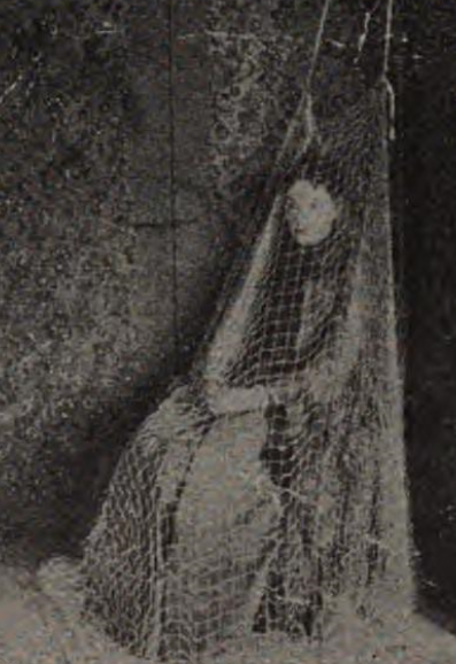
The photographs were taken in the dark with the magnesium flash then current.33Parker & Warwood (2016), 247-48. In their paper, Parker and Warwood present a series of five images (Figures 1–5) which demonstrate how d’Esperance employed masks and dummies to produce her apparent materialisations:
Figure 1 reveals the medium dressed up enacting the role of Yolande (the supposedly Arab girl). In Figure 2, the medium is wearing a mask of a woman with the edge of it clearly seen tied to the medium’s forehead …. In Figure 3, the medium is seen together with a pile of drapery enclosing what appears to be a mask in it, whereas Figure 4 shows the medium sitting alongside what may be the same mask as in Figure 3. Finally, in Figure 5, the medium can be identified by her body length and hands, enacting the spirit Walter by means of wearing a moustache or mask …. Hedlund (1890) comments that some of the masks were well-constructed and that the medium’s movements were carried out in a convincing manner. Sometimes the voice of the medium even appeared to come from the cabinet, which led Hedlund to speculate that some form of ventriloquism was involved (although how this would work without a doll is not known).34Parker & Warwood (2016), 248.
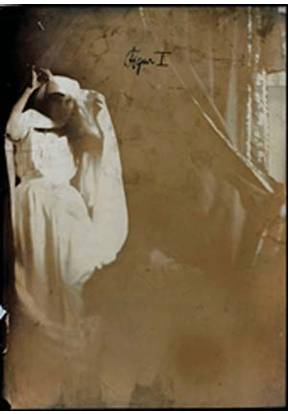
Figure 1. Madame d’Esperance dressed as Yolande.35Parker & Warwood (2016), 249.
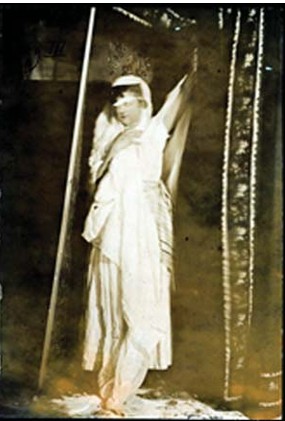
Figure 2. Madame d’Esperance wearing the mask of a woman with the edge of it tied to the forehead.36Parker & Warwood (2016), 249.
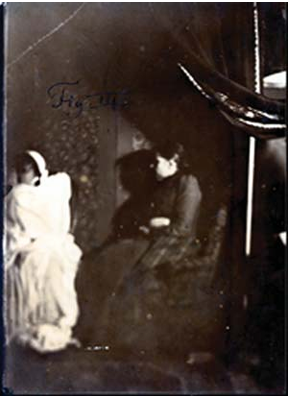
Figure 3. Madame d’Esperance with a pile of drapery enclosing the mask.37Parker & Warwood (2016), 249.
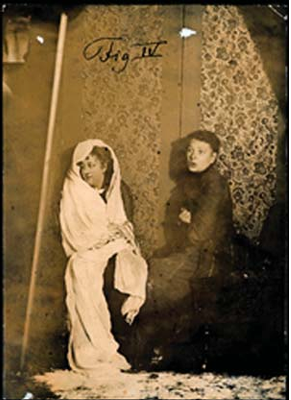
Figure 4. Madame d’Esperance sitting alongside the mask in Figure 3.38Parker & Warwood (2016), 249.
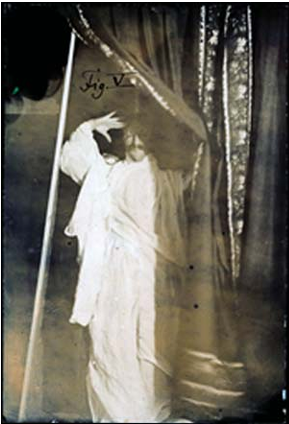
Figure 5. Madame d’Esperance as Walter with a moustache and/or mask.39Parker & Warwood (2016), 250.
The Psychology of Misperception
Parker and Warwood are unable to explain how d’Esperance achieved all of her physical effects, yet there is no reason to believe that any aspect of her performance was anything but theatrical. In Shadow Land, d’Esperance displays spirit photographs she says were the results of her own experimentation, but they are rather clearly double exposures.40Parker & Warwood (2016), 247. Although it seems possible that d’Esperance exhibited some psychic talent early in her life, her ‘mediumship’ was likely not of a mixed type, with some genuine phenomena alongside the faked. In cases of the latter sort, such as Eusapia Palladino, fraud may be unconscious, whereas d’Esperance appears to have been aware of everything she did. She evidently learned her basic skills from other fake mediums and took over from them when one of them retired.41Parker & Warwood (2016), 243-44.
If d’Esperance was a deliberate hoaxer, how was she able to get by with it for so long, despite her Newcastle and Gothenburg exposures? Parker and Warwood note that she performed in semi-darkness, which would have hidden imperfections and allowed suggestibility to shape perception. By the period she was active, there was in Spiritualism an acceptance of physical phenomena accompanying mediumistic communications, although investigators associated with the SPR had learned to be sceptical of it and by and large were not interested in pursuing it.42On this tension, see Psychical Research before 1882. As to the processes by which our perceptions may be socially influenced, in 1886 Eleanor Sidgwick described this with surprisingly modern insights:
Our conclusions as to what we see or hear are always founded on a combination of observation and inference; but in daily life it is seldom necessary to distinguish between the two elements, since, when the object and its mode of presentation are familiar, our inferences are generally correct. But it is different when, owing to circumstances, such as a bad light, we have to infer more in proportion to what we perceive than usual; or when someone e.g., a conjurer or a ventriloquist, is trying to deceive us by presenting one object under the familiar aspect of another and suggesting false inferences. It is not uncommon to find people at séances encouraging each other in the belief that they see, say, a living human figure, when all that they actually see is something moving which is about the size of a human being; the rest is inference.43Sidgwick (1886, 63) quoted in Parker & Warwood (2016, 257-58).
Melvyn Willin and James G Matlock
Works Cited
Aksakof, A. (1898). A Case of Partial Dematerialization of the Body of a Medium: Investigation and Discussion. Boston, Massachusetts, USA: Banner of Light Publishing Co. [Internet Archive. Download PDF.]
Anon. (1919). Transition of Madame d’Esperance. Light 39/2011 (26 July), 239. [IAPSOP. Embedded in PDF.]
Barkas, T.P. (1885a). Impromptu replies through a lady psychic of very limited education. Light (February, March, April, etc.). [IAPSOP. Embedded in PDF.]
Barkas, T.P. (1885b). Mr Barkas’ medium. Journal of the Society for Psychical Research 2/22, 116-17. [IAPSOP. Embedded in PDF.]
Carrington, H. (1907). An examination and analysis of the evidence for ‘dematerialization’ as demonstrated in Mons. Aksakof’s book A Case of Partial Dematerialization of the Body of a Medium: Investigation and Discussion. Proceedings of the American Society for Psychical Research 1, 131-68. [IAPSOP. Embedded in PDF.]
Carrington, H. (1920). The Physical Phenomena of Spiritualism, Fraudulent and Genuine. New York: Dodd, Mead, & Co. [Internet Archive. Download PDF.]
d’Esperance, E. (1897). Shadow Land, or Light from the Other Side. London: George Redway. [Hathi Trust. Full text.]
d’Esperance, E. (1907). Correspondence. Journal of the American Society for Psychical Research 1, 606. [IAPSOP. Embedded in PDF.]
Doyle, A.C. (1989). The History of Spiritualism, Volume 2. London: Psychic Press Ltd. Originally published 1926 by Cassell & Co., London. [Project Guttenberg. Full text.]
Edmunds, S. (1966). Spiritualism: A Critical Survey. London: Aquarian Press.
Fidler, M. (1880). Mrs. Esperance’s seances. The Medium and Daybreak 528 (14 May), 305-8. [IAPSOP. Embedded in PDF.]
Hedlund, T. (1890, 22 March). Spiritiska trollkonster [Spiritistic conjuring]. Göteborgs Handels- och Sjöfarts-Tidning, 68.
Holmes, A.C. (1927). The Facts of Psychic Science and Philosophy Collated and Discussed. Jamaica, New York, USA: The Occult Press. [HathiTrust. Full text.]
Hyslop, J.H. (1907). Replies to Mr Carrington’s criticism of M. Aksakof. Journal of the American Society for Psychical Research 1, 605-11. [IAPSOP. Embedded in PDF.]
Keene, M.L. (1997). The Psychic Mafia. New York: Prometheus Books.
Myers, F.W.H. (1885). Correspondence. Journal of the Society for Psychical Research 2, 31. [IAPSOP. Embedded in PDF.]
Orthwaite, F. (1879a). Mrs. Esperance’s séances. The Medium and Daybreak 483 (4 July), 411. [IAPSOP. Embedded in PDF.]
Orthwaite, F. (1879b). Mrs. Esperance as a medium for materialisation. The Medium and Daybreak 495 (26 September), 601. [IAPSOP. Embedded in PDF.]
Parker, A., & Warwood, E. (2016). Revealing the real Madame d’Esperance – A historical and psychological investigation. Journal of Scientific Exploration 30/2, 233-66. [Web page. Auto Download.]
Petrovo-Solovovo, M. (1903). Alexander Aksakof. Journal of the Society for Psychical Research 11, 46-48. [IAPSOP. Embedded in PDF.]
Podmore, F. (1902). Modern Spiritualism, Volume 2. London: Methuen & Co. [Internet Archive. Download PDF.]
Price, L. (2013). Madame D’Esperance was probably a Puttock. Psypioneer 9/8, 233-34. [Academia.edu. Full page.]
Price, L. (2016). 16 Queensbury Place. Paranormal Review 80, 28-31.
Resurgam (1880). The seizure seance. The Medium and Daybreak 11 (Sept. 10), 545, 580-81. [IAPSOP. Embedded in PDF.]
Richet, C. (1923). Thirty Years of Psychical Research. New York: Macmillan.
Seiling, M. (1907). Correspondence. Journal of the American Society for Psychical Research 1, 607-9. [IAPSOP. Embedded in PDF.]
Sidgwick, E. (1886). Results of a personal investigation into the physical phenomena of Spiritualism. With some critical remarks on the evidence for the genuineness of such phenomena. Proceedings of the Society for Psychical Research 4, 45-74. [IAPSOP. Embedded in PDF.]
Warwood, E. (2013). Doubt about Madame D’Esperance’s early life. Psypioneer 9/9-10, 298-301. [Academia.edu. Full text.]