
Marcello Truzzi (1935–2003) was an American sociologist and sceptic of psi phenomena, a major advocate of “zetetic” inquiry into paranormal and anomalous claims. Known for distinguishing open-minded scepticism from debunking, he edited Zetetic Scholar, helped shape anomalistics and wrote about psychic detectives, conjuring and standards of evidence.
- Truzzi helped found the Committee for the Scientific Investigation of Claims of the Paranormal but resigned after disputes over whether sceptical inquiry should be scholarly and open-ended or more popular and debunking.
- His zetetic approach argued for suspended judgement, rigorous standards of evidence and fair treatment of both proponents and critics of anomalous claims.
- Truzzi’s work connected sociology, conjuring, parapsychology and anomalistics, leaving a model of scepticism that rejected both credulity and scoffing.
Life and Career
Early Years
Marcello Truzzi was born in Copenhagen, Denmark, on 6 September 1935, into a circus family of Italian and Russian origins. His father, Massimiliano, was billed as the world’s greatest juggler; his mother, Sonya, was Russian. He moved with his family to the United States in 1940.
Truzzi’s early life in the circus left him with a lasting interest in conjuring and carnivals, subjects that later appeared in some of his publications. He studied sociology, psychology and law in Florida, earning a master’s degree in sociology. Truzzi received a doctorate in sociology from Cornell University in 1970. He became a full professor at Eastern Michigan University and chaired its Sociology department from 1974 to 1985. Truzzi wrote and edited several books on sociology; parapsychology was but one of his many interests.1Oliver (2003); Hövelmann (2005).
Editorial Work
Over his life, Truzzi edited several publications. The first was the Subterranean Sociology Newsletter, which ran from 1967 to 1979 and once received attention in the New York Times.2Shenker (1970). He was interested in the occult revival that occurred during the 1960s and 1970s in the United States. In the early 1970s he published a small newsletter, first named Explorations, ‘a newsletter dealing with the scientific investigations into occult movements’.3Truzzi (1973), 7. He later renamed it The Zetetic: A Newsletter of Academic Research into Occultisms. The term, Zetetic, implies inquiry and suspension of judgement.4Truzzi (1987b). James McClenon remembered Truzzi as ‘a remarkable man—a clever, brilliant individual with a good sense of humor and an intense curiosity. His general position was that of a Zetetic, a person who does not advocate a particular position but who evaluates evidence without prejudgment’.5McClenon (2003), 186.
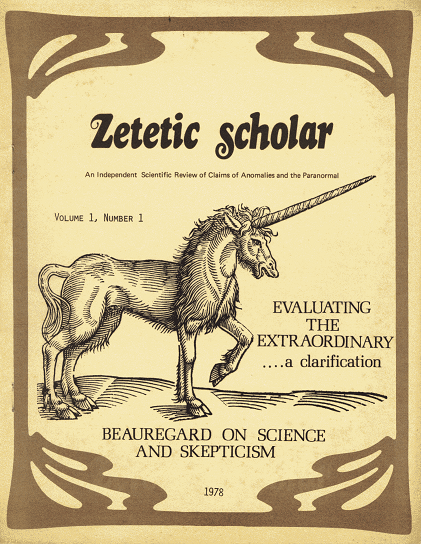
Truzzi participated in the founding of the Committee for the Scientific Investigation of Claims of the Paranormal (CSICOP) in 1976.6Bush (1976). The Zetetic became its official journal, and Truzzi edited the first two issues before resigning. He then started his own journal, Zetetic Scholar (1978–1987). He wanted the journal to function ‘as an amicus curiae or “friend of the court” through bringing full information and diverse opinions before the scientific community’.7Truzzi (1978), 2. His wife was listed as his associate editor in the first issues. Later, in secret, the Dutch sceptic Piet Hein Hoebens acted as an associate editor.8Truzzi (1987a). In the final issue, Truzzi noted that the journal had been ‘published with an intentionally limited circulation (600)’.
CSICOP and Scepticism
Before the founding of CSICOP, a small group had already formed, first called Sanity In Research (SIR)9This is wordplay on the Stanford Research Institute (SRI). and later Resources for the Scientific Evaluation of the Paranormal (RSEP). In addition to Truzzi, the group included Martin Gardner, Ray Hyman, and James Randi. Announcing the formation of RSEP, Truzzi stated that they were ‘all committed to the scientific method’ and that ‘that method demands serious skepticism along with receptivity to new facts’.10New association to study ESP (1975). They intended to produce a newsletter, titled Uncommon Sense.11Polidoro (2026).
In 1975, in a reply to a letter, Truzzi wrote, ‘It is the basic character of science to be both conservative and demand parsimony in its explanations. Extraordinary claims require extraordinary proof’.12Truzzi (1975), 24. Carl Sagan famously popularised a variant of this: ‘extraordinary claims require extraordinary evidence’. Truzzi noted that the expression could be misused and that one central problem is defining what counts as extraordinary.13Truzzi (1998).
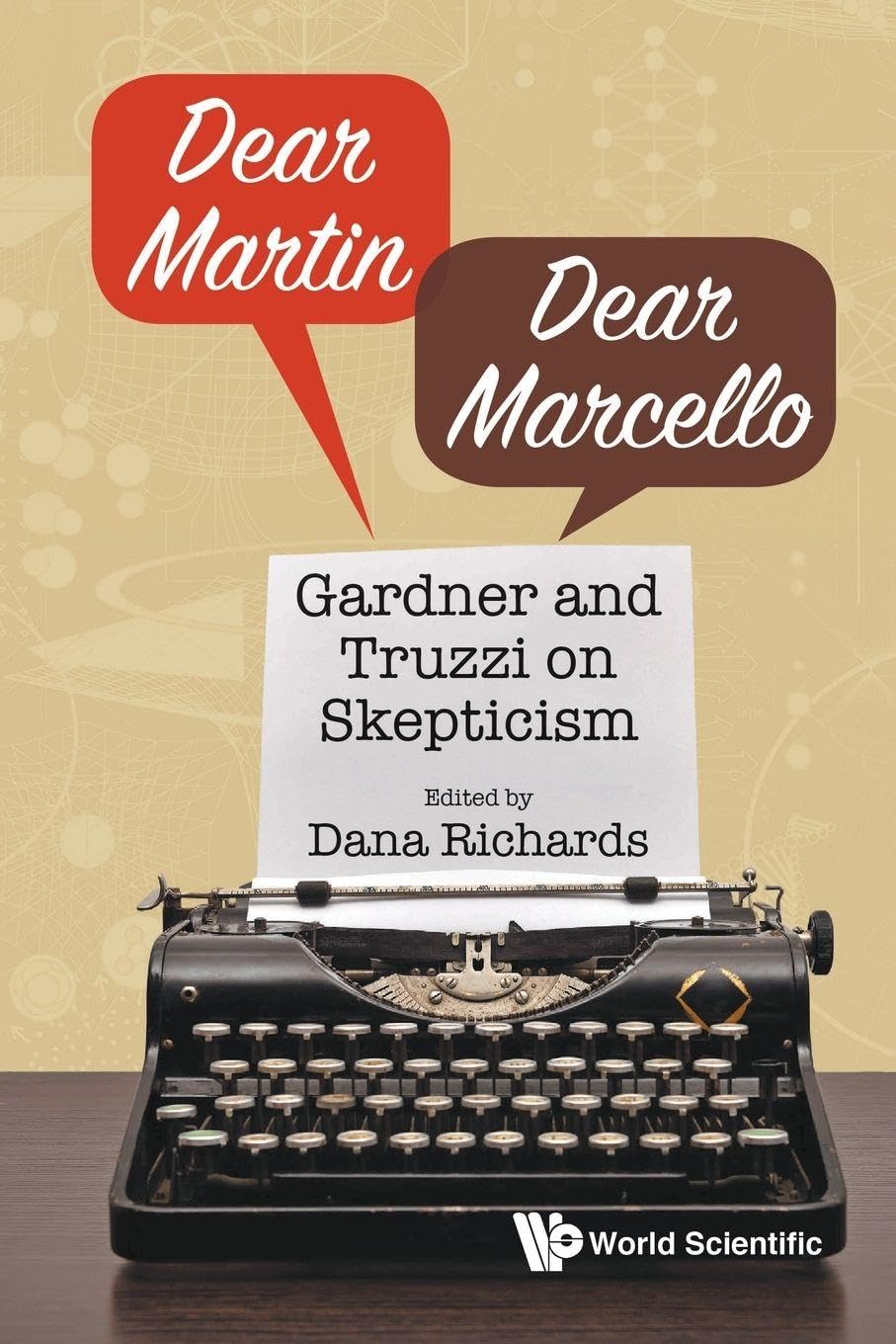
When CSICOP was founded in 1976, Kendrick Frazier wrote that ‘Truzzi brings to the new effort a refreshing sense of fairness and balance’.14Frazier (1976). However, in the wake of disagreements, Truzzi resigned on 29 October 1977. Robert McLuhan has quoted from two letters Truzzi wrote to CSICOP fellows.15McLuhan (2013). Disagreements concerned, among other things, the organisation’s journal.16Gardner (2001). This issue also appears in Truzzi’s correspondence with Gardner.17Richards (2017). Truzzi had wanted the journal to be scholarly rather than popular. He also wanted it to function as a forum for both believers and sceptics.
Truzzi has presented his perspective on what had happened and why he resigned.18Clark & Melton (1979a, 1979b); Williams (1991). He wanted ‘nothing to do with an operation oriented toward debunking’.19Clark & Melton (1979a), 75. He would argue that ‘The key problem is that the journal is far more interested in discrediting and debunking than it is in inquiring’.20Weisburd (1991).
Truzzi published reflections on scepticism and pseudo-scepticism, a term he popularised, several times during his life.21For example, Truzzi (1987b, 1998). He argued that some sceptics were actually scoffers and often ‘make judgments without full inquiry … they may be more interested in discrediting an anomaly claim than in dispassionately investigating it’.22Truzzi (2000), xxiv.
Michael Shermer argued: ‘In skeptical and scientific circles Truzzi is well-known as a fence-sitter … Truzzi has sat on the sidelines and taken potshots at what he thinks are the weaknesses in the positions of those who have the courage to stand on either side.’ Shermer went on to ask whether Truzzi believed in psi and whether Uri Geller had psychic powers.23Shermer (2001), 319. An entry in The Skeptic’s Dictionary also shows how Truzzi’s stance bothered sceptics. Adrian Parker, who corresponded with Truzzi about Geller, felt that he would always argue the counterpoint to his pro and con arguments.24A. Parker, personal communication, 3 May 2026.
Truzzi replied to Shermer: ‘I personally (philosophically) strongly disbelieve in the existence of extrasensory or psychic abilities, and I scientifically take the view that parapsychology has not yet met the burden of proof for psi required by the general scientific community. Psi remains unproven …’ Concerning Geller, he wrote: ‘Since I have always publicly stated I do not believe anyone has psychic powers, I certainly do not believe Geller has them. I consider Geller a friend and a remarkable psychic entertainer …’25Truzzi (2001).
Anomalies
In the ‘paranormal’ arena, Truzzi was interested in far more than parapsychology. When he founded the Center for Scientific Anomalies Research in 1981, his aim was to bring people together to study scientific anomalies in general.
He helped popularise the term anomalistics, ‘the emerging interdisciplinary study of scientific anomalies (alleged extraordinary events unexplained by currently accepted scientific theory)’. Truzzi argued that anomalistics ‘insists on the testability of claims … seeks parsimonious explanations, places the burden of proof on the claimant, and expects evidence of a claim to be commensurate with its degree of extraordinariness (anomalousness)’.26Truzzi (2000), xxiii.
With Zetetic Scholar, Truzzi also provided parapsychologists and others with a forum. In addition, he compiled several bibliographies.27For example, see McRae (1984), 139-50. He was a co-founder of the Society for Scientific Exploration in 1982. Truzzi was also a co-founder of the International Remote Viewing Association (IRVA) in 1999.28International Remote Viewing Association (n.d.).
Truzzi’s correspondence shows that he functioned as a consultant for the Defense Advanced Research Projects Agency (DARPA) several times. For example, on behalf of DARPA, in 1982 he provided a report on children with allegedly extraordinary abilities in China.29Hövelmann (2005).
However, Truzzi’s most notable work within parapsychology was his research on psychic detectives, including Gerard Croiset, and his contribution to the series Advances in Parapsychological Research, which concerned conjurers. Truzzi had been interested in conjuring throughout his life and was active in associations for conjurers, including the Psychic Entertainers Association, sometimes contributing to their journals.
Legacy
Truzzi was diagnosed with colorectal cancer when he was 60, and the illness went in and out of remission. He died on 2 February 2003, aged 67. Truzzi had two sons, Kristofer and Gianni. He had been married to Patricia, an artist who designed the cover for The Zetetic. After Truzzi’s death, she and his sons donated his papers to Eastern Michigan University Archives.30Eastern Michigan University Archives (n.d.).
George P Hansen set up a website devoted to Truzzi, which includes publication lists, links to Zetetic Scholar and other resources.31Hansen (n.d.). Robert Morris, Rosemarie Pilkington, Stanley Krippner and John Palmer spoke about Truzzi at the annual convention of the Parapsychological Association in 2003. Krippner said, ‘I only wish he would have written more because he had a fund of knowledge and understanding that was unique in our field’.32Krippner (2003), 396.
Selected Publications
Sociology and Everyday Life (ed., 1968). Englewood Cliffs, New Jersey, USA: Prentice-Hall. [Book scan.]
Sociology: The Classic Statements (ed., 1971). New York: Random House.
The occult revival as popular culture: Some random observations on the old and the nouveau witch (1972). Sociological Quarterly 13/1, 16-36.
On the extraordinary: An attempt at clarification (1978). Zetetic Scholar 1/1, 11-22. [PDF download.]
Reflections on paranormal communication: A zetetic’s perspective (1981). Annals of the New York Academy of Sciences 364/1, 297-309.
Reflections on “Project Alpha”: Scientific experiment or conjuror’s illusion? (1987). Zetetic Scholar 12-13, 73-98. [PDF download.]
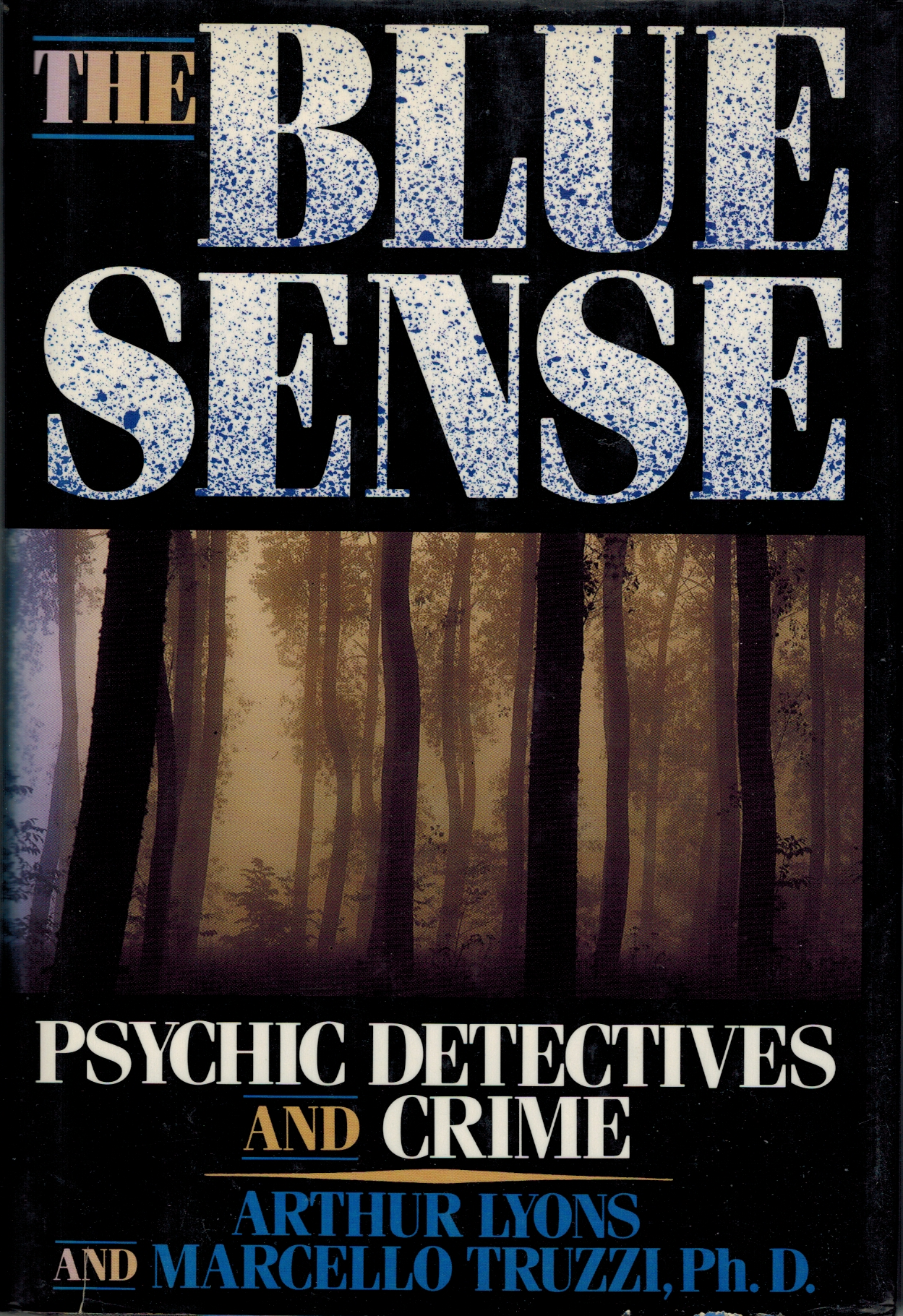
The Blue Sense: Psychic Detectives and Crime (with A. Lyons, 1991). New York: Mysterious Press.
Reflections on The Blue Sense and its critics (1995). Journal of Parapsychology 59/2, 99-130.
Reflections on the sociology and social psychology of conjurors and their relations with psychical research (1997). In Advances in Parapsychological Research Volume 8, ed. by S. Krippner, 221-71. Jefferson, North Carolina, USA: McFarland.
Nemo C. Mörck
Works Cited
Bush, L. (1976, 18 July). Truzzi tracks the occult. Ann Arbor News.
Clark, J., & Melton, J.G. (1979a). Marcello Truzzi talks about the crusade against the paranormal – Part 1. Fate 33 (September), 70-76.
Clark, J., & Melton, J.G. (1979b). Marcello Truzzi talks about the crusade against the paranormal – Part 2. Fate 33 (October), 87-94.
Eastern Michigan University Archives (n.d.). Marcello Truzzi papers. [Web page.]
Frazier, K. (1976, 29 May). Science and the parascience cults. Science News 109/22, 346-48, 350. [PDF download.]
Gardner, M. (2001). Confessions of a skeptic. In Skeptical Odysseys: Personal Accounts by the World’s Leading Paranormal Inquirers, ed. by P. Kurtz, 355-62. Amherst, New York, USA: Prometheus Books.
Hansen, G.P. (n.d.). Marcello Truzzi home page. The Trickster and the Paranormal. [Web page.]
Hövelmann, G.H. (2005). Devianz und Anomalistik: Bewährungsproben der Wissenschaft Prof. Dr. Marcello Truzzi (1935–2003). Zeitschrift für Anomalistik 5/1, 5-30. [PDF download.]
International Remote Viewing Association (n.d.). About IRVA. [Web page.]
Krippner, S. (2003). Marcello Truzzi memorial panel. In Proceedings of Presented Papers: Parapsychological Association 46th Annual Convention, Vancouver, Canada, 2-4 August, 396-97.
McClenon, J. (2003). Marcello Truzzi (1935–2003). Journal of Parapsychology 67/1, 185-86.
McLuhan, R. (2013, 9 July). Marcello Truzzi and CSICOP. Paranormalia. [Web page.]
McRae, R. (1984). Mind Wars: The True Story of Secret Government Research Into the Military Potential of Psychic Weapons. New York: St Martin’s Press.
New association to study ESP (1975). Parapsychology Review 6/4, 8.
Oliver, M. (2003, 11 February). Marcello Truzzi, 67; professor studied the far-out from witchcraft to psychic powers. Los Angeles Times. [Web page.]
Polidoro, M. (2026). Notes on as strange world: The missing catalyst. Skeptical Inquirer (July/August) [Web page.]
Richards, D. (2017). Dear Martin / Dear Marcello: Gardner and Truzzi on Skepticism. Singapore: World Scientific. [Book excerpt.]
Shermer, M. (2001). Letter to the editor. Journal of Parapsychology 65/3, 316-22.
Shenker, I. (1970, 14 March). Sociologist’s Subterranean Newsletter takes a poke at pomposity. New York Times.
Truzzi, M. (1973). Letter to the editor. Change 5/2, 7.
Truzzi, M. (1975). Letter to the editor. Parapsychology Review 6/6, 24-25.
Truzzi, M. (1978). Editorial. Zetetic Scholar 1/1, 2, 34. [PDF Download.]
Truzzi, M. (1987a). Editorial. Zetetic Scholar 12-13, 3-4. [PDF Download.]
Truzzi, M. (1987b). Zetetic ruminations on skepticism and anomalies in science. Zetetic Scholar 12-13, 7-20. [PDF download.]
Truzzi, M. (1998). On some unfair practices towards claims of the paranormal. In Oxymoron: Annual Thematic Anthology of the Arts and Sciences, Volume 2: The Fringe, ed. by E. Binkowski, 147-52. New York: Oxymoron Media.
Truzzi, M. (2000). The perspective of anomalistics. In Encyclopedia of Pseudoscience: From Alien Abduction to Zone Therapy, ed. by W.F. Williams, xxiii-xxxvi. New York: Facts On File. [Full paper.]
Truzzi, M. (2001). Letter to the editor. Journal of Parapsychology 65/3, 320-22.
Weisburd, S. (1991, 12 August). Science/medicine: What’s beyond belief? Magazine puts startling claims, tabloid hype under close scrutiny. Los Angeles Times.
Williams, C. (1991). Interview with Marcello Truzzi. Psi Researcher 3 (October), 6-7.