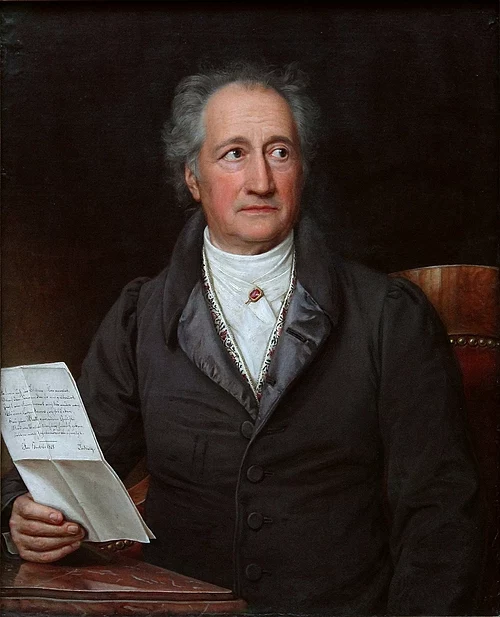
Johann Wolfgang von Goethe’s life and writings were deeply shaped by his mystical, spiritual and anomalous experiences. Drawing on his autobiography, letters, conversations and literary works, this article examines Goethe’s accounts of telepathy, precognition, hauntings, apparitions, reincarnation, and other phenomena.
- The psychic dimension of Goethe ‘s life and work not been presented in English previously.
- Accounts include Goethe’s apparent foreknowledge of Schiller’s death, the Messina earthquake episode, doppelgänger experiences, and encounters interpreted as ghostly or paranormal.
- Goethe expressed enduring belief in immortality and reincarnation, while retaining a critical attitude toward claims he considered insufficiently clear or reliable.
Introduction
The night seems deeper all around me,
Only within me is there gleaming light.1Goethe (2003, Faust, Part Two, Act 5, Scene 5, Midnight); trans. by A.S. Kline.
Goethe puts these words expressing an openness to the hidden and mysterious world within human beings into the mouth of Faust, who had gone blind by then. The poetry and body of Goethe’s works mirror his thoughts and personal experiences – ranging from ‘paranormal’ to magical, mystical and spiritual anomalous phenomena. His work and his experiences, beliefs and convictions are tightly inter-mingled and it is clear that some sentences and phrases in his writings derive from his personal experiences and views. Regarded as a whole, there can be no doubt about Goethe’s deep and serious involvement in the wide field of psychical and spiritual phenomena throughout his life.2See Puhle (2004, 2006, 2014a). These three books are the result of a 4.5-year project on historical cases of ghosts and apparitions in the German-speaking area during the time of Goethe, supported mainly by the IGPP, Freiburg, but also by the Stifung Weimarer Klassik, Weimar. See also Puhle & Parker-Reed (2017), index ‘Goethe’, and Puhle (2021), index ‘Goethe’ and ‘Goethezeit’. All these items except for Puhl & Parker-Reed (2017) are in German. Apart from the chapter on Goethe in Chambers (2009), this article is the first to focus on Goethe’s psychic experiences in English.
Johann Wolfgang von Goethe was born on 28 August 1749, precisely as the clock struck midnight, in Frankfurt am Main, Germany. He died on 22 March 1832 in Weimar, at age 83. Goethe spent most of his life in Weimar and that city owes much of its fame to him and to Friedrich von Schiller (1759–1805), lending its name to the literary epoch known as ‘Weimarer Klassik’, ‘Weimar Classicism’. Weimar attracted other literary dignitaries such as Christoph Martin Wieland (1733–1813) and Johann Gottfried Herder (1744–1803) during this period as well.
Goethe came to be esteemed as the German ‘Dichterfuerst’, the Prince of Poets, being himself a great admirer of William Shakespeare.3See Puhle (2009), the parallel book to Puhle (2005); Puhle (2014a), supported by the Tate Fund, Cambridge, Trinity College; and Puhle & Parker-Reed (2017), expanded and improved edition of Puhle (2009), including a Part 3 on consciousness research by Adrian Parker-Reed. Despite his world renown, Goethe’s biographers, interpreters and commentators have paid little attention to his psychic experiences and how they are reflected in his writing. This, however, is a hugely important aspect of Goethe’s life and work, so much so that it is impossible to cover the topic thoroughly in a brief space.4Puhle (2014a) devoted four volumes to the task. Goethe is a spokesman for an expanded consciousness beyond our consensus reality. According to Rudolf Steiner (1861–1925), Goethe is the ‘founding father of spiritual research’, in the sense of giving us a ‘spiritual understanding of the world’. Goethe reminded Steiner of the oft-quoted line of Novalis (Georg Philipp Friedrich Freiherr von Hardenberg, 1772–1801), ‘the spirit world is not closed to us even here’.5Steiner (1918).
Goethe’s complete works were first published between 1887 and 1919 in 143 volumes called the ‘Sophienausgabe,’ the ‘Sophie-edition’ (after the Dutch Princess and Grand Duchess Sophie von Sachsen-Weimar-Eisenach, 1824–97, who had inherited the handwritten manuscripts and the correspondence from Goethe’s grandson) or the ‘Weimarer Ausgabe’, the ‘Weimar edition’. The only definitive edition of Goethe’s works,6Goethe (1887–1919). this series includes 63 volumes of poetry, fourteen volumes about the nature sciences,7The natural science volumes were edited by Rudolph Steiner. sixteen volumes of diaries, and fifty volumes of letters.8A ‘Neue Weimarer Ausgabe’, ‘New Weimar edition,’ in 150 volumes, has been in progress since 2009. Other editions are selective – the ‘Hamburg edition’ in fourteen volumes,9Edited by E. Trunz (1st–3rd eds., Hamburg: Christian Wegner, 1949–57; new ed., Munich: C.H. Beck, 2023). the ‘Frankfurt edition’ in forty volumes,10Edited by F. Apel, H. Birus, & D. Borchmeyer et al. (Frankfurt am Main: Deutscher Klassiker Verlag, 1989) and the ‘Munich edition’ in twenty volumes.11Goethe (1997). Other editions of collected works are Goethe (1827–30) and Goethe (1903–7).
Two things must be pointed out when diving into Goethe’s world with its fiction, drama and poetry: His texts are written in a sophisticated and aesthetic way, offering a rich spectrum of words, because whatever he says is expressed with a high level of subtlety in the German language. Goethe was a master or even wizard at using German. For this reason, much is lost in translation to English and other languages. This is especially noticeable in his poems, where producing words that rhyme is at the cost of sacrificing their full meaning, feelings and atmosphere, and may be one reason that the spiritual and psychic dimensions of Goethe’s oeuvre have not been appreciated by non-German readers.
Goethe’s Experiences: Between Poetry and Truth
Goethe’s Faust may be the greatest work on ghosts and spirits ever written, but references to the psychical, mystical, and esoteric, along with spiritual ideas, can be found in nearly all of Goethe’s novels, dramas, poems, letters and diaries. However, because his personal attitude and experiences are not always crystal clear in his writings, it is best to refrain from quickly drawing conclusions about this. Without doubt, a positive attitude and openness towards – as well as an intimate familiarity with – psychic phenomena pervade his words, however. In contrast to the sparse information available about Shakespeare’s possible anomalous experiences and beliefs,12Puhle & Parker-Reed (2017). there are an overwhelming number of incidences in Goethe’s life to point to in this connection.
The title of Goethe’s autobiography is confusing, because it sounds as if it trods a rather narrow path between poetry and truth: Aus Meinem Leben: Wahrheit und Dichtung (translated as From My Life: Poetry and Truth). This autobiography was written in the years 1808 to 1831 and published in four parts in 1811, 1812, 1814, with the final instalment posthumously in 1833.The narrative passes over Goethe’s childhood, picking up in 1775, when he was about to move to Weimar. Goethe was aware of the ‘paradoxical title’ and in a letter to Carl Friedrich Zelter (1758–1832)13Zelter was a highly influential German musician, composer and conductor. explains what he intended:
As to the title of my life’s confidences – Wahrheit mid Dichtung – which is certainly somewhat paradoxical, I used this heading, because my experience is, that the public always entertains some doubt as to the truthfulness of such biographical efforts. To meet this, I acknowledged to having written a kind of fiction, driven to it, to some extent unnecessarily, by a certain spirit of contradiction.14Goethe to Zelter, 15 February 1830, in Coleridge (1872, 378).
The most important thing to know, Goethe told Johann Peter Eckermann (1792–1854)15Eckermann was a German poet and writer, very close to Goethe. is that all his works bear the influence of his life.16Eckermann (1836/1906). Further, he says about his novel Die Wahlverwandtschaften (Elective Affinities, also translated as Kindred by Choice, 1809), ‘Indeed, there is not a line in the [book] that is not taken from my own experience, and there is more in it than can be gathered by anyone from a first reading.’17Goethe to Eckermann, 9 February 1829 (Eckermann, 1836/1906. No page number available, but look under date). On the other hand, he adds a bit later, a reader thought that he had based the character Mittler on himself, but he had never met him or heard of him before.18Goethe to Eckermann, 9 February 1829 (Eckerman, 1836/1906).
Thus, despite Goethe’s claim that the novel derives from his life, it is by no means obvious that all of it does. This becomes a sensitive issue, when we consider the mingled relationships in Wahlverwandtschaften: There is the married couple Eduard and Charlotte who become crossed in love with their guests, Otto and Ottilie. The paranormal aspect concerns the power of thoughts: When the son of Charlotte and Eduard is born, his appearance resembles strikingly Otto and Ottilie – as a result of the parents’ passionate fantasies while conceiving the child. It is puzzling how this phenomenon could relate to Goethe’s personal experiences, although he might have had passionate feelings for women other than Christiane Vulpius (1765–1816), to whom he was married when he wrote Wahlverwandtschaften.
Goethe met Vulpius in 1788 and married her in 1806. They had five children together out of wedlock, the first, August von Goethe, in 1789, and the last in 1802. Except for August, all died in their first year. The standard assumption is that Goethe’s direct line of descendants stops with August’s three children (Wolfgang Walther, Maximilian Wolfgang, Alma Sedlina Henriette), but it has been speculated that August (or perhaps even Goethe himself) may have had another surviving child, a daughter.19A. Richter (2018). Curiously, in Memories, Dreams, Reflections, Jung (1963, 35) remarks on ‘an annoying tradition that my grandfather was a natural son of Goethe’. Editor A. Jaffé (Jung, 1963, 35-36 n1) explains that the ‘stubbornly persistent legend’ presumes that ‘Sophie Ziegler, the wife of Jung’s great-grandfather Franz Ignaz Jung (1759–1831), had an illegitimate child from Goethe, and this child was Karl Gustav Jung (1794–1864)’, Jung’s grandfather. While disavowing the rumour, Jung nonetheless spoke about it ‘with a certain gratified amusement’, Jaffé says (Jung, 1963, 36 n1). He surmised that it might explain the fascination he had always had with Faust (Jung, 1963, 234). Nonetheless, officially Goethe has no direct descendants today. His only recognized descendants are through his sister Cornelia (1750–77).20See here and here. Goethe’s heritage is better known. He has a well-researched, almost unbroken line of ancestors, dating back to the 700s, to Charlemagne and other famous persons like Albert the Bear (b ca 1100). Albert’s great-aunt is thought to have been Uta von Ballenstedt (b ca 1000), whose statue in the Naumburg Dom, the ‘Uta von Naumburg’ has become an icon of the German arts.21See here.
Despite the wide range of psychical, spiritual, mythical and even mystical phenomena permeating Goethe’s life and work, it is astonishing that hardly any attention has been given to this fact. Steiner contributed a great number of articles, lectures and even books about these aspects of Goethe,22Available from the Rudolf Steiner Archive. See here. but this is not surprising, since Steiner was the editor of Goethe’s work on nature sciences for the Sophie-edition and was himself deeply involved in occult studies.
There was another scholar who was fascinated by Goethe’s ignored psychic side, the German engineer and writer Max Seiling (1852–1928). Seiling was at one time close to Steiner and his anthroposophy. He brought attention to the psychic dimension of Goethe in his book Goethe als Okkultist (Goethe as an Occultist, 1919), which was based on his earlier publications Goethe und der Okkultismus (Goethe and Occultism, n.d., ca. 1910) and Goethe und der Materialismus (Goethe and Materialism, 1904). Seiling’s 1904 book was edited by Trutz Hardo and reissued in 1988 as Goethe als Esoterike (Goethe as an Esoteric). This book points out the deep and serious interest Goethe had in psychic matters during his lifetime. It reveals Goethe’s experiences with anomalous phenomena and related fields, his thoughts about the unknown in general and the history and mythology of ghosts and spirits.
Max Seiling was a professor of mechanical technology in Helsingfors, now Helsinki, Finland, and in spite of his broad interest in philosophy, he had arrived at a materialistic worldview, as was typical for his time. At the end of 1893, he was – unexpectedly – invited to spiritistic séances and became interested in them.23Revalo Bund 2 (January 1926). At this time, the English medium Madame d’ Esperance performed in Helsingfors, including at Seiling’s apartment, and Seiling finally became convinced that the appearances of deceased persons were real.24Ironically, Madame d’Esperance was at least was twice exposed in trickery. See Parker & Warwood (2016). Seiling furthermore made contact with Alexander Nikolayevich Aksakov (1832–1903), a Russian journalist and psychical researcher, and Carl Du Prel (1839–99), a German philosopher and writer. These contacts led Seiling to turn against the materialism propagated by Ernst Haeckel (1834–1919), who falsely believed Goethe would have sided with him. Unfortunately, because Seiling’s books have not been translated into English, they are little known outside of Germany.
Above all, Goethe’s Faust, Parts I and II, is about ghosts and spirits, both evil and good. The non-human figures who appear in the poem range from the devil (Mephistopheles), witches, an earth spirit (‘Erdgeist’) and other spirits (‘Geister’), the three archangels Raphael, Gabriel, and Michael, and a choir of angels, up to the highest spirit, God. This much has been recognized by critics, but the reception of Goethe’s work has not appreciated how this side of Goethe is far ahead of his time, if we credit recent findings. To take one example, the modern research on remote viewing would correspond with Goethe’s clairvoyant perception of the 1783 earthquake in Messina, Italy. The American parapsychologist Dean Radin shows how to train the skill of remote viewing25Radin (2018), 89-91. and reports how other ‘magical’ phenomena can on an experimental level get recognized as real.26 Radin (2018, 2025). According to Radin, ‘There are rising trends in science suggesting that what was once called magic is poised to evolve into a new scientific discipline, just as medieval astrology and alchemy evolved into today’s astronomy and chemistry.’27Radin (2018), 3.
Paranormal Heritage
Goethe’s Psychic Grandfather
In his early years, Goethe learned about a special clairvoyant gift possessed by his maternal grandfather, Johann Wolfgang Textor (1693–1771), who had officiated at the marriage of Goethe’s father, Johann Casper Goethe (1710–82). Johann Wolfgang Textor was the ‘Schultheiss’, the town magistrate, in Frankfurt am Main, and thus the highest and most prestigious office in the town’s judicial system. Supposedly, he had the gift of sometimes foreseeing future events in his life in the form of dreams.28See Puhle (2018), chap. 4. It was a gift said to be shared by others, as Goethe explained in his autobiography:
But the reverence we entertained for this venerable old man was raised to the highest degree by a conviction that he possessed the gift of prophecy, especially in matters that pertained to himself and his destiny. It is true he revealed himself to no one distinctly and minutely, except to my grandmother; yet we were all aware that he was informed of what was going to happen by significant dreams. He assured his wife, for instance, at a time when he was still a junior councillor, that, on the first vacancy, he would obtain the place left open on the bench of the Schoeffen; and soon afterwards, when one of those officers actually died of apoplexy, my grandfather gave orders that his house should be quietly prepared on the day of electing and balloting, to receive his guests and congratulators. Sure enough, the decisive gold ball was drawn in his favour. The simple dream by which he had learned this, he confided to his wife as follows: He had seen himself in the ordinary full assembly of councilmen, where all went on just as usual. Suddenly the late Schoeff rose from his seat, descended the steps, pressed him in the most complimentary manner to take the vacant place, and then departed by the door.
Something similar occurred on the death of the Schultheiss. They make no delay in supplying this place; as they always have to fear that the emperor will, at some time, resume his ancient right of nominating the officer. On this occasion, the messenger of the court came at midnight to summon an extraordinary session for the next morning; and, as the light in his lantern was about to expire, he asked for a candle’s end to help him on his way. “Give him a whole one,” said my grandfather to the ladies: “he takes the trouble all on my account.” This expression anticipated the result, – he was made Schultheiss. And what rendered the circumstance particularly remarkable was, that, although his representative was the third and last to draw at the ballot, the two silver balls first came out, leaving the golden ball at the bottom of the bag for him. Perfectly prosaic, simple, and without a trace of the fantastic or miraculous, were the other dreams, of which we were informed. Moreover, I remember that once, as a boy, I was turning over his books and memoranda, and found, among some other remarks which related to gardening, such sentences as these: “To-night N. N. came to me, and said,” – the name and revelation being written in cipher; or, “This night I saw,” – all the rest being again in cipher, except the conjunctions and similar words, from which nothing could be learned. It is worthy of note also, that persons who showed no signs of prophetic insight at other times, acquired, for the moment, while in his presence, and that by means of some sensible evidence, presentiments of diseases or deaths which were then occurring in distant places. But no such gift has been transmitted to any of his children or grandchildren, who, for the most part. have been hearty people, enjoying life, and never going beyond the actual.”29Goethe (1811–33/1883, 34); trans. by J. Oxenford.
Childhood Dreams
In his early childhood years, Goethe suffered from night terrors, such that already at the age of nine weeks, his grandparents, parents, and nurse noticed how he awoke crying or screaming in his cradle. Sometimes this was so much that his breathing stopped and, fearing for his life, his parents fixed a bell at his bedside that rattled whenever he got restless in his sleep. This would help him, they believed, forget his dream after waking.30Seiling (1988), 11. Goethe continued to suffer from nightmares as he matured.
On the night before Whitsunday, not long since, I dreamed that I stood before a mirror engaged with the new summer clothes which my dear parents had given me for the holiday. The dress consisted, as you know, of shoes of polished leather, with large silver buckles, fine cotton stockings, black nether garments of serge, and a coat of green baracan with gold buttons. The waistcoat of gold cloth was cut out of my father’s bridal waistcoat. My hair had been frizzled and powdered, and my curls stuck out from my head like little wings; but I could not finish dressing myself, because I kept confusing the different articles, the first always falling off as soon as I was about to put on the next. In this dilemma, a young and handsome man came to me, and greeted me in the friendliest manner. “Oh! you are welcome,” said I: “I am very glad to see you here.” – “Do you know me, then?” replied he, smiling. “Why not?” was my no less smiling answer. “You are Mercury -I have often enough seen you represented in pictures.” – “I am, indeed,” replied he, “and am sent to you by the gods on an important errand. Do you see these three apples?” He stretched forth his hand and showed me three apples, which it could hardly hold, and which were as wonderfully beautiful as they were large, the one of a red, the other of a yellow, the third of a green, color. One could not help thinking they were precious stones made into the form of fruit. I would have snatched them; but he drew back, and said, ” You must know, in the first place, that they are not for you. You must give them to the three handsomest youths of the city, who then, each according to his lot, will find wives to the utmost of their wishes. Take them, and success to you!” said he, as he departed, leaving the apples in my open hands. They appeared to me to have become still larger. I held them up at once against the light, and found them quite transparent; but soon they expanded upward, and became three beautiful little ladies about as large as middle-sized dolls, whose clothes were of the colors of the apples. They glided gently up my fingers: and when I was about to catch them, to make sure of one at least, they had already soared high and far; and I had to put up with the disappointment. I stood there all amazed and petrified, holding up my hands, and staring at my fingers as if there were still something on them to see. Suddenly I saw a most lovely girl dance upon the very tips. She was smaller, but pretty and lively; and as she did not fly away like the others, but remained dancing, now on one fingerpoint, now on another, I regarded her for a long while with admiration. And, as she pleased me so much, I thought in the end I could catch her, and made, as I fancied, a very adroit grasp. But at the moment I felt such a blow on my head that I fell down stunned, and did not awake from my stupor till it was time to dress myself and go to church.31Goethe (1811–33/1883, 43-44); trans. by J. Oxenford.
Training to Get Used to the Unknown
Goethe recalls from his childhood:
The old, many cornered, and gloomy arrangement of the house was moreover adapted to awaken dread and terror in childish minds. Unfortunately, too, the principle of discipline that young persons should be early deprived of all fear for the awful and invisible, and accustomed to the terrible, still prevailed. We children, therefore, were compelled to sleep alone, and when we found this impossible, and softly slipped from our beds to seek the society of the servants and maids, our father, with his dressing-gown turned inside out, which disguised him sufficiently for the purpose, placed himself in the way, and frightened us back to our resting-places. The evil effect of this any one may imagine. How is he who is encompassed with a double terror to be emancipated from fear?32Goethe (1811–33/1883, 12); trans. by J. Oxenford.
ESP and Altered States of Mind
Telepathy and the Power of Thoughts
Eckermann writes at some length about his conversations with Goethe concerning what would now be called telepathy: These were his views and experiences of the power of thoughts,33See Puhle (2004), 88-100, chap. ‘Gedanken und Imagination’. in particular about the influence of one’s thoughts or wishes on other persons. Eckermann had told Goethe of a ‘strange dream’ he had as a boy, which was fulfilled the next morning. This was about three young linnets, one of which one had escaped, but Eckermann found him the next morning thanks to his dream. Goethe confirmed that this was certainly remarkable, commenting, according to Eckermann:
“But there are many such things in nature, though we have not the right key to them. We all walk in mysteries. We are surrounded by an atmosphere of which we do not know what is stirring in it, or how it is connected with our own spirit. So much is certain,—that in particular cases we can put out the feelers of our soul beyond its bodily limits, and that a presentiment, nay, an actual insight into the immediate future, is accorded to it.”
“I have lately experienced something similar,” returned [Eckermann]. “As I was returning from a walk along the Erfurt road, about ten minutes before I reached Weimar, I had the mental impression that a person whom I had not seen, and of whom I had not even thought for a length of time, would meet me at the corner of the theatre. It troubled me to think that this person might meet me, and great was my surprise when, as I was about to turn the corner, this very person actually met me, in the same place which I had seen in my imagination ten minutes before.”
“That is also very wonderful, and more than chance,” returned Goethe. “As I said, we are all groping among mysteries and wonders. Besides, one soul may have a decided influence upon another, merely by means of its silent presence, of which I could relate many instances. It has often happened to me that, when I have been walking with an acquaintance, and have had a living image of something in my mind, he has at once begun to speak of that very thing. I have also known a man who, without saying a word, could suddenly silence a party engaged in cheerful conversation, by the mere power of his mind. Nay, he could also introduce a tone which would make everybody feel uncomfortable. We have all something of electrical and magnetic forces within us, and we put forth, like the magnet itself, an attractive or repulsive power, accordingly as we come in contact with something similar or dissimilar. It is possible, nay, even probable, that if a young girl were, without knowing it, to find herself in a dark chamber with a man who designed to murder her, she would have an uneasy sense of his unknown presence, and that an anguish would come over her, which would drive her from the room to the rest of the household.”
“I know a scene in an opera,” returned [Eckermann] “in which two lovers, who had long been separated by a great distance, find themselves together in a dark room without knowing it; but they do not remain long together before the magnetic power begins to work! one feels the proximity of the other—they are involuntarily attracted towards each other— and it is not long before the young girl is clasped in the arms of the youth.”
“With lovers,” answered Goethe, “this magnetic power is particularly strong, and acts even at a distance. In my younger days I have experienced cases enough, when, during solitary walks, I have felt a great desire for the company of a beloved girl, and have thought of her till she has really come to meet me. ‘I was so restless in my room,’ she has said, ‘that I could not help coming here.’
“I recollect an instance during the first years of my residence here, where I soon fell in love again. I had taken a long journey, and had returned some days; but, being detained late at night by court affairs, I had not been able to visit my mistress; besides, our mutual affection had already attracted attention, and I was afraid to pay my visits by day, lest I should increase the common talk. On the fourth or fifth evening, however, I could resist no longer, and I was on the road to her, and stood before her house, before I had thought of it. I went softly upstairs, and was upon the point of entering her room, when I heard, by the different voices, that she was not alone. I went down again unnoticed, and was quickly in the dark streets, which at that time were not lighted. In an impassioned and angry mood I roamed about the town in all directions, for about an hour, and passed the house once more, full of passionate thoughts of my beloved. At last I was on the point of returning to my solitary room, when I once more went past her house, and remarked that she had no light. ‘She must have gone out,’ said I to myself, ‘but whither, in this dark night? and where shall I meet her?’ I afterwards went through many streets—I met many people, and was often deceived, inasmuch as I often fancied I saw her form and size; but, on nearer approach invariably found that it was not she. I then firmly believed in a strong mutual influence, and that I could attract her to me by a strong desire. I also believed myself surrounded by invisible beings of a higher order, whom I entreated to direct her steps to me, or mine to her. ‘But what a fool thou art!’ I then said to myself; ‘thou wilt not seek her and go to her again, and yet thou desirest signs and wonders!’
In the mean time I had gone down the esplanade, and had reached the small house in which Schiller afterwards lived, when it occurred to me to turn back towards the palace, and then go down a little street to the right. I had scarcely taken a hundred steps in this direction, when I saw a female form coming towards me which perfectly resembled her I expected. The street was faintly lighted by the weak rays which now and then shone from a window, and since I had been already often deceived in the course of the evening with an apparent resemblance, I did not feel courage to speak to her in doubt. We passed quite close to each other, so that our arms touched. I stood still and looked about me; she did the same. ‘Is it you?’ said she, and I recognised her beloved voice. ‘At last!’ said I, and was enraptured even to tears. Our hands clasped each other. ‘Now,’ said I, ‘my hopes have not deceived me; I have sought you with the greatest eagerness; my feelings told me that I should certainly find you; now I am happy, and I thank God that my forebodings have proved true.’ ‘But, you wicked one!’ said she, ‘why did you not come? I heard to-day, by chance, that you had been back three days, and I have wept the whole afternoon, because I thought you had forgotten me. Then, an hour ago, I was seized with a longing and uneasiness on your account, such as I cannot describe. There were two female friends with me, whose visit appeared interminable. At last, when they were gone, I involuntarily seized my hat and cloak, and was impelled to go out into the air and darkness, I knew not whither; you were constantly in my mind, and I could not help thinking that I should meet you.’ Whilst she thus spoke truly from her heart, we still held each other’s hands, and pressed them, and gave each other to understand that absence had not cooled our love. I accompanied her to her door, and into the house. She went up the dark stairs before me, holding my hand and drawing me after her. My happiness was indescribable; both because I at last saw her again, and also because my belief had not deceived me, and I had not been deluded in my sense of an invisible influence.”34Eckermann (1836/1906, 274-76); trans. by J. Oxenford.
Premonition
Goethe expressed in his operetta Erwin und Elmire the possibility – even the probability – of what can be translated as premonition, foresight or precognition. He described here the gift of seeing into the future of an older, noble hermit. In Part 6 of Sprüche in Prosa, Maximen und Reflexionen (translated as Maxims and Reflections),35Goethe (1840/1906). both the fortune teller and poet are recognized as seers. Goethe also mentions his ‘Vorgesicht’ of the tragic fall of the cloister at Eibingen, unforeseen by the nuns, during his journey along the Rhine in 1814.36Seiling (1988), 47.
Goethe experienced a not-uncommon expression of foresight in the form of an unconscious slip when writing a New Year’s card to his very dear and close friend, the poet, historian, philosopher and doctor of medicine, Friedrich von Schiller. From his early years, Schiller suffered serious illnesses, but when Goethe wrote to him a greeting card at the morning of New Year’s Day, 1805, not expecting anything bad, he had to tear the card into pieces because he had wished him a good ‘last New Year’. When Goethe wrote another card, he found it difficult not to repeat writing the same. That same day, he told his friend Charlotte von Stein (1742–1827) about it and that he just was not certain if the error he kept making was foreseeing Schiller’s death or his own.37Report from Heinrich Voss to Christian Niemeyer, 12 August 1806, regarding a 1904 article by Freudenberg, an MD, cited in Seiling (1988, 18-19). Sadly, Goethe was right: Schiller fell gravely ill again in February and died on 9 May of that year, when he was just 46 years old. Goethe saw him for the last time four days before his death, and it only then was it shockingly apparent how sick Schiller was. According to the Dr Freudenberg, Goethe had no reason on New Year’s Day 1805 to expect the worst, however.38Seiling (1988), 18-19.
Clairvoyance
Goethe’s valet told Eckermann about an experience he had in the middle of a night in Winter or early Spring 1783, possibly the night of 5–6 February.
Once, he rang the bell in the middle of the night, and when I went into his room, he had rolled his iron bed from the far end of the room right up the window, and was lying there watching the sky. ‘Haven’t you seen anything in the sky?’ he asked me, and when I said no, he replied: ‘Then run over to the guardhouse and ask the sentry if he’s seen anything.’ I ran over, but the sentry had seen nothing, which I reported to my master, who was still lying there, gazing intently at the sky. ‘Listen,’ he then said to me, ‘we are in a telling moment: either we’re having an earthquake right now, or we’re about to have one.’ And so I had to sit down beside him on the bed, and he demonstrated to me the signs from which he had deduced this.
I asked the good old man what the weather had been like.
‘It was very cloudy,’ he said, ‘and there wasn’t a breath of wind; it was very still and muggy.’
I asked him whether he had straight away taken Goethe’s remark at face value.
‘Yes,’ he said, I took him at his word, for whatever he predicted was always correct. The very next day,’ he continued, ‘my master recounted his observations at court, whereupon a lady whispered into her neighbour’s ear: ‘Listen! Goethe is raving!’ The Duke [Herzog Carl August von Sachsen-Weimar-Eisenach (1757–1828), who had brought Goethe to Weimar in 1775], however, and the other men believed in ‘Goethe’s ravings’, and it was soon confirmed that he had been right: After a few weeks, news arrived that on that very night, part of Messina [Italy] had been destroyed by an earthquake.39Eckermann (1836, 85-86); trans. by A. Puhle.
In fact, a series of five severe earthquakes occurred in southern Italy between 5 February and 28 March, 1783. The tremors triggered several tsunamis, destroyed about three thousand villages, and killed an estimated thirty to forty thousand people. The first
major earthquake took place at 12.45 pm local time on 5 February, followed by the next main earthquake at 1.06 am on 6 February.40Details about the earthquake series are given in the German Wikipedia, ‘Erdbeben in Kalabrien’, here. When Goethe travelled to Italy and passed Messina four years later, in 1787, he noted in his diary that twelve thousand residents were killed, the other thirty thousand persons had no place to stay, most buildings had collapsed and that the shattered walls made the remaining buildings unsafe.
Altered States of Mind
Goethe was well aware of what are now called altered states of consciousness and declared that he written most of his works in a dreamlike state. In a letter to Charlotte von Stein, he says that his state of mind during his literary creations was very different from the ordinary state of mind while he was writing this letter to her – he composed his literary works in a state between dream and waking.41Seiling (1988), 20. In his autobiography, Goethe confesses, ‘the scratching and splattering of the pen would sometimes wake me from my somnambular poetizing, confuse me, and stifle a little conception in its birth’, and he felt towards his just-created poems ‘somewhat as the hen does towards her chicks, which she sees hatched and chirping about her.’42Goethe (1811–33/1897), 586. In his Annalen (Annals), Goethe tells of the remarkable origin of the poem ‘Um Mitternacht’ (‘At Midnight Hour’): It had come to him at the ‘midnight hour’ during ‘sublime moonshine,’ and it was these circumstances that made the poem special for him.43Cited by Seiling (1988, 21).
In 1814, while preparing a new edition of Wilhelm Meister Lehrjahre (Wilhelm Meister’s Apprenticeship), Goethe described to Karl Ludwig von Knebel (1744–1834) how he had written his novel in a state of a ‘nightwalker’ (somnambulism), as was the case with all his other works.44Goethe to Knebel, 1814, cited in Seiling (1988, 21). It often happened that the poems suddenly came into his mind and he felt an urge to write them down immediately, although in his ‘dreamlike state’ he would not even notice if there was a skewed sheet of paper in front of him.45Cited in Seiling (1988, 21).
‘Poetry is ‘inspiration… one should neither call it art nor science, but genius’, Goethe once wrote.46In Sprüche in Prosa (1909), cited by Seiling (1988, 22). In a letter to philosopher and religious scholar Friedrich Victor Leberecht Plessing (1749–1806) in 1782, Goethe assured him ‘that not my will is done, but the will of a higher power, whose thoughts are not my thoughts.’47Cited by Seiling (1988, 22). In his autobiography, Goethe describes entering a mystical state: ‘One feeling which prevailed greatly with me, and could never find an expression odd enough for itself, was a sense of the past and present together in one; a phenomenon which brought something spectral into the present.’48Goethe (1811–33/1897), 543-44.
Spooky Events
The German word ‘Spuk’ denotes haunting phenomena. For Goethe and his time, Spuk meant the two major macro-psychokinetic aspects of hauntings, the place-bound and person bound, but Spuk can include also incidents such as apparitions that appear round the time of death. This third aspect was termed by Fanny Moser (1872–1953), German/Swiss zoologist much interested in this domain, ‘ephemeral Spuk’49Moser (1950, 38); see also Puhle (2004, 300-1). Goethe wove these spooky spontaneous and unexplained phenomena, most often associated with noisy poltergeist activity, into his writings.50See Puhle (2001). He also witnessed some unexplained Spuk phenomena himself. According to Seiling51Seiling (1988), 27., Goethe experienced so many spooky occurrences that there is no reason to doubt his openness to their reality. He told Karl Ludwig von Knebel in a letter:
Just as it was during the times when I lived in my father’s house, it never occurred to me to link the apparitions of ghosts with legal practice, and so too it is now that I now keep the Privy Councillor and my other self separate, without which a Privy Councillor can function very well.52Goethe to Knebel, 21 November 1782, in Goethe & Knebel (1851, 39); trans. by A. Puhle.
In Eine Erinnerung an Goethe‘s letzte Stunden (A Memory of Goethe’s Last Hours), Julius Schwabe recounted another event that had occurred in Goethe’s presence:
Many people may well find it interesting to learn on this occasion that, whilst the Goethe family still lived there, a familiar spirit (Spiritus familiaris)53See Puhle (2014a), vol. 2, 340-53. haunted Goethe’s house. This ghost had the peculiarity of appearing not at night, like other ghosts, but in broad daylight. He did not confine his activities solely to the house where Goethe lived in the town but was also occasionally seen in the well-known garden house at Stern. Goethe happened to be in the latter on a Sunday morning in the summer of 1824. The town-clock had just struck twelve; the July sun shone warmly and brightly from its midday height as Goethe walked out through the front door to go into town. In front of this front door is a small cobbled square. To his surprise, by stepping out, Goethe found a girl there whom he did not recognise at all, busily holding her broom in her hands. ‘Well, my child, where on earth do you come from?’ Goethe asked her. The girl, however, continued to sweep the area in front of the house earnestly, without looking at Goethe or responding to him. ‘Well, that is rather strange,’ said Goethe, ‘answer me, who are you?’ But the girl did not answer and calmly carried on sweeping, and while Goethe watched her in amazement, her figure suddenly became indistinct, misty, and dissolved completely in the rays of the sun.’
This strange spirit familiaris also played the role of the ‘knocking spirit’, at this he did at a time, when professional ‘knocking spirits’ were still long time away from being invented. He particularly enjoyed practising his art in a coach house situated directly beneath Goethe’s study. He would often start knocking and pounding, like woodcutters splitting a stubborn rootstock. Whenever Goethe sent someone down to enquire about the cause of the unseemly noise that was disturbing him, there was nothing to be heard or seen. But no sooner had the investigating committee left than the knocking spirit resumed its futile work. These spiritus familiares are simply foolish, mischievous creatures.
This is what Goethe himself told a person very close to him, from whom I have received this information. Was he really serious about it? – It is well known that Goethe had a great penchant for the marvellous and the mysterious; after all, such things provide a pleasant thrill for any lively phantasy. This inclination often led the noble master, in a light-hearted mood, to mystify the one the other person. It might have happened this way with that story about the spirit familiar as well.
However, even if we were to accept that we ought not to doubt the worth personality of Goethe’s knocking spirit, we can hardly suppose that this spirit—whose activity had hitherto been confined solely to knocking, rumbling and wielding a broom—should suddenly became musical and produced those ethereal tones.54Schwabe (1860, 248-51); trans. by A. Puhle.
In another place, Goethe says, ‘Let’s see if the evil spirits can smash the house to pieces which good folk have kept in shape for so long.’55Goethe (1802, 46-47); trans. by A. Puhle.
Spooky occurrences penetrate all of Goethe’s works, specially Faust. In Faust, Part One, during the Walpurgisnight, the Proktophantasmist makes fun of the Enlightenment and thinkers like Friedrich Nicolai (1733–1811), author and publisher of Berlin, who ironically for ten months suffered from ‘Proktophantastmistische Halluzinationen’, that is, he saw spirits of all sorts.56See Puhle (2014a), vol. 2, 29-48. The Proktophantasmist ridicules Nicolai and alludes to the circulating rumours of a haunting in Tegel, concerning the forester’s office next to the country estate of the Humboldt family (the so-called Humboldt-Schloesschen in Tegel, then still in existence outside Berlin):
You still are here? Nay, ’tis a thing unheard!
Vanish, at once! We’ve said the enlightening word.
The pack of devils by no rules is daunted:
We are so wise, and yet is Tegel haunted.
To clear the folly out, how have I swept and stirred!
Twill ne’er be clean: why, ’tis a thing unheard!57Faust, Part One, Walpurgisnacht (Walpurgis-Night), trans. by B. Taylor.
Goethe’s poem ‘Die Geheimnisse’ (‘The Mysteries’)58Goethe (1825). can be read as symbolizing a spiritual journey, beginning with a slow awakening in the morning dawn, until it culminates in the active search for knowledge of oneself, for higher insights and the reconnection with a higher order. The poem is full of mystical experiences, such as seeing a divine female figure, and includes spooky bangs and sounds. In the novel Wilhelm Meister’s Wanderjahren (Wilhelm Meister’s Years of Travel),59Goethe (1821–29), vol. 3, chap. 1. Goethe lets Wilhelm awake by some strange and almost frightening sound. Wilhelm cannot make out if the sound comes from far away or from inside the house, since the house would sometimes tremble and the beams would creak.
The ghostly phenomena surrounding the opera singer Hyppolyte Clairon60Stage name of Claìr Josèphe Léris (1723–1803). also stimulated Goethe’s creativity and became a template for a short story about the singer Antonelli inhis collection, Unterhaltungen deutscher Ausgewanderten (The German Refugees, 1795):
Suddenly it happened that, whenever the girl walked around in the house because of her tasks, she could hear a knocking beneath her, here and there. At first it seemed to be a coincidence, but as the knocking did not stop and accompanied almost every step she took, she became frightened and hardly dared to leave her Madam’s room, the only place where she found peace.
This knocking was heard by everyone who walked with her or stood not far from her. At first people joked about it, but eventually the matter began to become unpleasant. The master of the house, who was a man of lively spirit, now set about investigating the circumstances. The pounding could only be heard once the girl had left, and not so much when she set her foot down as when she lifted it to take the next step. Yet the thuds were sometimes irregular, and were particularly loud when she crossed a large hall.
One day, the head of the household had some tradesmen working nearby and, as the pounding was at its most intense, had the floorboards torn up directly behind her. Nothing was found, except that on this occasion a couple of large rats came to light, the hunt for which caused a great deal of noise in the house.
Outraged by this incident and the confusion it caused, the master of the house resorted to drastic measures: he took his largest hunting whip from the wall and swore that he would beat the girl to death if the knocking were to be heard even once more. From that moment on, she walked about the whole house unmolested, and the knocking was never heard again.
‘From which,’ Luise remarked, ‘it is clear that the beautiful child was her own ghost and, for some reason, had been playing this prank and making fun of her masters.’
‘Not at all,’ replied Fritz, ‘for those who attributed this phenomenon to a spirit believed that, whilst a guardian spirit did indeed wish to drive the girl out of the house, it would not allow her to come to any harm.’ Others looked into the matter more closely and believed that one of her suitors had had the knowledge or the skill to produce these sounds in order to lure the girl out of the house into his arms. Be that as it may, the poor child was almost completely worn down by this incident and seemed like a sorrowful spirit, whereas before she had been fresh, lively and the cheeriest in the whole house. But even such a physical decline can be interpreted in more than one way.
‘It is a pity,’ remarked Karl, ‘that such incidents are not investigated thoroughly, and that, when judging events that interest us so much, we must always waver between various possibilities, because not all the circumstances under which such miracles occur are noted.’
‘If only it weren’t so difficult to investigate,’ said the old man, ‘and, the moment something of the sort occurs, to have all the key points and details at one’s fingertips—the very things that really matter—so that nothing slips by in which deception and error might lurk.’ Is it really so easy to see through a trickster, when we know full well that he’s pulling our leg?
No sooner had he finished speaking than a very loud bang was suddenly heard from the corner of the room. Everyone jumped, and Karl said jokingly: ‘Surely it’s not a dying lover making himself heard.’
He would have liked to take his words back, for Luise turned pale and confessed that she feared for her fiancé’s life.
Fritz, in an attempt to reassure her, took the lamp and went over to the desk standing in the corner. The arched top of the desk was completely split right through; so there was the cause of the sound; but nevertheless it struck them as odd that this desk, one of Rautchen’s finest pieces, which had stood in the same place for several years, should have happened to break at that very moment. It had often been praised and held up as a fine example of excellent and durable joinery, and now it was suddenly supposed to have cracked, without the slightest change in the air being perceptible.
‘Quick,’ said Karl, ‘let us first sort this out and check the barometer.’ The mercury had remained exactly at the same level as it had been for several days;
The thermometer itself had not fallen any further than the natural variation between day and night would suggest.
‘It’s a pity we don’t have a hygrometer to hand,’ he exclaimed; ‘that instrument, of all things, would be the most essential!’
‘It seems,’ said the old man, ‘that we are always lacking the necessary instruments whenever we wish to conduct experiments on ghosts.’
They were interrupted in their musings by a servant who came in hurriedly and reported that a bright fire could be seen in the sky, though it was impossible to tell whether it was in the town or in the surrounding area. As the previous events had already made them more susceptible to fear, everyone was more deeply affected by the news than they might otherwise have been.
Fritz hurried up to the belvedere of the house, where a detailed map of the region was drawn on a large horizontal panel; with its help, one could determine the various locations of the places quite accurately, even at night. The others remained together, not without anxiety and agitation. Fritz returned and said: ‘I bring no good news. ‘For it is highly likely that the fire is not in the town, but on our aunt’s estate. I know the direction very well and do not fear I am mistaken.’ They lamented the loss of the beautiful buildings and calculated the damage. ‘However,’ said Fritz, ‘a curious thought has occurred to me, which may at least reassure us regarding the strange mark on the desk.’ First and foremost, let us establish the exact time at which we heard the sound. They worked backwards and it must have been around half past eleven.
Well, whether you laugh or not,’ continued Fritz, ‘I shall tell you my theory. You know that several years ago our mother gave our aunt a similar—indeed, one might say identical—desk. Both were made at the same time from the same wood with the utmost care by a master craftsman; both have held up splendidly so far, and I’d bet that at the very moment our aunt’s summer house goes up in flames, the second desk will burn too, and that its twin will suffer the same fate. I intend to set out myself tomorrow and try to get to the bottom of this strange matter as best I can.
Whether Friedrich truly held this view, or whether the desire to reassure his sister prompted him to come up with this idea, we shall not decide; suffice it to say that they seized the opportunity to speak of certain undeniable affinities and ultimately found it quite plausible that there might be an affinity between pieces of wood carved from the same trunk, or between works created by a single artist. Indeed, they agreed that such phenomena might just as well be regarded as natural phenomena as others which recur more frequently, which we can grasp with our hands and yet cannot explain.”61Goethe (1795, 16 [152]-21([157]); trans. by A. Puhle.
Here, Goethe gives an impression of the kind of discussion that at that time is taking place about poltergeist phenomena. These were mysterious sounds, pistol-like shots without any damage, knockings and a suddenly split desk. Compare this to the well-known phenomenon that happened to CG Jung: Jung was sitting as a student during the summer holidays 1898, in his working room while the door was open to the dining room with a round dining table made of walnut wood, where his mother was sitting about one metr away from the table. Suddenly a loud shot occurred like from a pistol. Both persons got a shock hearing it. The table had got a crack in the middle of the solid wood. About two weeks later, Jung came home and found his mother, sister and housemaid greatly troubled. They had heard a deafening shot like from a pistol which was not coming from the table again but from a large and heavy wooden buffet, in which a heavy steel bread knife had shattered, exploded. The best cutler’s workshop in the city could not explain this in a natural way.62Jung (1963), 111-14.
Unterhaltungen deutscher Ausgewanderten includes two other Spuk stories. One of them is about spooky knockings which occur in the presence of a fourteen-year-old girl – an example of a person-bound poltergeist phenomena like the Antonelli case. The story about the mysterious knockings is told by Fritz, who observed them himself. His talk is interrupted by the sound of a breaking writing desk-top, and at the same moment the group sees the glow of a fire coming from the direction of the mansion belonging to the aunt where another desk, a twin desk, might burn, which turns out to be true. Both desks were made from the wood of the same tree and built by the same carpenter. A discussion about possible mutual influence of two objects over distance arises. Finally, they agree that such sympathy is a natural phenomenon, just like all other natural phenomena that are just more common.
See below for a discussion of Spuk phenomena that occurred shortly before Goethe’s death. Other types of ghosts and apparitions are treated in the next section.
Ghosts and Apparitions
Apparitions of the Living and Doppelgänger
Apparitions do not refer exclusively to unexplained appearances of known living persons, but also to figures of unknown origin. What mostly characterizes an apparition is the sudden dissolving or disappearing of the subtle, more-or-less-solid figure. One example is Goethe’s apparition of a girl in front of his house, mentioned above.
Nataly von Eschstruth (1860–1939) reported a striking experience Goethe had together with his friend, the privy councillor and medical doctor August Klemm (1799–1883), who wrote about this special occurrence:
It was at a time when Goethe was staying temporarily in Jena so that he could work undisturbed in the chemistry laboratory. Thanks to a glowing recommendation from my professor, I was granted the honour of being allowed to perform small tasks for him, and because fortune was always on my side, the great master took such a liking to me that I was even permitted to accompany him on his walks. He would make his way to the battlefield with particular interest. He particularly liked to go in the evening, so that darkness would often take us by surprise. Then he would suddenly stand still, listening intently and mysteriously, his sharp, eagle-like gaze piercing the darkness.
“Can’t you hear anything? Can’t you see anything?” he often asked in a whisper, “The stamping of hooves and the clang of weapons, death throes and cries of anguish?” …
I shook my head in surprise.
“They say this place is haunted –,” Goethe continued animatedly (according to Rosenberger 1952,.42, Goethe heard this from five eyewitnesses; note by the author), “and I would love, for the sake of my life, to experience something extraordinary just once! I feel drawn here as if by overwhelming forces. There is a chilling poetry in these vast, lonely, blood-soaked fields! How many a heart must lie broken here, unreconciled with its God! And such spirits, they say, are bound to the earth. – I am immensely interested in this subject; I yearn to catch just a single, fleeting glimpse through the mysterious door that separates ‘there’ from ‘here’! But I experience nothing. A certain person – a thoroughly respectable lady who enjoys great trust at the court in Weimar – has told me of a strange experience, corroborated by four further eyewitnesses.
The lady had been delayed in Jena by some unforeseen circumstances and was forced to return home by carriage that very night.
Their route took them across the battlefield.
A delightfully warm, moonlit summer’s night. Everyone is laughing and chatting in the open carriage; the two daughters begin to sing and the son-in-law accompanies them with his pleasant voice. Then the chimes of a clock ring out from afar through the silence – it is midnight.
At the same time, the coachman turns his head in alarm: ‘May Your Lordship not be alarmed – a carriage is coming towards us at breakneck speed, with the horses seemingly about to bolt!’
That’s right, a muffled rumbling, a drone and the clatter of hooves echo towards them.
“Stop!” my wife’s son-in-law calls out to the coachman. “I want to get down and take our brown horses by the reins! They’re also passers-by, and a bad example often spoils good manners!”
He leapt down and stood beside the horses, whilst the ladies, with understandable curiosity, leaned out of the carriage to see this peculiar vehicle rushing past so wildly.
Strange – at first they had heard a dull rumbling and the clatter of hooves, but now, all of a sudden, the horse and carriage were flying past silently, almost ghostlike.
“There are four black horses!” said the coachman. “But they look as thin as skeletons!” added the young gentleman.
“Why haven’t we heard a word from the fellow?” asked the son-in-law, surprised.
And just then, a shadowy figure came hurtling towards them.
At the same moment, the coachman let out a cry of horror, which was met with a blood-curdling echo from the ladies. –
A four-horse black carriage, a French baggage van, whizzed past them, and crammed onto it were French soldiers; instead of heads, white, grinning skulls peered out from beneath their caps. – Half fainting with horror, the ladies recoiled; the coachman pressed his arms against his face; and the young gentleman stood paralysed with dread, staring silently across the fallow field, whilst the black carriage finally vanished into the misty moonlight, without the keen eyes of the watcher being able to see where it went. “
Goethe paused, taking a deep breath, and then continued in a quieter voice: “This marvellous event has five eyewitnesses, whose word is a full guarantee to me of its truth! Since then, I have had no greater wish than to experience something similar myself, for only when we have seen it with our own eyes are we fully convinced!”
…
“Your Excellency,” I said, my eyes sparkling, “it might well be possible to witness a ghostly apparition on the battlefield! I personally know quite a few reliable people in Jena who have seen the ‘Shield Guard’ on the field more than once; indeed, the whole town knows about it, and I am convinced that we too shall see it. But to do so, we would have to set out on a moonlit night at the eleventh hour!”
Goethe looked at me in silence with his beautiful, large eyes. There was almost something suspiciously probing in his gaze, which seemed to pierce right through me. “I have never heard of a haunting sentry,” he replied earnestly, “but I would be delighted to meet one. You will accompany me, won’t you?”
“If Your Excellency would do me the honour, by all means!” I exclaimed boldly, “I am highly sceptical of all things supernatural and would be absolutely delighted to be able to expose any hoax!”
“Very well, let’s go, my young friend! My pistols shall assist you in this unmasking.”
Goethe suspected that I was going to stage a little farce to please him; there was no doubt about that.
And in fact, the old gentleman insisted on going for his nightly walk the very next evening, even though the sky was overcast. He only told me of his decision when he was already standing before me, ready to set off. He probably thought this was the best way to thwart any student prank that might be in the offing, and I could see from this just how serious this distinguished man was about his thirst for knowledge.
Well equipped, we set off on our walk. I had been given precise directions to the spot where the ghostly sentry was supposed to appear. It was impossible to miss, as it lay right by the path, at the foot of a small hill beneath which a French mass grave was believed to lie.
We walked on, engaged in serious conversation. The sky was cloudy, but the night was not dark. We grew accustomed to the dim light and were soon able to make out every object with perfect clarity – indeed, when we were halfway there, the moon even emerged for a while and bathed the battlefield and the mountains in a silvery glow.
Goethe was smoking a small pipe; he suddenly took it out of his mouth and, with a soft, brief exclamation of ‘There!’, pointed straight ahead towards the hill.
We stopped. “Something’s moving over there!” – I strained my eyes. Indeed, a figure, still distant and indistinct, was walking slowly back and forth.
Now something about her caught my eye. The bayonet or the headgear.
A feverish excitement took hold of us. Goethe slipped his pipe into his pocket and gripped the pistol with a convulsive grip.
“Are you armed too?” he whispered to me.
“I’ve got my bat, Your Excellency.”
“Good, then let’s go!” –
Quietly, but as quickly as possible, we continued walking across the soft ground. We were getting closer and closer to the strange apparition.
Goethe was breathing heavily. “Truly – a French soldier!” he muttered.
We were very close – we’d got within about twenty paces.
Before us, in the open field, the figure paced calmly and steadily to and fro. We recognised him at once: the high boots, the white trousers, the tunic with its bandolier, and the tall cap. With his rifle in his arms, Napoleon’s old guardsman paced back and forth over a short distance.
“Do you recognise that face?”
“It seems to me, Your Excellency, though strangely enough not as clearly as everything else, that it appears to be a phosphorescent white!” –
‘We want to ring him – come closer.’
Once again, we moved three or four steps closer. Then Goethe stopped. –
“Hey! – Who’s there?” His voice rang out eerily loud across the silent field.
The sentry continued on his way calmly.
“Qui vive?!”
The figure showed no sign of movement; it continued to pace back and forth, just as before, like a marionette.
“Answer me, mate, or I’ll shoot!”
The same result.
I saw Goethe clench his teeth. “An insolent parody!” he ground out. “That lad deserves a reprimand!”
He raised his pistol, took aim and fired.
The gun smoke cleared – and the sentry continued to pace up and down as calmly as before.
For a moment we stood motionless, as if frozen.
Then Goethe threw his head back like an irritated lion. “Now let us seize this spectre with our own hands!” he gasped. His white hair was forgotten; like a young man, he rushed ahead of me – and suddenly we stood there, staring at one another in utter bewilderment. ‘Where had the sentry gone?’ – The vast plain lay silent and desolate before us. Not a soul to be seen, near or far; not a footprint in the sand where, just moments before, the old grenadier had been pacing to and fro. –
Goethe clasped my arm with a spasmodic grip.
“Where’s he gone, K.? Where’s he gone?!” I shook my head and stammered out some confused nonsense. I’m not ashamed to admit that an icy shiver ran down my spine. “Is there a ditch over there that he might have jumped into?”
Nothing of the sort to be seen far and wide. We even stamped the ground in the surrounding area to see if a hollow sound might reveal a cave – but found nothing, absolutely nothing.
The heath lay bathed in the bright moonlight, and the dew-laden blades of grass and panicles trembled in the night wind.
Goethe slowly ran his hand over his forehead. “Let us return home!” he said quietly.”63Eschstruth (1897, 136-50); trans. by A. Puhle.
Eschstruth gave a description of another remarkable experience that Goethe had while out for a walk with Klemm in Weimar. She wrote that this was vividly discussed in Goethe’s private circle but had never come to the public light. She then recounted the incident in her book Spuk, giving Klemm’s memory of it, which he had related to a small circle of friends in a pub at the Wartburg. Klemm recalled the episode from his student days in 1813:
I received an invitation to visit Goethe in Weimar to assist him with his particularly laborious work in the laboratory. We had been working hard all morning and afternoon, and although the weather was rainy, Goethe suggested we go for a walk towards evening.
It was summer and the days were still long, so we made our way back along the path from Belvedere before dusk fell. –
We did not chat all that animatedly; Goethe seemed to feel the need to enjoy some peace and quiet, mentally as well.
The open, deserted path lay ahead of us.
Suddenly, my companion stopped, craned his neck slightly to get a better look, and said in a tone of utter surprise: “Unthinkable … could it really be him?”
I looked at the speaker in bewilderment. “Who are you referring to, Your Excellency?”
“Now, as for that gentleman coming towards us: if I didn’t know for a fact that Friedrich 64Note by Seiling (1988, 31): ‘Probably Johann Friedrich Rochlitz (1769-1842) from Leipzig who visited Weimar in 1813.’ is in Frankfurt, I’d swear it was him!” –
Terrified, I stared at the old gentleman. Had he suddenly gone mad? – He was talking about a gentleman he could see, and yet the rain-soaked street was completely deserted and silent. Before I could reply, Goethe clasped his hands above his head and burst into jubilant laughter. “Truly, it is him! My friend Friedrich! – Here in Weimar! – But for heaven’s sake, man, what a state you’re in! You’re walking here on the open street in my dressing gown – in my morning slippers?!” –
I was seized by horror – my patron was raving! – he was speaking to a person whom, try as I might, I could not see.
“Your Excellency –” I stammered –
At the same time, however, Goethe staggered a few steps forwards, showing every sign of being deeply shaken, his arms outstretched as if he were trying to reach out to someone.
“Friedrich – for heaven’s sake … where have you gone?! Dear K., did you not see where the gentleman went who just came towards us here?!” –
Cold sweat beaded on my forehead. “I haven’t seen a soul, Your Excellency; there was no one here” –
Goethe then clasped his hands to his forehead. He looked pale with shock. ‘A vision! I have clearly seen my friend – in the flesh and in the flesh – standing before me! Clad in my own dressing gown and my slippers! What can this mean? – Certainly nothing good! He has made his presence known – he is dead!’ – The old gentleman was so agitated and distraught that I could scarcely manage to calm him down to any degree. –
“The news of his death is probably already waiting for me at home,” Goethe continued, in a state of nervous agitation. “And the fact that he was wearing my dressing gown … oh, without a doubt that is a sign that I shall soon follow him!” –
All my protests were to no avail. “Isn’t the vision in and of itself something inexplicable – supernatural?” he shook his head agitatedly, “and why do I see the figure of my friend dressed in my clothes? There must be some mysterious connection here, and surely you, of all people, will not wish to deny that there are unfathomable things between heaven and earth, dear K., after our experience on the battlefield!” –
What was I to say in reply? I, too, was overcome by a sense of foreboding, and it was not without some trepidation that I followed the old gentleman into his flat. – Goethe opened the door and hurried in ahead of me. A cry burst from his lips, and as I hurried after him, startled by the sight of him standing there frozen with his arms raised, I too saw the eerie, ghostly figure that had once again filled the Master with dread.
A stranger was sitting on the sofa, wearing Goethe’s dressing gown and slippers; at the sound of the cry, he hurriedly looked up from the book he had been reading, jumped to his feet and came towards us, laughing loudly with his arms outstretched.
But Goethe staggered backwards. “Get away from me, ghost!” he gasped.
“But Wolf! My dear, loyal friend – is that any way to welcome your most loyal friend?”
At the sound of the voice, Goethe breathed a deep sigh – stepped towards the stranger as if in a moonlit trance, reached out for his hand, grasped it … felt it – and then, half weeping, half laughing with joy, exclaimed: ‘No – this time it is no ghost – he is of flesh and blood!’ – A moment later, the old friends were embracing, and it felt to me as though a hundredweight had been lifted from my heart.
Naturally, over a glass of wine, the great poet’s strange vision was recounted. My friend Friedrich listened in amazement, asked to be told the spot along the path where Goethe had seen him, and then told us the following. I arrived here unexpectedly and was very disheartened not to find you at home. I was told that you had gone for a walk to Belvedere. At first I wanted to follow you, but given the bad weather, which had just soaked me to the skin, I abandoned the idea. I had your dry clothes brought to me – as my luggage hadn’t yet been delivered – sat down on the sofa and, full of impatience, imagined your surprise when you came home. To my loving, longing heart, your delay seemed unbearably long, and as I know the way to Belvedere so well, I followed your steps in my mind, imagining: ‘He must be there now – there now – there now’ – and whilst lost in such thoughts I must have fallen asleep, for I dreamt most vividly that I was walking towards you and saw you right at the spot where I had appeared to you as a vision. I was about to rush towards you when you called out to me: ‘Out on the street in my dressing gown and slippers?’ –
I looked down at myself, felt ashamed and was so startled by my own indecency that I woke up! –
Goethe and I looked at one another, deeply moved. He had heard the words that Goethe, who was probably half an hour’s walk away, had called out to him as he appeared.65Eschstruth (1897, 150-57); trans. by A. Puhle. See also Rosenberger (1952, 41-42), and Piper (1922, 29). This famous episode is treated also by Gurney, Myers, & Podmore (1886) and by Fodor (1966), under the heading ‘Double’.
Another event – which has become known as the Drusenheim vision – we get directly from Goethe. Goethe come to know the beautiful Frederica Brion (1752–1813), then 18 years old,66Brion probably is the model for Gretchen in Faust. in October 1770, and they had immediately fallen in love. Frederica inspired Goethe to write poetry again and, in Spring 1771, he composed the Sesenheimer Lieder, the Sesenheim songs, which heralded the start of the ‘Sturm und Drang’ movement and established Goethe’s reputation as a lyric poet. But the liaison did not last even a year. On 7 August 1771, Goethe, who was known for his fear of commitment, separated from Frederica. During their farewell, he had a doppelgänger experience of seeing himself precognitively:
Amid all this pressure and confusion I could not fail to see Frederica once more. Those were painful days, the memory of which has not remained with me. When I reached for her my hand from my horse, the tears stood in her eyes, and I felt very uneasy. I now rode along the footpath towards Drusenheim, and here one of the most singular forebodings took possession of me. I saw, not with the eyes of the body, but with those of the mind, my own figure coming towards me, on horseback, and on the same road, attired in a dress which I had never worn; — it was pike-grey (hecht-grau) with somewhat of gold. As soon as I shook myself out of this dream, the figure had entirely disappeared. It is strange, however, that eight years afterwards (25th / 26th of September 1779, note by the author), I found myself on the very road, to pay one more visit to Frederica, in the dress of which I had dreamed, and which I wore, not from choice, but by accident. However it may be with matters of this kind generally, this strange illusion in some measure calmed me at the moment of parting. The pain of quitting for ever the noble Alsace, with all that I had gained in it, was softened, and having at last escaped the excitement of a farewell, I found myself on a peaceful and quiet journey, pretty well recovered.67Goethe (1811–33/1897, 434); trans. by J. Oxenford.
The separation from Goethe was very hard on Frederica and was most likely the reason she never married. She died shortly before the publication of their love story in Goethe’s autobiography.68Resch & Heim (n.d.).
Appearances of the Dead
Goethe was admitted to the Freemasonic lodge Anna Amalia zu den drei Rosen in 1780 and then to the Illuminaten Orden in 1783. However, he soon came to see Freemasonry as a cult and became sceptical towards its rituals.69Golz (2000) discusses this turn in his review of Nickel (2020). Goethe’s poem ‘Symbolum’ (translated as ‘The Mason’s Transformation’) represents Freemasonic symbolism.
In ‘Der Gross-Cophta’ (‘The Grand Kofta’), Goethe puts the following words in the mouth of the Count: ‘Do you think that contact with a ghost would be a funny thing?’70Goethe (1817), scene 5, ‘Der Graf’ (‘The Count’). Goethe had no doubt about the existences of such phenomena and was positively excited about Sir Walter Scott’s Letters on Demonology and Witchcraft (1830), which he mentioned to Friedrich von Müller (1779–1849), Chancellor of Sachsen-Weimar-Eisenach, who happened to visit him just after he had read it in 1831.71See here.
In a later letter to Johann Caspar Lavater (1741–1801), Goethe says, ‘I am more inclined than anyone else to believe in a world besides the visible one, and I have enough poetic creativity and vitality to feel even my own limited self being extended into a Swedenborgian spirit universe.’72Hirzel (1833, 133); trans. by A. Puhle. But Goethe certainly kept a critical mind. In the context of discussing the famous Seeress of Prevorst whose case was investigated by the medical doctor Justinus Kerner (1786–1862),73Kerner (1829/1845). he tells von Müller:
When he spoke of magnetism and the seeress of Prevorst, he remarked, ‘From my youth onwards, I have always kept my distance from such matters, allowing them merely to pass me by. Whilst I have no doubt that these wondrous powers lie within human nature – indeed, they must lie there – they are evoked in the wrong, often sacrilegious, ways. Where I cannot see clearly, where I cannot act with certainty, there is a sphere for which I am not suited. I have never cared to see a somnambulist.’74Goethe to von Müller, 10 February 1830, in Burckhardt (1870, 130-31); trans. by A. Puhle.
Near-death experiences and the encounters with spirit beings often associated with them can have a comforting and healing effect. August Klemm had such positive experiences, for he twice witnessed apparitions that Goethe experienced in his presence75The battlefield experience and the apparition of Goethe’s friend Friedrich von Müller. See above. which also served as confirmation for him of the existence of an afterlife. Goethe retained the belief in a future existence after death until the end of his life. Klemm comments:
I also have often reflected on the inexplicable, and I gladly admit that, in my heavy profession as a doctor, it has often been a blessed comfort to me at the deathbeds of my patients. – I have recounted these experiences to many desperate dying persons, and they have squeezed my hand with a gleam in their eyes and smiled: ‘Thank you! Now I know that I too shall see my loved ones again – that there is a heaven.’76Eschstruth (1897, 158); trans. by A. Puhle.
In the last act of his play Götz von Berlichingen (translated as Goetz of Berlichingen with the Iron Hand, 1773/1779),77Götz von Berlichingen (1480–1562) was an German imperial knight and mercenary who wore an iron prosthetic after losing a hand in battle. Goethe mentions the possibility of possession, when he lets Maria speak to Weislingen: ‘Your soul is possessed by hostile forces right down to its most inner depths.’78Goethe (1773/1779, Act 5).
Puhle has a more extended treatment of Goethe and apparitions in Verbunden mit geliebten Verstorbenen.79Puhle (2022).
Other Beings
Higher Beings, Demons, Nature Beings and Invisible Beings
Goethe’s works are intensively filled with ‘Geistern’, spirits, which can mean spirits of the living, of the dead, or ‘spirits of another sort’.80See Puhle & Tulloch (2015)., as in Shakespeare’s A Midsummer Night’s Dream81Act 3, Scene 2. In later years, Goethe wrote much about demons, too. Demons for him represent a cosmic power and they can be evil as well as benevolent.82Puhle (2004), ‘Daemon’ and ‘Daemonisches’, 113.. He explained to Zelter: ‘What the human thinks, will get steered differently, unless the higher or lower demons interfere.’83Goethe to Zelter, 22 July 1816, in Reimer (1834). On another occasion, Goethe wrote to Zelter that amongst other beautiful drawings, a major drawing by Rembrandt had come into his possession. Without a special favour of the demons, it could not have reached him, Goethe believed.84Goethe to Zelter, 28 March 1829, in Reimer (1834). To Alexander von Humboldt (1796–1859), Goethe related that now and then he would be led by demons and therefore was not always successful in pushing through some good things.85Goethe to Alexander von Humboldt, 16 May 1821, in Bratránek (1876, 316). He also signed some of his letters to Zelter with acknowledgements to the demons.86See, e.g., Goethe to Zelter, 27 July 1828, in Reimer (1834).
Eckermann records a conversation with Goethe he had in the last month of Goethe’s life:
I dined with Goethe to-day, and the conversation soon turning again on the Dæmonic, he added the following remarks to define it more closely.
“The Dæmonic,” said he, “is that which cannot be explained by Reason or Understanding; it lies not in my nature, but I am subject to it.”
“Napoleon,” said I, “seems to have been of the dæmonic sort.”
“He was so thoroughly,” said Goethe, “and in the highest degree, so that scarce any one is to be compared with him. Our late Grand Duke, too, was a dæmonic nature, full of unlimited power of action and unrest, so that his own dominion was too little for him, and the greatest would have been too little. Dæmonic beings of such sort the Greeks reckoned among their demigods.”
“Is not the Dæmonic,” said I, “perceptible in events also?”
“Particularly,” said Goethe, “and, indeed, in all which we cannot explain by Reason and Understanding. It manifests itself in the most varied manner throughout all nature— in the invisible as in the visible. Many creatures are of a purely dæmonic kind; in many parts of it are effective.”
“Has not Mephistophiles,” said I, “dæmonic traits too?”
“No,” said Goethe, “Mephistophiles is much too negative a being. The Dæmonic manifests itself in a thoroughly active power.
“Among artists,” he continued, “it is found more among musicians—less among painters. In Paganini, it shows itself in a high degree; and it is thus he produces such great effects.”
I was much pleased at all these remarks, which made more clear to me what Goethe meant by the Dæmonic. 87Eckermann (1836/1906), 2 March 1832; trans. by J. Oxenford.
In a letter to Johann Gottfried Herder, Goethe wrote, ‘I haven’t handed over your parcel yet; I don’t know why. A demon is holding me back. The distraction, confusion and inhumanity all around us are too great.’88Goethe to Herder, 2 June 1793. There are many other examples, for instance:
Good spirits surround you and want to stand by you. They will appear to you at once when your heart calls upon them.89Lila. Ein Festspiel mit Gesang und Tanz (a festival performance on stage with song and dance). II, Magus. In Goethe (1997, vol. 2, 1, 143); trans. by A. Puhle.
Good spirits are sympathetically leading, gently guiding the highest masters, towards Him who creates and has created all things.90From the poem ‘Eins und Alles’, 1821. Goethe (1997, vol. 12, 744); trans. by A. Puhle.
In Goethe’s world of ideas, there was a natural place for non-material beings, higher beings and demons, nature beings, or any other normally invisible beings. These invisible beings were neither good nor evil. Eckermann mentions that Goethe and himself often took the demonic as their theme:
We talked again of the Daemonic.
“It throws itself willingly into figures of importance”, said Goethe, “and prefers somewhat dark times. In a clear prosaic city, like Berlin, for instance, it would scarcely find occasion to manifest itself.”91Eckermann (1836/1906, 30 March 1831, 493); trans. by J. Oxenford.
In his hymn ‘Das Goettliche’, ‘The Divine’, Goethe honours higher beings:
Salvation to the Unknown
Higher Beings
Whom we sense!92From Goethe’s poem ‘Das Goettliche,’ 1783 or earlier, which was published in 1785 without Goethe’s consent by F.H. Jacobi in Über die Lehren des Spinoza (On the Teachings of Spinoza); trans. by A. Puhle.
In his autobiography, Goethe says that besides the benevolent, there is a dark side to the demonic:93In contrast to the modern understanding, there was in old times also a positive side to demons. See Puhle (2004, 113).
But the most fearful manifestation of the Daemonical, is when it is seen predominating in some individual character. During my life I have observed several instances of this, either more closely or remotely. Such persons are not always the most eminent men, either morally or intellectually, and it is seldom that they recommend themselves to our affections by goodness of heart; a tremendous energy seems to be seated in them, and they exercise a wonderful power over all creatures, and even over the elements; and, indeed, who shall say how much farther such influence may extend?94Goethe (1811–33/1897), Book 20, 679.
Also, Eckermann relates:
“The higher a man is,” said Goethe, “the more he is under the influence of demons, and he must take heed lest his guiding will counsel him to a wrong path.”95Eckermann (1836/1906, 24 March 1829, 350); trans. by J. Oxenford.
It was not always clear to Goethe if these beings were benevolent or deceptive. For example, in his novel Die Leiden des jungen Werthers (The Sorrows of Young Werther, 1774), one can read:
Fairies and genii hover over my steps, or the most lively imagination influences my senses and fills my heart. All Paradise is before me. Here is a fountain, to which I am attached by a sort of enchantment like Melusina96Compare Paracelsus’ ‘Tractatus De Nymphis’ about water spirits and Melusina in Puhle (2014a), vol. 2, 363-73). and her sisters. It is a spring of pure and clear water, which gushes from the rock, in a cave at the bottom of one of the hills; about twenty rough steps lead to it; the high trees which hang over it, the cool refreshing air of the place, every thing is agreeable, interesting, striking. I never fail to go to it every day… I see our ancestors…making alliances by the side of fountains, propitious angels bearing witness.97Goethe (1788), 19-20. Letter 3 of 12 May; trans. variously attributed to R. Graves and D. Malthus.
In Goethe’s poem ‘Einsamkeit’ (‘Solitude’, 1782), beneficial nymphs appear:
O healing nymphs, who live in rocks and trees,
Give everyone what he secretly desires!
Bring comfort to those who are sad, and advice to those who doubt,
And let the lover encounter his happiness.
For the gods gave you what they withheld from mankind,
To be comforting and supportive for everyone who has trust in you.98Goethe (1877, 126); trans. by A. Puhle. See also Puhle (2021), 195.
Goethe was a firm seeker of the truth concerning an invisible realm of higher beings. He strived always for the good, as best summarized in a verse of his poem ‘Symbolum’ (‘The Mason’s Transformation’, 1815):
From the beyond are calling
The voices of the spirits,
The voices of the masters:
Don’t miss to practice
The forces of the good!99ca. 1815, presented in Weimar to Masonic Lodge ‘Anna Amalia zu den drei Rosen’. In Goethes Werke (1827–30, vol. 3, sec. 2); trans. by A. Puhle.
Extraterrestrials
Goethe talked to author Johannes Daniel Falk (1768–1826)100Falk wrote, for example, the lyrics for the Christmas carol ‘O du froehliche’ (‘Oh, how joyful’), the most popular carol after ‘Silent Night’. about the possibility of life on other planets:
Just as there are human-planets, there might be also fish-planets and birds-planets. In one of our earlier conversations, I described the human as the first conversation that nature has with God. I have no doubt whatsoever that this conversation can be conducted on other planets at a much higher, deeper and more sensible level. For us today a thousand pieces of knowledge about this are missing.101Mit Johann Daniel Falk, 25 January 1813), in Biedermann (1889–96); trans. by A. Puhle.
Magic and Mysticism
Goethe’s ballad ‘Der Zauberlehrling’ (‘The Sorcerer’s Apprentice’, 1797), demonstrates the struggles of a young overconfident adept who cannot master the flow of the water anymore:
Go, I say,
Go on your way,
Do not tarry,
water carry,
let it flow abundantly,
And prepare a bath for me!
…
I have need of Thee!
From the spirits that I called
Sir, deliver me!102From ‘Der Zauberlehrling’, ‘The Sorcerer’s Apprentice’, trans. by B. Dubiel.
Goethe experienced mystical states in various ways. In his autobiography, he gives an example of an experience in an altered state of consciousness, when he describes ‘a sense of past and present as becoming one together: a vision that brought something ghostly into the present’. This gives an impression of how deeply he could perceive time as something different from a continuing process like the time arrow:
One feeling which prevailed greatly with me, and could never find an expression odd enough for itself, was a sense of the past and present together in one; a phenomenon which brought something spectral into the present. It is expressed in many of my smaller and larger works, and always has a beneficial influence in a poem, though, whenever it began to mix itself up with actual life, it must have appeared to every one strange, inexplicable, perhaps gloomy.103Goethe (1811–33/1897, 543-44); trans. by J. Oxenford.
The Count in ‘Gross-Coptha’ (‘The Grand Kofta’) reveals the greatest secrets:
Graf: … The greatest secrets, powers, and effects lie hidden – – in verbis, herbis, et lapidibus.
All: How?
Graf: In words, herbs and in stones.
…
Above all, you must realise that it is not the lips that matter, not the syllables that are spoken, but the heart that sends these words to the lips.104Goethe (1817, Act 4, Scene 1); trans. by A. Puhle. Concerning ‘verbis’, see Puhle (2021, chap. 13, Kraft des
Wortes und Zaubersprueche‘, 101-6). Concerning ‘herbis’, see Puhle et al. (2013). Concerning for magic herbs, see Puhle (2021, chap. ‘Pflanzenbewusstsein’, 176-89).
But at the end of Faust, Goethe lets the Chorus Mysticus come with the final insight:
All that must disappear
Is but a parable;
What lay beyond us, here
All is made visible.105Faust, Part Two (Act 5, 12104ff., Chorus mysticus); trans. by B. Taylor.
Healing
There is in Goethe’s writings a reference to the power of healing by touch. In his drama Iphigenie auf Tauris (Iphigenia in Tauris, 1779), he has the mad and tantalized Orest say to his sister Iphigenia: ‘Von Dir berührt war ich geheilt” (‘Touched by you, I was healed’).
At thy blest touch,
I felt myself restor’d. Within thine arms.
Madness once more around me coil’d its folds.
Crushing the marrow in my frame, and then
For ever, like a serpent, fled to hell.
Through thee, the daylight gladdens me anew.106Goethe (1779/1786/2005, Act 5, Scene 6); trans. by A. Swanwick. See also the chapter by the anthroposophical doctor and psychiatrist Friedrich Husemann about ‘Iphigenie und Orest, Das Problem der geistigen Heilung und der Verwandlung des Boesen’ (‘The problem of spiritual healing and the transformation of evil’), in Goethe und die Heilkunst (Husemann, 1935, 131-45).
Goethe touches on the topic healing in other places, too, and some weeks before his death he wrote to privy councillor Peter Beuth (1781–1853)107Goethe was close to Beuth, a politician in Berlin, who shared similar ideas about aesthetics and art. that he had written his novel Wilhelm Meister in the form of ‘half fiction’ and presented as a ‘surgical anatomy’: ‘I have hidden there quite some things under the headings Paradox and Fable … the realisation of which, either whether sooner or later, has been close to my heart since a long time.’108Husemann (1935, 7); trans. by A. Puhle.
Death, Immortality and Reincarnation
Death
Goethe’s life began with death:
On the 28th of August, 1749, at mid-day, as the clock struck twelve, I came into the world, at Frankfort-on-the-Maine. My horoscope was propitious: the sun stood in the sign of the Virgin, and had culminated for the day; Jupiter and Venus looked on him with a friendly eye, and Mercury not adversely; while Saturn and Mars kept themselves indifferent; the Moon alone, just full, exerted the power of her reflection all the more, as she had then reached her planetary hour. She opposed herself, therefore, to my birth, which could not be accomplished until this hour was passed.
These good aspects, which the astrologers managed subsequently to reckon very auspicious for me, may have been the causes of my preservation; for, through the unskilfulness of the midwife, I came into the world as dead, and only alter various efforts was I enabled to see the light. This event, which had put our household into sore straits, turned to the advantage of my fellow-citizens, inasmuch as my grandfather, the Schultheiss, John Wolfgang Textor, took occasion from it to have an accoucheur established, and to introduce or revive the tuition of midwives, which may have done some good to those who were born after me.109Goethe (1811–33/1897, Part 1, Book 1, 2); trans. by J. Oxenford.
After having learnt about Goethe’s attitude and convictions of a continuation of the soul after death, one could guess that he has made friends with death. Yet death would always play a disturbing and threatening role throughout his life, from the start: First there was the unskillfulness of the midwife who confronted Goethe at his birth with death. Then four of his five children died in their first year: one who did not even get a name (1791), Caroline (1793), Carl (1795), Kathinka (1802). His son August also had a short life (1789–1830), dying two years before his father. Goethe also had a foreboding of Schiller’s death, as described above.
Another issue Goethe had with death concerned dead or ill persons, even a repugnance to look at distorted bodies. When his wife Christiane was dying, he would not once go to her bedside, although she was screaming in pain so much that she bit a piece of her tongue off:
‘Why,’ he said, ‘should I allow the lovely impressions I have of my friends’ features to be marred by the distortions of a mask? It forces something strange, indeed something completely untrue, upon my imagination. I have taken great care not to see Herder, Schiller, or the widowed Duchess Amalia in their coffins. Death is a very mediocre portrait painter. For my part, I wish to preserve in my memory a more soulful image of all my friends than the masks he paints. So I ask you, should it ever come to that, to do the same for me as well.110With Johann Daniel Falk, 25 January 1813, in Biedermann (1889–96); trans. by A. Puhle.
Phenomena Before Goethe’s Death
While living in Weimar for almost a year, Annekatrin Puhle was told that Goethe used to have a strange and unpleasant feeling concerning his own death day, such that he was always glad when 22 March was over. In the end, Goethe did die on that day in 1832.
Julius Rudolph Schwabe (1821–1892), son of Carl Leprecht Schwabe, the Mayor of Weimar from 1820 to 1838, a medical doctor with a sceptical mind, described a couple of spooky events that occurred just before Goethe’s death. Those phenomena fall in Fanny Moser’s (1950) category of ‘ephemeral Spuk’.
It was 22 March 1832 at 10 am, about two hours before Goethe’s death, when the Countess B came to see Goethe after having heard that he was about to die. She was accompanied by one servant and Ottilie, Goethe’s daughter in law, in addition to the doctor B and the Councillor S. All heard some strange music in Goethe’s house. The description of the sounds varied from organ, piano, accordion to four-part singing. All the effort to find the source of the music was unsuccessful.
The following story is based on a weak ground since it is third-hand information.
The author Wilhelm Friedrich Bode111Bode (1862–1922) was an important German researcher. received it from the master baker, Mrs. Voigtritter, who lived across Goethe’s house. She was told about it by the private teacher of Goethe’s grandchildren, Wilhelm Rothe, who lived at the time in the attic of Goethe’s house. The story tells about several ghostly phenomena that occurred shortly before Goethe died: eight days before his death. The personnel in Goethe’s house heard somebody chopping wood, and because Goethe just had become ill, they went and asked the neighbour to cease with this. The neighbour swore however that no wood had been chopped in his house. But the personal still heard the sound of splitting and sawing wood, even as if logs were tumbling down the stairs. Another phenomenon concerns ghostly music which was first perceived by Miss Von Pogwisch.112Ulrike von Pogwisch (1798–1875), sister of Ottilie, the daughter-in-law of Goethe. According to Wikipedia, Ulrike stayed from for ten years in the attic of Goethe’s house, from 1817 to 1827, and so was not living in Goethe’s house in 1832, when he died. It frightened her so much that she took another way to her room but the music still was there. Then other persons in the house started hearing soft melodies flowed from the walls. It was also observed that candles went out without any draught in the room.113Summarized by A. Puhle after Seiling (1988, 33-34), who refers to Bode (1905–21, vol. 4, 200).
Goethe’s famous last words ‘Mehr Licht’, ‘More light’, have been much discussed, but there is no agreement on what he meant by them. Was it too dark for him in the room – he died about half past 11 in the morning – or was he literally seeing more light in the sense of inner light?114Compare Puhle (2014b), a collection of 800 cases of extraordinary experiences with non-physical light. However, if the spiritual interpretation is right, this would fit certainly smoothly into Goethe’s magical course of life.
Phenomena After Goethe’s Death
As mentioned, the highly sensitive Goethe did not like to look at dead persons, not even at his wife or Schiller or anybody else, apparently because he wanted to keep the well und undistorted look of the body in his memory. Similarly, Goethe did not wish to be looked at after his own death. However, Eckermann reports that:
The morning after Goethe’s death, a deep desire seized me to look once again upon his earthly garment. His faithful servant, Frederic, opened for me the chamber in which he was laid out. Stretched upon his back, he reposed as if asleep; profound peace and security reigned in the features of his sublimely noble countenance. The mighty brow seemed yet to harbour thoughts. I wished for a lock of his hair; but reverence prevented me from cutting it off. The body lay naked only wrapped in a white sheet; large pieces of ice had been placed near it, to keep it fresh as long as possible. Frederic drew aside the sheet, and I was astonished at the divine magnificence of the limbs. The breast was powerful, broad, and arched; the arms and thighs were full, and softly muscular; the feet were elegant, and of the most perfect shape; nowhere, on the whole body, was there a trace either of fat or of leanness and decay. A perfect man lay in great beauty before me; and the rapture which the sight caused made me forget for a moment that the immortal spirit had left such an abode. I laid my hand on his heart—there was a deep silence—and I turned away to give free vent to my suppressed tears.115Eckermann (1836/1906, 519); trans. by J. Oxenford.
A story went that, whenever the door to the garden pavilion next to Goethe’s house on Frauenplan in Weimar was inadvertently left open, his ghostly figure would step out through it, leading a beautiful young girl by the arm, and stroll through his garden. As soon as the door was shut, the haunting would end.116Mitzschke (1904).
Eckermann recorded the following dream from 14 November 1836, about four and a half years after Goethe’s death:
It is an age-old truth that whatever occupies our minds so vividly during the day often haunts us in our dreams at night; and so it was hardly surprising that, in the first few years following Goethe’s death, when every day brought his memory vividly back to me, I also frequently encountered him in my dreams at night. Indeed, I usually saw him as though he were alive; I had all manner of conversations with him and always left him with the joyful conviction that he was not dead.
Last night, too, the dream took me back once more to Goethe’s house, and I saw him, this time with his son,117Julius August Walther von Goethe (1789–1830). coming to meet me in a most cheerful and lively manner. We greeted one another as people who had not spoken for a long time, whilst I felt a kind of shame deep within me that I had not visited him in four years and that, despite my repeated dreams of him, I had believed the general rumour that he was dead.
Goethe and his son were both wearing hats and brown overcoats, and their movements were particularly swift and sprightly. They struck me as men who were returning home after a long absence and who were filled with a cheerful excitement at seeing their beloved surroundings again. Yet the colour of their faces was as though they had long been exposed to the open air, the wind and the weather; thoroughly fresh and full of the most powerful expression.
So, after we had greeted one another most warmly and I had settled down a little following the initial surprise of our reunion, I could not help but mention the general rumour of his passing to Goethe. ‘People say,’ I called out to him with a laugh, taking his hand, ‘that you were dead; but I’ve always said that wasn’t the case, and now, to my great delight, I see that I was right. Isn’t that so? You aren’t dead, are you?” “Those foolish people,” replied Goethe, looking at me very mischievously, “dead? – Why on earth would I be dead! – I’ve been travelling! In the meantime, I’ve seen many countries and people; last year I was in Sweden.’ ‘To hear this,’ I replied, ‘gives me infinite pleasure. But above all, before we go on, what do you make of my Conversations? You have no doubt read the book, and, as you can imagine, it is very important to me to hear from you personally what you think of it.
“I’ve read the book,” replied Goethe. “You’ve done a fine job with your pranks, and I must commend you. I’ve also heard many good things about it everywhere I’ve been; indeed, a very clever man even remarked that my character appears more favourably in it than in my own writings. He wanted me to explain the mystery, to which I replied that it was down to the southern light.”
As one might imagine, I was delighted by this remark of Goethe’s; although the expression ‘southern illumination’ struck me as a little strange, so that I was not quite sure what to make of it or what to think of it.
Goethe went into his study to settle some business matters, leaving me alone with his son, with whom I had all sorts of cheerful conversations about our trip to Italy.
…
We then spent the rest of the night together, though I found it strange that, apart from Goethe and his son, no one else turned up – neither anyone from his own family nor any of his other friends or relatives; not even a single servant was to be seen.
As day broke, the scene had changed. We had left the town behind us and found ourselves by a very wide river, at a ferry crossing…
…
The dawn was already beginning to give way to daylight, the heralding the imminent rise of the sun. A beautiful stork flew close past us, across the river towards the damp lowlands on the opposite bank. Both Goethe and his son noticed it. ‘The stork is already hunting for frogs for its young,’ said the young Goethe. ‘It is time, dear Father.’ The bird is flying to the right; that is a good omen. ‘Well then, Doctor, take care! It seems you do not wish to come with us? Very well! You still have business to attend to.’ ‘Yes,’ I said, returning his mysterious smile, ‘I still have a few things to do on this side.’ And so I shook his hand and wished them both a safe journey. Goethe strode ahead towards the ferry; he did not utter a word; it seemed as though he was forbidden to speak. Nor did he offer me his hand. A very fleeting, friendly glance and a slight nod as I boarded were the only signs of farewell.
…
I watched them go for as long as I could. I did not regret their departure, just as I had detected no trace of warmth in their farewell; it all seemed as though it were bound to be that way. They set off towards the south-east, where flat meadows and pastures, dotted with some very inviting bushes and copses, stretched as far as the eye could see. However, there was no sign of any buildings nearby or spires in the distance, and I concluded that this was a land uninhabited by humans.118Eckermann (1836/1885/1949, 774-79); trans. by A. Puhle from the 1949 ed. of this work.
It is interesting how the scenery of the dream changed, and how in the second part Eckermann noticed that Goethe and his son were not quite like other living beings. Finally, the dream becomes symbolic and lets both figures take a ferry on a river which would not be suitable for Eckermann yet. It was indeed not Eckermann’s time to follow Goethe and his son into the other world, since it took about 18 years until Eckermann followed them.
Annekatrin Puhle was informed about Eckermann’s dream in a dream she herself had in 1994, in which a stranger appeared whom she could later identify as the German historian W. Avenarius (1927–2011). This dream unravelled over years in many steps: First it offered information about a historical philosopher, R. Avenarius (1843–96).119R. Avenarius wrote the two-volume Kritik der reinen Erfahrung (Critique of the Pure Experience, 1921), a work which contributed to Puhle’s Japanese study friend in philosophy, Sakiko Kitagawa, and her seminar at Humboldt University, Berlin, after having been for ten years working as a professor at Tokyo University. This seminar was about the Japanese philosopher Nishida Kitaro, whose book Inquiry into the Good is exactly about a critic of the term ‘pure experience’ that he had based on William James, Henri Bergson and the Christian Mystics. Then about one and a half year later; Puhle met a researcher who told her about the historian W. Avenarius who had published a book Und um die Weisse Frau (About the White Lady), which fit Puhle’s research project on Ghosts and Apparitions. She contacted W. Avenarius, who in fact was related to R. Avenarius. W. Avenarius rang her in the last moment before she sent the texts of her book Mit Goethe durch die Welt der Geister (Goethe through the Realm of Ghosts and Spirits) to the publisher and told her about Eckermann’s account of his dream, which he had reported in a private publication not then known to her. Coincidentally she received this informative telephone call while staying in Goete-borg, Sweden, but it was just in time to incorporate it into her book.
Remarkably, Goethe never visited Sweden in his lifetime. It sounds almost like a ‘joke of a demon’ that this telephone call reached Puhle in Goeteborg, Sweden, and that Goethe told Eckermann that in his afterlife had travelled to Sweden.120It is not clear if the names ‘Goethe’ and ‘Göteborg’ are related, as the etymology of neither has been established.
Immortality and Reincarnation
Goethe’s avoidance of looking death straight in the face is in contrast to his conviction of immortality, about which he liked to talk. Maria Caroline Herder (1750–1809), editor and author, an important woman in the Weimar Classic period, recalled driving ‘merrily through the moonlit night, whilst Goethe told us about the state of the soul after death’.121Herder in Varnhagen von Ense & Mundt (1835, vol. 2, 234).
Goethe elaborated on this subject in remarks to Friedrich von Müller in the presence of Friedrich Wilhelm Riemer (1774–1845), a high school teacher, writer and librarian:
It is utterly impossible for a thinking being to conceive of non-existence, of a cessation of thought and life; in this respect, everyone carries within themselves, quite involuntarily, the proof of immortality. But as soon as one seeks to step outside oneself objectively, as soon as one seeks to prove or comprehend, in a dogmatic manner, one’s personal continuity, or to dress up that inner perception in a philistine manner, one becomes lost in contradictions. Nevertheless, human beings are always driven to seek to unite the impossible.122Goethe to von Müller, 19 October 1823; trans. by A. Puhle.
The first line of Goethe’s late poem ‘Vermächtnis’ (‘A Legacy,’ 1829) is well known:
No living atom comes at last to naught!
Active in each is still the eternal Thought:
Hold fast to Being if thou wouldst be blest.
Being is without end; for changeless laws
Bind that from which the All its glory draws
Of living treasures endlessly possessed.123Goethe (1827–30), vol. 22 (1829, 261-62); translator unknown.
And quite like a wise life coach, Goethe says:
What matters is that human beings are constantly reminded of their three ideal aspirations: God, immortality and virtue, and that these are guaranteed to them as far as possible.124Goethe (1887–1919), Tagebuecher (Diaries), 7 September 1807; trans. by A. Puhle.
I would by no means dispense with the happiness of believing in a future existence, and, indeed, would say, with Lorenzo de Medici, that those are dead even for this life who hope for no other.12525 February 1824 in Eckermann (1836/1906, 85); trans. by J. Oxenford.
Goethe made occasional comments which revealed a belief in reincarnation, based on déjà vu experiences and possibly past-life memories. When he visited Venice during his famous tour of Italy in Autumn 1786, he notes in his travel diary at the end of his stay: ‘I don’t feel indeed even now as if I were seeing things for the first time, but as if I were seeing them again.’126Goethe (1816-17), 12 October 1786; trans. by A. Puhle.
Many years later, Sulpiz Boisserée (1783–1854), a German art historian and art collector from Cologne, one of the initiators of the completion of the Cologne Cathedral, recounted a conversation with Goethe in Mainz: ‘Goethe’s fondness for everything Roman was expressed later; he had certainly lived once under Hadrian. Everything Roman drew him to it involuntarily. … I surely must have been there before, too, back in the 15th century.127Mit Sulpiz Boiserrée (1 August 1815) in Goethe (1949); trans. by A. Puhle.
The idea of reincarnation gives another perspective on Goethe’s strong attraction to Charlotte von Stein, a married writer who lived close by in Weimar. He writes to her that Herder’s conversations about the transmigration of souls would be very beautiful and will delight her, since they express her hopes and attitudes, and that some parts would be absolutely lovely. Then, with the date of the 14 April 1776, Goethe sends one of his many poems to her, titled ‘Warum gabst du uns die Tiefen Blicke’ (‘Why did you give us the deep insights’):
Tell, what fate wants to prepare us for?
How did it bind us so tightly together?
Ah, you were long times before
My wife or sister, however.128First published 1848 in the earliest edition of Goethe’s letter to Charlotte von Stein. See here. Trans. by A. Puhle.
And in a letter to Christoph Martin Wieland (1733–1813), also written in the middle of April 1776, he mentions reincarnation explicitly:
I cannot explain the meaningfulness – the power this woman has over me, other than reincarnation. – Yes, we were once husband and wife! – Now we know of each other, veiled in the scent of spirits – I have no name for us: – the past – the future – the universe!129Cited by E. Richter (2014); trans. by A. Puhle.
Goethe’s deep fascination with reincarnation is revealed also in his poem, ‘Gesang der Geister über den Wassern’ (‘Song of the Spirits over the Waters’, 1799):
The soul of man
Is like water:
It comes from heaven,
It rises to heaven,
And back down
To earth it must again,
Eternally changing.
…
Soul of man,
How like water you are!
Fate of man,
How like the wind!130See here for the full poem. Translator unknown.
A passage of the hymn ‘Harzreise im Winter’ (‘Winter Journey in the Harz Mountains’, 1777) tells about the divine path of life:
For a God hath
Unto each prescribed
His destined path,
Which the happy one
Runs o’er swiftly
To his glad goal:
He whose heart cruel
Fate hath contracted,
Struggles but vainly
Against all the barriers
The brazen thread raises,
But which the harsh shears
Must one day sever.131First published in Goethe (1787-90, vol. 8 [1789], 193-97). See here for the poem in parallel translation; translator unknown.
And in ‘Torquato Tasso’ (1790), Goethe says:
Try to Forbid the silkworm to continue spinning
Though it is spinning on to its own death.
It will evolve its precious weft from deep
Within its inner self and will not cease
Till it has cased itself in its own coffin.
O would that a good god would give us also
The destiny of that same enviable worm,
To spread out our wings abroad with speed and joy
In a new valley of the sun.132Goethe (1790/1966 [Act 5, Scene 2], 93; trans. by C.E. Passage.
More Goethe words about reincarnation include:
The ability to refine every Sensual and to revitalise the deadest of matter by uniting it with the spiritual idea, is the surest guarantee of our supernatural origin, and however much we may be drawn to and captivated by the countless phenomena of this world, yet a deep-seated longing compels us to lift our gaze to the heavens time and again, because an inexplicable, profound feeling gives us the conviction that we are citizens of those worlds that shine so mysteriously above us, and we shall one day return there.133Mit Kanzler Von Müller, 29 April 1818, in Biedermann (1889–96, vol. 3, 316-18).
Finally, in a conversation with Johannes Daniel Falk (1768–1826), Goethe reveals himself to be a thoroughly enthusiastic believer, not only of immortality, but also in the transmigration of souls. He says: ‘I am sure that, as you can see me here, I have been here a thousand times before, and I hope to return a thousand times more’.134Mit Johannes Daniel Falk, 25 January 1813, in Goethe (1887–1919), Part III, Vol. 13; trans. by A. Puhle.
Divine Direction
The angels in the last scene of the final Act V of Faust, Part Two leave no doubt when soaring through the higher realms, they carry off the immortal part of Faust and proclaim:
He’s escaped, this noble member
Of the spirit world, from evil,
Whoever strives, in his endeavour,
We can rescue from the devil.
And if he has Love within,
Granted from above,
The sacred crowd will meet him,
With welcome, and with love.135Goethe (1832), Act 5, Scene 5; trans. by M. Greenberg.
When Goethe and Eckermann discuss this much-debated positive turn at the end of the tragedy, Goethe clarifies:
“In these lines,” said he “is contained the key to Faust’s salvation. In Faust himself there is an activity which becomes constantly higher and purer to the end, and from above there is eternal love coming to his aid. This harmonizes perfectly with our religious views, according to which we cannot obtain heavenly bliss through our own strength alone, but with the assistance of divine grace.
“You will confess that the conclusion, where the redeemed soul is carried up, was difficult to manage; and that I, amid such supersensual matters, about which we scarcely have even an intimation, might easily have lost myself in the vague, if I had not, by means of sharply-drawn figures, and images from the Christian Church, given my poetical design a desirable form and substance.”136Eckermann (1836/1906 [6 June 1831], 502); trans. by J. Oxenford.
Goethe was extremely happy when he finished the still-missing Act IV of Faust, Part Two. According to Eckerman, “My remaining days,” said he, “I may now consider a free gift; and it is now, in fact, of little consequence what I now do, or whether I do anything.”137Eckermann (1836/1906), 502 (6 June 1831); trans. by J. Oxenford.
Goethe had a firm believe or conviction that there is a divine producer of our life:
General, natural religion, properly speaking, requires no faith; for the persuasion that a great producing, regulating, and conducting Being conceals himself, as it were, behind Nature, to make himself comprehensible to us — such a conviction forces itself upon every one. Nay, if we for a moment let drop this thread, which conducts us through life, it may be immediately and everywhere resumed.”138Goethe (1811–33/1897, Book 4, 113); trans. by J. Oxenford.
Synopsis
The international assessment of Goethe has intensively analyzed his life and work down to the smallest detail. It is asserted here that the analysis is nevertheless incomplete and lacks a holistic view of Goethe’s life, because it fails to deal with his extraordinary experiences with the mystical, magical, paranormal and spiritual side of reality. In his autobiography, in his conversations and in his letters, Goethe is very curious and open about his personal experiences of psychic phenomena. All his life he was driven to expand his views about those topics in the face of narrowness caused by mainstream thinking. Goethe accepted his experiences in a way which was far ahead of his time, which he describes in a way that today would be consistent with what Larry Dossey termed ‘non-local consciousness’. In deference to Goethe’s openness and curiosity, it is surprising that there is virtually no recognition of his insights concerning what he regarded as real anomalous phenomena. Goethe respected his psychic experiences and strived lifelong for deeper understanding of them.
Annekatrin Puhle
Works Cited
For clarity of referencing, all editions and translations of a given work have been brought together under the date of its first printing.
Avenarius, W. (1984). Rund um die Weiße Frau. Ein Geister-Handbuch: Übersinnliche Erscheinungen im Volksleben, auf Burgen und Schlössern (All About the White Lady. A Ghost Handbook: Supernatural Apparitions in Folk Life, Castles, and Palaces). Sigmaringendorf, Germany: Regio Verlag.
Biedermann, [W.F.]F. von (1889–96). Goethes Gespräche (Conversations with Goethe) (10 vols.). Leipzig, Germany: Biedermann.
Bode, W. (ed.) (1905–21). Stunden mit Goethe. Für die Freunde seiner Kunst und Weisheit (Hours with Goethe. For the Friends of his Art and Wisdom) (10 vols.). Berlin, Germany: E. G. Mittler und Sohn.
Bratránek, F.T. (1876) (ed.). Goethes Briefwechsel mit den Gebrüdern von Humboldt 1795–1832 (Goethe’s Correspondence with the Brothers von Humboldt 1795–1832). [Full text.] Leipzig, Germany: F.A. Brockhaus.
Burckhardt, C.A.H. (ed). (1870). Goethes Unterhaltungen mit dem Kanzler Friedrich v. Müller (Goethe’s Conversations with Chancellor Friedrich von Müller). [Full text.] Stuttgart, Germany: J.G. Cotta’sche Buchhandlung.
Chambers, J. (2009). The Secret Life of Genius: How 24 Great Men and Women Were Touched by Spiritual Worlds. Rochester, Vermont, USA: Destiny Books.
The Secret Life of Genius by John Chambers
Coleridge, A.D. (1872). Goethe’s Letters to Zelter. London: George Bell & Sons.
Eckermann, J.P. (1836/1885/1906/1949). Gespräche mit Goethe in den letzten Jahren seines Lebens, vol 1. [Full text.] Leipzig, Germany: F.A. Brockhaus, 1885. (Conversations with Goethe, trans. by J. Oxenford. [Full text.] 1906; digital reproduction, 2010.)
Eschstruth, N. von (1897). Spuk. Leipzig, Germany: Paul List.
Fodor, N. (1966). Encyclopaedia of Psychic Science. Secaucus, New Jersey, USA: University Books.
Goethe, J.W. von. (1773/1779). Götz von Berlichingen. First draft in Weimarer Ausgabe 1897, vol. 39. (Goetz of Berlichingen, with the Iron Hand: A Tragedy, trans. by W. Scott). [Full text.] London: J. Bell, 1779.)
Goethe, J.W. von (1774/1788). Die Leiden des jungen Werthers. [Download PDF.] Leipzig, Germany: Weygand. (The Sorrows of Werter, a German Story, trans. variously attributed to R. Graves and D. Malthus. [Full text.] London: T. Osborn and S. Griffin, 1788.)
Goethe, J.W. von (1779/1786/2005). Iphigenie auf Tauris. Ein Schauspiel. [Full text.] Leipzig: Goeschen. (Iphigenia in Tauris, trans. by A. Swanwick. [Full text.] New York: Arthur Hinds & Co., 2005).
Goethe, J.W. von (1790/1966). Torquato Tasso. Ein Schauspiel. [Full text.] Leipzig: G.J. Goeschen. (Torquato Tasso: A Play, trans. by C.E. Passage. [Full text.] New York: F. Unger Co., 1966.)
Goethe, J.W. von (1795). Unterhaltungen deutscher Ausgewanderten (The German Refugees). [Full text.] Stuttgart, Germany: J.G. Cotta’sche Buchhandlung.
Goethe, J.W. von. (1802). Was wir bringen. Vorspiel, bey Eröffnung des neuen Schauspielhauses zu Lauchstaedt (What We Present. Prelude, at the Opening of the New Theater in Lauchstaedt). [Full text.] Tübingen, Germany: J.G. Cotta’sche Buchhandlung.
Goethe, J.W. von (1808/1888/2014). Faust, 1808. Faust II, 1888, in Goethe (1887–1919), Vol 15. (Faust: A Tragedy, Parts One and Two, Fully Revised. Trans. by M. Greenberg. Yale University Press, 2014.)
Goethe, J.W. von (1811–33/1883/1897). Aus meinem Leben. Wahrheit und Dichtung (From my Life: Truth and Poetry) (2 vols). Stuttgart, Germany. (The Autobiography of Goethe, Truth and Fiction: Relating to my Life (Vol. 1), trans. by J. Oxenford. [Full text.] Boston: Estes and Lauriat, 1883; The Autobiography of Goethe. Truth and Poetry: From my Own Life (Books I–XX), trans. by J. Oxenford, rev. by F.H. Hedge & L. Noa. [Full text.] Boston, Massachusetts, USA: Estes and Lauriat, 1897.)
Goethe, J.W. von (1816–17). Italienische Reise. Aus seinen Reisetagbüchern (Italian Journey: From his Travel Diaries). [Full text.] Munich, Germany: Edition Deutscher Taschenbuchverlag.
Goethe, J.W. von (1817). Der Gross-Cophta (The Grand Kofta). [Full text.] Tübingen, Germany: Krautfuss und Armbruster / J.G. Cotta.
Goethe, J.W. von (1821–29). Wilhelm Meisters Wanderjahre oder die Entsagenden (Wilhelm Meister’s Years of Travel or The Renunciants). Stuttgart and Tübingen, Germany: J.G. Cotta’sche Buchhandlung.
Goethe, J.W. von (1825). Die Geheimnisse. Ein fragment (The secrets). [Full text.] Web page.
Goethe, J.W. von (1827–30). Goethe’s Werke (60 vols.). Stuttgart and Tübingen, Germany: J.G. Cotta.
Goethe, J.W. von (1840/1906). Sprüche in Prosa, Maximen und Reflexionen (Maxims and Reflections). [Full text.] Leipzig, Germany: Insel.
Goethe, J.W. von (1887–1919). Gesamtausgabe [Weimarer Ausgabe] (143 vols.). Weimar, Germany: Hermann Boehlau.
Goethe, J.W. von (1903–7). Goethes sämtliche Werke. Jubiläumsausgabe in 40 Bänden (Goethe’s Complete Works. Anniversary Edition in 40 Volumes). Stuttgart and Berlin, Germany: J. G. Cotta’sche Buchhandlung Nachfolger.
Goethe, J.W. von (1949, 28 August). Gedenkausgabe der Werke, Briefe und Gespräche (Commemorative Edition of the Works, Letters, and Conversations), ed. by E. Beutler. (Issued on Goethe’s birthday, 28 August.) Zurich, Switzerland, and Munich, Germany: Artemis Verlag.
Goethe, J.W. von (1997). Sämtliche Werke (Complete Works) (40 vols.), ed. by K. Richter & G. Goepfert. [Full text.] Munich, Germany: Hanser.
Goethe, J.W. von, & Knebel, K.L. von (1851). Goethe’s und Knebel’s Briefwechsel (1774–1832) (2 vols.). Leipzig, Germany: F.A. Brockhaus.
Goethe, J.W. von, & Morrison, A.J.W. (2016). The Autobiography of Goethe. Truth and Poetry from My Own Life; The Concluding Books. Also Letters from Switzerland and Travels in Italy. Sydney, New South Wales, Australia: Wentworth Press.
Golz, J. (2020, 4 August). Es waren die Freimaurer! [Full text.] Newsletter der Goethe-Gesellschaft. Web page.
Gurney, E., Myers, F.W.H., & Podmore, F. (1886). Phantasms of the Living. London: Trübner.
Hirzel, H. (ed.) (1833). Briefe von Goethe an Lavater. Aus den Jahren 1774 bis 1783 (Letters from Goethe to Lavater. From the years 1774 to 1783). Leipzig, Germany: Weidmann’sche Buchhandlung.
Husemann, F. (1935). Goethe und die Heilkunst. Dornach, Switzerland: Philosophisch-Anthroposopischer Verlag.
Jacobi, F.H. (1785). Über die Lehren des Spinoza in Briefen an den Herrn Moses Mendelssohn. (On the Teachings of Spinoza in Letters to Mr Moses Mendelssohn). Breslau, Germany: Gottlieb Loewe.
Jung, C.G. (1963). Memories, Dreams, Reflections. Recorded and ed. by A. Jaffé; trans. by R. & C. Winston. New York: Random House.
Kerner, J.A.C. (1829/1845). Die Seherin von Prevorst (The Seeress of Prevorst, trans. by C. Crowe. London: J.C. Moore, 1845.)
Matthes, C. (2007). Friederike Brion von Sesenheim. Goethes Jugendliebe. Versuch einer Darstellun (Friederike Brion of Sesenheim. Goethe’s Youthful Love. An Attempt at a Portrayal). Dresden, Germany: Eigenverlag.
Mitzschke, E.W. (1904). Sagenschatz der Stadt Weimar und ihrer Umgebung (Legendary Treasures of the City of Weimar and its Surroundings). [Full text.] Weimar, Germany: Hermann Boehlaus Nachfolger.
Moser, F. (1950). Spuk. Irrglaube oder Wahrglaube? Eine Frage der Menschheit. Baden bei Zuerich, Switzerland: Gyr-Verlag.
Nickel, A.C. (2020). Goethes Römisches Haus: Ein Freimaurertempel (Goethe’s Roman House: A Freemason Temple). Berlin, Germany: Peter Lang.
Parker, A., & Warwood, E. (2016). Revealing the real Madame d’Esperance: A historical and psychological investigation. [Download PDF.] Journal of Scientific Exploration 30/2, 233-66.
Piper, O. (1922). Der Spuk. 250 Geschehnisse aus der Welt des Uebersinnlichen (The Spook: 250 Events from the World of the Supernatural). Munich, Germany: R. Piper & Co.
Puhle, A. (2001). Learning from historical cases: Six selected poltergeist cases from the 1700s in Germany. [Full text.] European Journal of Parapsychology, 16, 61-72.
Puhle, A. (2004). Das Lexikon der Geister: Über 1000 Stichwoerter aus Mythologie, Volksweisheit, Religion und Wissenschaft (The Encyclopedia of Spirits: Over 1000 Entries from Mythology, Folk Wisdom, Religion, and Science). Munich, Germany: Atmosphaeren Verlag.
Puhle, A. (2006). Mit Goethe durch die Welt der Geister. Geisterbegegnungen aus vielen Jahrhunderten. St. Goar, Germany: Reichl Verlag Der Leuchter.
Puhle, A. (2009). Mit Shakespeare durch die Welt der Geister: Geisterberichte aus England, Schottland, Irland, Wales und Cornwall. St. Goar, Germany: Reichl Verlag Der Leuchter.
Puhle, A. (2014a). Mit Goethe durch die Welt der Geister. Geisterbegegnungen aus vier Jahrtausenden (4 vols). [Full text.] St. Goar, Germany: Reichl Verlag Der Leuchter.
Puhle, A. (2014b). Light Changes: Experiences in the Presence of Transforming Light. Guildford, UK: White Crow Books.
Puhle, A. (2018). Das grosse Buch vom Traeumen. Wie Sie gut schlafen und etwas Schoenes traeumen (The Big Book of Dreaming. How to Sleep Well and Have Pleasant Dreams). Saarbruecken, Germany: Neue Erde.
Puhle, A. (2021). It’s Magic: Magie ist keine Zauberei (It’s Magic: Magic is not Witchcraft). Saarbruecken, Germany: Neue Erde.
Puhle, A. (2022): Verbunden mit geliebten Verstorbenen. Warum die Liebe mit dem Tod nicht ende (Connected with Beloved Deceased. Why Love Doesn’t End with Death). Grafing, Germany: Crotona.
Puhle, A., & Parker-Reed, A. (2017). Shakespeare’s Ghosts Live: From Shakespeare’s Ghosts to Psychical Research. Newcastle upon Tyne, UK: Cambridge Scholars Publishing.
Puhle, A., Trott-Tschepe, J. & Moeller, B. (2013). Heilpflanzen für die Gesundheit. Neues und überliefertes Heilwissen. Pflanzenheilkunde, Homöopathie, Aromakunde (Medicinal Plants for Health. New and Traditional Healing Knowledge, Herbal Medicine, Homeopathy, Aromatherapy). Stuttgart, Germany: Kosmos.
Puhle, A., & Tulloch, M. (2015). Naturgeister. Wahre Begegnungen mit Elfen und Zwergen (Nature Spirits: True Encounters with Elves and Dwarves). Grafing, Germany: Aquamarin.
Radin, D. (2018). Real Magic: Ancient Wisdom, Modern Science, and a Guide to the Secret Power of the Universe. New York: Harmony Books.
Radin, D. (2025). The Science of Magic: How the Mind Weaves the Fabric of Reality. New York: Harmony Books.
Resch, A., & Heim, B. (n.d.). Drusenheimer face. [Full text.] Imago Mundi, Institut für Grenzgebiete der Wissenschaft.
Richter, A. von (2018). Gibt es doch direkte Nachkommen Johann Wolfgang von Goethes bis zur Gegenwart? (Are there actually direct descendants of Johann Wolfgang von Goethe up to the present?) [Full text.] Goethe-Genealogie.
Richter, E. (2014). Goethes gedichtbriefe für Charlotte von Stein (Goethe’s poetic letters to Charlotte von Stein). [Full text.] Blog post.
Riemer, F.W. (1834). Briefwechsel zwischen Goethe und Zelter in den Jahren 1796 bis 1832 (Correspondence between Goethe and Zelter from the years 1796 to 1832). [Full text.] Berlin: Duncker und Humblot.
Rosenberger, L. (ed.). (1952). Geisterseher (Ghost Watcher). Munich, Germany: Ernst Heimaran.
Schwabe, J. (1860). Eine Erinnerung an Goethe’s letzte Stunden (A memory of Goethe’s last hours). [Full text.] Die Gartenlaube 16, 248-51.
Seiling, M. (1988). Goethe als Esoteriker (Goethe as an Esotericist), ed. by T. Hardo. Melsbach, Germany: Verlag Die Silberschnur.
Steiner, R. (1918). The eternal in the human soul: Goethe as the father of spiritual research. [Full text.] Lecture in Berlin, 21 February 1918. Rudolf Steiner Archive.
Varnhagen von Ense, K.A., & Mundt, T. (eds.) (1835). K.L. von Knebel’s literarisxher Nachlass und Briefwechsel, vol. 2 (K.L. von Knebel’s Literary Estate and Correspondence, vol. 2). [Full text.] Leipzig, Germany: Gebrueder Reichenbach.
Wenzel, T. (1999). Metzler-Goethe-Lexikon: Personen – Sachen – Begriffe, ed. by B. Jeßing, B. Lutz, & L. Wild. Stuttgart, Germany: Metzler.