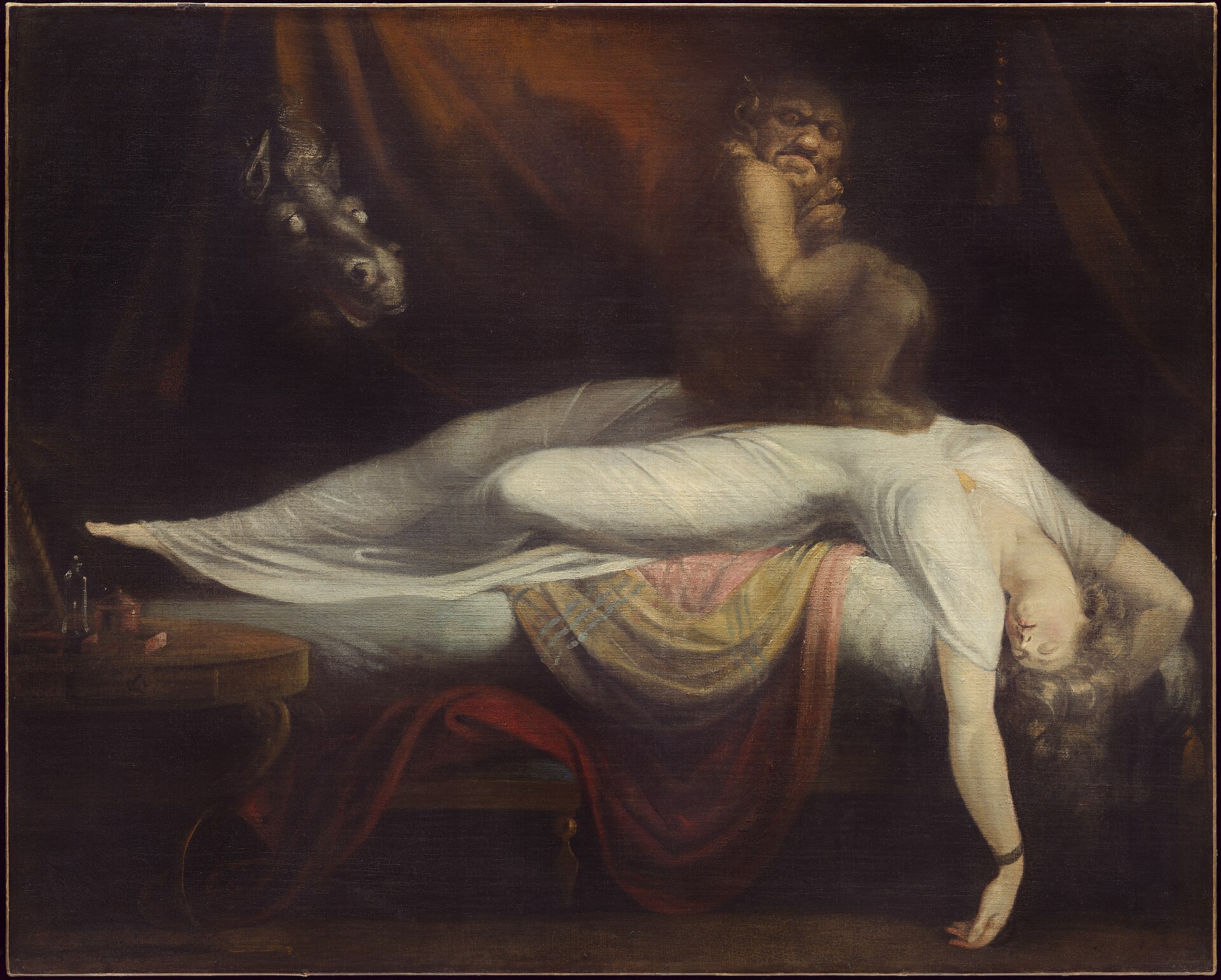
Sleep paralysis is a REM-related state of waking immobility, but reports often include sensed presences, apparitional figures and voices, altered environments, and out-of-body movements. Historical and cross-cultural accounts show recurring experiential patterns, while cultural beliefs shape how encounters are understood and explained.
- REM-related paralysis can coincide with vivid presences, multisensory encounters, altered surroundings and apparent out-of-body movement.
- Similar core experiences recur across cultures, while traditions interpret them as demons, spirits, djinn, witches or other beings.
- Some episodes include apparent psi features or lasting spiritual and existential effects, encouraging broader models beyond a purely clinical account.
Introduction
Sleep paralysis is a recognised sleep-related phenomenon characterised by temporary bodily immobility during the transition into or out of sleep, while conscious awareness is preserved. Although classified within sleep medicine as a parasomnia associated with rapid eye movement (REM) sleep, reports extend considerably beyond bodily paralysis. Episodes may involve presence, encounters with figures, entities, or other intelligences; multisensory phenomena; alterations in the surrounding environment; movement beyond the physical body; intense emotional responses; and enduring personal transformation.
Sleep paralysis has been examined across sleep medicine, psychology, anthropology, folklore, history, theology, consciousness studies, and psychical research. These traditions have contributed important insights but have largely investigated different dimensions of the phenomenon through separate concepts, methods, and explanatory frameworks. Clinical research has emphasised physiology and associated mechanisms, cultural research has examined belief systems and interpretation, while psychical research has explored relationships with apparitional, out-of-body and other exceptional experiences.
The result is a fragmented body of knowledge in which different aspects of sleep paralysis are often discussed in isolation. Consequently, relationships between recurring phenomenology, historical continuity, cultural variation, and wider anomalous experience have often remained implicit rather than becoming an explicit focus of investigation.
The Nature of Sleep Paralysis
Sleep Paralysis as a Sleep–Wake Phenomenon
Within sleep medicine, episodes are described as hypnagogic when occurring during sleep onset and hypnopompic when occurring upon awakening.1American Academy of Sleep Medicine (2014). The prevailing neurophysiological account attributes the paralysis to the persistence of rapid eye movement (REM) sleep muscle atonia into wakefulness. During REM sleep, the body is temporarily paralysed to prevent us from acting out our dreams. Sleep paralysis is said to occur when awareness returns before this paralysis has ended. The experiencer is therefore consciously aware while the body remains in a sleep state.2Sharpless & Doghramji (2015).
This account provides the foundation of contemporary clinical understanding and explains the defining bodily immobility and associated difficulties with voluntary movement or speech. Recognition of sleep paralysis as a physiological sleep-related condition has also helped distinguish it from neurological and psychiatric disorders. However, the clinical account primarily addresses the physiological condition and does not, by itself, describe the broader lived experience associated with it.
Clarifying the Meaning of Sleep Paralysis
One longstanding conceptual difficulty surrounding sleep paralysis is that the term has come to refer to two related but distinct aspects of the phenomenon: the physiological condition characterised by REM-related muscle atonia, and the broader lived experience associated with it. Because both are called sleep paralysis, they have frequently been treated as synonymous. This conflation has influenced research, clinical and public understanding, and the ways experiencers recognise and describe their experiences.
The distinction becomes particularly important in relation to awareness. In some episodes, awareness of bodily paralysis dominates and becomes the defining feature of the experience. In others, awareness is organised primarily around other features of the experience rather than bodily immobility. Bodily paralysis may receive little attention, be recognised retrospectively, or not become a salient feature of the remembered experience. Consequently, experiences sharing the broader phenomenology associated with sleep paralysis may not be recognised or reported as such when paralysis is not central to conscious awareness.
This ambiguity has contributed to a widespread understanding of sleep paralysis primarily as temporary immobility, obscuring the breadth of the experience. Distinguishing the physiological condition from the broader lived experience therefore provides an important basis for examining the phenomenology, cultural interpretations and anomalous associations discussed in the sections that follow.
The Phenomenology of Sleep Paralysis
Qualitative studies, cross-cultural reports and first-person accounts of sleep paralysis describe recurring bodily, perceptual, environmental, relational and emotional features 3Cheyne et al. (1999); Cheyne (2003); Pryce Brooks (2024). Bodily experiences include paralysis, restraint, pressure, altered breathing, vibration and tactile contact, while awareness of the surrounding environment may remain unusually clear or heightened. Episodes may unfold within familiar surroundings that appear exceptionally vivid or real, or within environments that become altered as the experience develops.
Presence is among the most consistently reported features.4Cheyne et al. (1999); Cheyne (2003). Experiencers describe the certainty that someone or something is nearby, sometimes before any figure appears. Encounters may involve human figures, shadow forms, luminous beings or other entities, accompanied by voices, footsteps, touch or other multisensory phenomena. Presences may observe, approach, communicate, threaten, reassure or otherwise respond to the experiencer, giving some encounters a distinctly relational and intentional character. Experiencers themselves may resist, communicate or engage in return. Movement, floating, displacement and separation from the physical body are also reported.5Cheyne & Girard (2009); Pryce Brooks (2024).
These features frequently occur together as components of a structured, unfolding experience rather than as isolated phenomena. Their relational organisation contributes to the coherence and unusual sense of reality with which many episodes are experienced and remembered. Emotional responses likewise vary considerably. Although fear and terror are common, particularly during unfamiliar episodes, many individuals instead describe curiosity, reassurance, awe, extreme spiritual significance or a lasting sense that the experience possessed personal meaning.
Historical and Cross-Cultural Perspectives
Accounts resembling contemporary sleep paralysis have been documented across historical periods and diverse cultural settings.6Hufford (1982); Sharpless & Doghramji (2015). Despite differing interpretations, recurring features include paralysis, presence, chest pressure, fear and multisensory encounters. These experiences have been incorporated into local explanatory traditions. These include European incubus and succubus traditions, the Newfoundland Old Hag, Japanese kanashibari, and interpretations involving djinn, witchcraft, ancestral spirits and demonic visitation.7Hufford (1982); Jalal et al. (2014); Sharpless & Doghramji (2015).
Hufford’s experience-centred study of the Newfoundland “Old Hag” tradition was particularly influential in challenging explanations that treated such experiences as products of folklore alone.8Hufford (1982). He argued that recurring experiential features could precede and inform cultural interpretation, rather than being produced solely by culturally transmitted beliefs.
Cross-cultural comparison therefore reveals both continuity and variation: recognisable experiential features recur across different settings, while their imagery, meaning and explanation are shaped through religious, spiritual, medical and cultural frameworks.9Hufford (1982); Jalal et al. (2014).
Sleep Paralysis and Anomalous Experience
Considered across lived accounts, sleep paralysis shares recurring features with experiential domains usually investigated separately. These relationships position it within a wider constellation of anomalous human experience.
Adjacent States of Consciousness
Sleep paralysis frequently occurs alongside neighbouring transitional states of consciousness. Experiencers describe transitions between sleep paralysis, hypnagogic and hypnopompic experience, dreaming, lucid dreaming, false awakenings and out-of-body experiences, sometimes within a continuous experiential sequence.10Cheyne et al. (1999); Pryce Brooks (2024). Floating, flying, falling, rotation and movement through space may accompany experiences of leaving the physical body.11Cheyne & Girard (2009).
Boundaries between these states are not always clearly experienced, while more limited phenomenological parallels with near-death experiences include altered embodiment, heightened awareness and subsequent changes in worldview.12Pryce Brooks (2024). Further parallels have been reported in coma, where individuals may remain outwardly unresponsive while describing awareness of their surroundings, vivid experiential environments and, in some cases, extended ‘alternate lives’ experienced as lasting far longer than the period of coma itself. Alan and Beverley Pearce draw attention to these experiences alongside near-death and other altered states of consciousness.13Pearce & Pearce (2024).
Presence, Apparitional and Contact Experiences
Presence, agency and encounter form particularly significant points of overlap. Presences include human and shadow figures, luminous beings, deceased or ancestral persons, spiritual figures, demons, malevolent entities, animals and unfamiliar intelligences. They may reassure, guide or protect, but also intimidate, restrain, threaten or attack.
Encounters may involve approach, observation, touch, communication and response, while experiencers themselves resist, question, communicate with or deliberately engage the presence.14Pryce Brooks (2024). Similar relational features occur in apparitional, mediumistic, religious, spiritual and contemporary non-human intelligence contact accounts.15Hufford (2000); McNally & Clancy (2005); Pryce Brooks (2024). The term intelligence is used here to describe the relational characteristics of the encounter, where the presence is experienced as demonstrating intention, responsiveness, communication or other behaviour indicative of agency. The recurring combination of presence, intentional behaviour, communication, responsiveness and reciprocal interaction gives some sleep paralysis encounters the phenomenological character of engagement with another intelligence, without establishing the source or ontological status of that intelligence.
Environmental and Spatial Phenomena
The surrounding environment may form an integral part of the experience rather than a passive backdrop.16Cheyne & Girard (2004); Pryce Brooks (2024). Familiar bedrooms can appear unusually clear or real, become altered, or give way to other rooms, landscapes or unfamiliar spaces. Reports include changes in lighting, architecture and spatial organisation, activity beyond the immediate room, movement through doors or walls, and awareness extending beyond the body’s position. Presences may occupy and move through these spaces rather than appear as isolated figures.
Atmosphere may also change, with foreboding, menace, heaviness or evil filling the environment, sometimes before a presence is identified. Experiences may retain continuity of self while the setting or spatial viewpoint changes. This environmental dimension has received comparatively little systematic attention within conventional descriptions of the experience.
Psi and Exceptional Experiences
Reported associations with psychical phenomena include telepathic impressions, intuitive or anomalous knowing, precognition, synchronicity and information regarded as veridical.17Pryce Brooks (2024). Some experiences are interpreted as mediumistic or suggestive of survival. Their paranormal interpretation remains unresolved, but their recurrence warrants consideration within the broader phenomenology of sleep paralysis.
Spirituality, Transformation and Meaning
Fear is common but neither universal nor phenomenologically uniform.18Cheyne (2003); Jalal et al. (2014); Pryce Brooks (2024). Its reported sources and contexts vary, and fear may precede any identifiable figure or threat. Other experiences involve curiosity, reassurance, awe, love, peace, wonder or transcendence, sometimes acquiring profound spiritual or religious significance, and some individuals describe experiences so positive or transcendent that they are reluctant for them to end.19Pryce Brooks (2024).
The experience may also continue after bodily movement has returned and the experiencer is fully awake, through continuing bodily sensations, environmental phenomena, reorientation, checking the surroundings, perceived correspondences between the experience and the waking environment, or a continuing sense of connection with what was encountered. Longer-term consequences include existential questioning, spiritual or religious awakening, altered worldviews, increased interest in consciousness, reduced fear of death and greater meaning or purpose. Recurrent experiences may also involve movement from fear towards curiosity, engagement and integration.20Pryce Brooks (2024).
Ontological and Existential Questions
These experiences raise questions concerning consciousness, perception, selfhood, agency, the relationship between mind and world, survival and the ontological status of encountered presences or intelligences. Reports of experiences regarded as more real than ordinary waking consciousness further complicate conventional distinctions between subjective experience and external reality. Sleep paralysis does not resolve these questions, but its capacity to generate them helps explain its continuing significance to psychical research, philosophy, theology and consciousness studies.
Interpreting Sleep Paralysis
Approaches to Sleep Paralysis
Neurophysiological approaches explain sleep paralysis primarily through REM-related muscle atonia, sleep fragmentation, and sensory and threat-processing mechanisms, while psychological models examine anxiety, panic, trauma, dissociation, expectation and prior belief.21Cheyne (2003); Sharpless & Doghramji (2015). These approaches contribute substantially to understanding the physiological and psychological processes associated with episodes, but do not necessarily address the full breadth of the reported experience.
Cultural and anthropological approaches examine how experiences are interpreted through culturally available beliefs, narratives and religious cosmologies. Traditions involving demons, witches, spirits, ancestors and djinn demonstrate the role of culture in shaping meaning and representation. However, the recurrence of recognisable experiential features across cultures challenges accounts that attribute the phenomenology primarily to cultural expectation.22Hufford (1982); Jalal et al. (2014).
Phenomenological and consciousness-oriented approaches examine the experience as lived without determining its cause in advance, while psychical, spiritual and religious interpretations consider its relationships with apparitional, mediumistic, survival and contact experiences. The reported experience of agency or intelligence does not, by itself, establish whether its source is internally generated, externally sourced or otherwise constituted.
Different approaches therefore illuminate different dimensions of sleep paralysis. No single framework presently encompasses all dimensions of sleep paralysis. The explanatory challenge is to establish what each approach explains, what assumptions it introduces and what remains outside its scope.
Emerging Integrative Frameworks
The breadth of experience associated with sleep paralysis raises questions about whether its current classification represents the phenomenon as a whole. One emerging approach is Threshold Contact Experience (TCE), developed through qualitative and phenomenological research into sleep paralysis and related anomalous experiences.23Pryce Brooks (n.d.). TCE provides a classificatory framework for the broader experiential configuration associated with sleep paralysis rather than defining the phenomenon primarily through bodily immobility.
More broadly, integrative and experiencer-centred approaches enable recurring patterns to be examined across disciplinary and experiential categories while maintaining the distinction between description, classification and explanation.
Conclusion and Future Directions
Sleep paralysis encompasses considerably more than temporary bodily immobility. Viewed across clinical, phenomenological, historical, cross-cultural and anomalous experience research, its constituent features extend across experiential domains traditionally investigated separately, including encounters with intelligence whose source remains unresolved.
Future research would benefit from approaches capable of examining these relationships directly. Priorities include more precise phenomenological description; systematic investigation of environmental and spatial features; longitudinal study of transformation and meaning-making; and comparative research across sleep paralysis, dreaming, out-of-body and near-death experiences, apparitions and contact experiences. Reports involving shared or veridical elements also warrant investigation using methods appropriate to evidential claims. Greater interdisciplinary collaboration is needed alongside approaches that neither pathologise anomalous reports automatically nor treat experiencers’ interpretations as established explanations.
Sheila Pryce Brooks
Works Cited
American Academy of Sleep Medicine (2014). International Classification of Sleep Disorders: Diagnostic and Coding Manual (3rd ed.). Darien, Illinois, USA: American Academy of Sleep Medicine.
Cheyne, J.A. (2003). Sleep paralysis and the structure of waking-nightmare hallucinations. [Full text.] Dreaming 13/3, 163-79.
Cheyne, J.A., & Girard, T.A. (2004). Spatial characteristics of hallucinations associated with sleep paralysis. [Full text.] Cognitive Neuropsychiatry 9/4, 281-300.
Cheyne, J.A., & Girard, T.A. (2009). The body unbound: Vestibular-motor hallucinations and out-of-body experiences. [Full text.] Cortex 45/2, 201-15.
Cheyne, J.A., Newby-Clark, I.R., & Rueffer, S.D. (1999). Hypnagogic and hypnopompic hallucinations during sleep paralysis: Neurological and cultural construction of the nightmare. [Full text.] Consciousness and Cognition 8/3, 319-37.
Hufford, D.J. (1982). The Terror That Comes in the Night: An Experience-Centered Study of Supernatural Assault Traditions. Philadelphia, Pennsylvania, USA: University of Pennsylvania Press.
Hufford, D.J. (2000). Awakening paralyzed in the presence of a ‘strange visitor’. In UFOs and Abductions: Challenging the Borders of Knowledge, ed. by D.M. Jacobs. Lawrence, Kansas, USA: University Press of Kansas.
Jalal, B., Simons-Rudolph, J., Jalal, B., & Hinton, D.E. (2014). Explanations of sleep paralysis among Egyptian college students and the general population in Egypt and Denmark. Transcultural Psychiatry 51/2, 158-75.
McNally, R.J., & Clancy, S.A. (2005). Sleep paralysis, sexual abuse, and space alien abduction. [Full text.] Transcultural Psychiatry 42/1, 113-22.
Pearce, A., & Pearce, B. (2024). Coma and Near-Death Experience: The Beautiful, Disturbing, and Dangerous World of the Unconscious. Rochester, Vermont, USA: Inner Traditions.
Pryce Brooks, S. (2024). Managing the phenomenology of sleep paralysis: Re-evaluating theories and challenging conventional understanding. [Full text.] PhD thesis, University of York.
Pryce Brooks, S. (n.d.). Threshold Contact Experience (TCE): Reclassifying sleep paralysis and seeding a new ontological framework. [Unpublished manuscript.]
Sharpless, B.A., & Doghramji, K. (2015). Sleep Paralysis: Historical, Psychological, and Medical Perspectives. New York: Oxford University Press.