The 2025–26 Kunstmuseum Basel exhibition Ghosts: Visualizing the Supernatural traced 250 years of visual culture surrounding apparitions, mediumship and the occult. Its displays included Spiritualist tools, spirit photographs, materialisation experiments and mediumistic art, many drawn from psychical research institutions.
- The exhibition placed psychical research and Spiritualist practice within a broader visual history of ghosts, art and science.
- Objects on display included ectoplasm photographs, spirit trumpets, slate-writing tablets, materialised hand casts and spirit photographs.
- A section on CG Jung connected mediumship and ghostly phenomena with his theory of externalised unconscious processes.
The Exhibition
The exhibition Geister. Dem Übernatürlichen auf der Spur (Ghosts: Visualizing the Supernatural),1A literal translation of the original German exhibition title would be ‘Ghosts. Tracing the Supernatural’. However, the exhibition’s English branding uses ‘Ghosts: Visualizing the Supernatural’ as its title. held at the Basel (Switzerland) Kunstmuseum (Museum of Art) from 20 October 2025 to 8 March 2026, explored the cultural and intellectual history of spirit apparitions and related phenomena over the past 250 years. While the exhibition spanned a wide range of artistic interpretations – from eighteenth-century Romanticism to contemporary digital media – it featured a significant concentration of artefacts and artworks directly related to the history of Spiritualism and psychical research. These exhibits highlight a period when the boundaries between sciences and the occult were actively being negotiated by eminent thinkers.
In the late nineteenth and early twentieth centuries, the search for empirical evidence for the mind’s survival after death, as well as non-survivalist approaches to telepathy and clairvoyance as capacities of the living, led to the development of psychical research (or “wissenschaftlicher Okkultismus”/”scientific occultism”, in German-speaking countries). Prominent researchers often sought to apply rigorous controls to the phenomena of the séance room. For a short video describing the exhibits related to psychical research, see here. The photographs below were taken by the author in October 2025.
The exhibition’s website may be viewed here. An English version of the exhibition booklet may be viewed here.
Notable Collections and Artefacts
Materialisation and Ectoplasm
- The Institut für Grenzgebiete der Psychologie und Psychohygiene (IGPP): The IGPP provided extensive documentation of experiments conducted by German physician Albert von Schrenck-Notzing. Photographic exhibits – several of which have never been published – included gelatin silver prints of mediums such as Eva C., Stanislawa P. and Rudi Schneider (Figure 1), allegedly externalising ‘ectoplasm’ or ‘teleplastic’ formations. Schrenck-Notzing viewed these not as evidence for spirits but as ‘ideoplasty’ – the projection of inner mental images into physical matter. Exhibits supplied by the IGPP also included photographs of ectoplasmic emanations allegedly produced by the Irish medium Kate Goligher (Figure 2), whose main investigator was the engineer William Crawford.
- The Society for Psychical Research (SPR): The SPR contributed numerous artefacts, such as wax thumbprints attributed to ‘Walter’, an alleged spirit who featured prominently in the mediumship of Mina ‘Margery’ Crandon.
- The Institut Métapsychique International (IMI): This collection included plaster casts of materialised ‘spirit hands’ produced during séances with the Polish medium Franek Kluski. These fragile moulds, created in paraffin wax under controlled experimental conditions, were considered by researchers such as Gustave Geley as evidence of authentic materialisations.
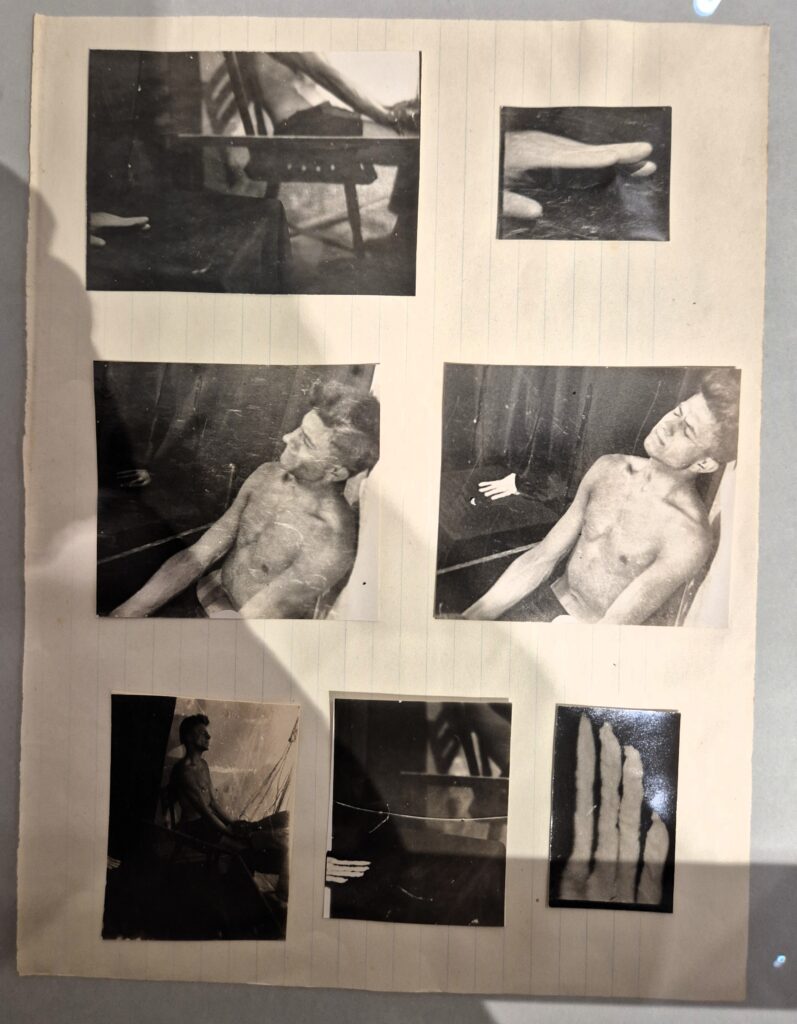
Figure 1. The medium Rudi Schneider with rudimentary ‘materialisations’ of a hand.
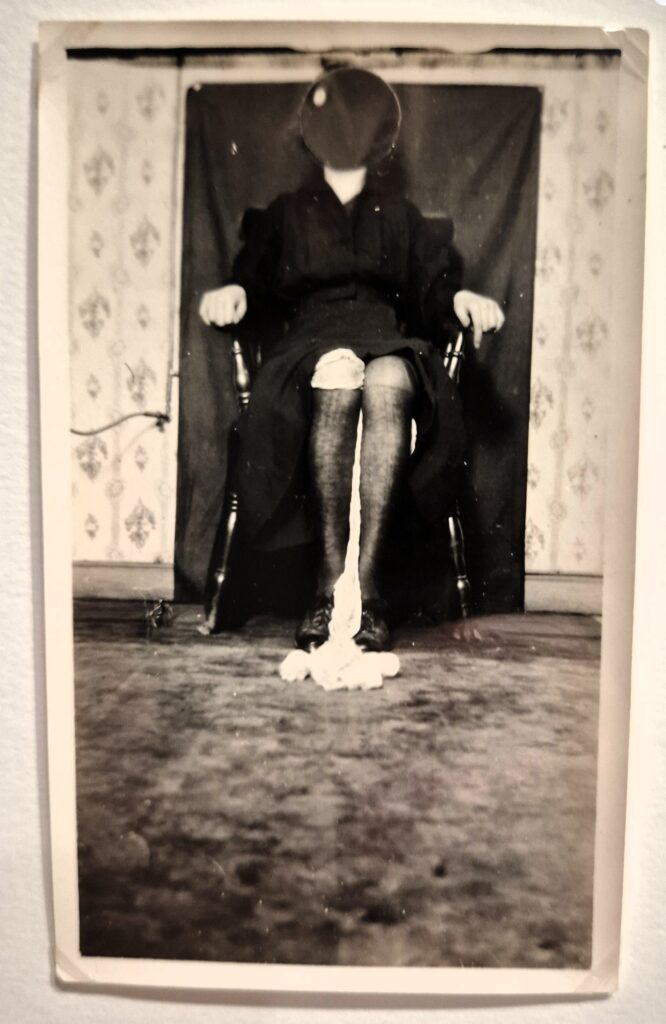
Figure 2. The medium Kate Goligher producing ‘ectoplasm’.
Spiritualist Practice and Tools
The exhibition showcased some of the physical instruments used by Spiritualist mediums to bridge the gap between the living and the dead.
- Communication devices: Exhibits included a ‘spirit trumpet’ (Figure 3, from the SPR archives) used to amplify the ‘direct voices’ of the deceased, and a slate-writing tablet (Figure 4, also from the SPR archives) featuring messages allegedly written by spirits in languages unknown to the medium, such as Greek.
- The Ouija board: A wooden Ouija board from the David Brandon Hodge archive (Figure 5) illustrated the commercialisation of Spiritualist tools. While often viewed as games now and then, these boards were once treated as serious instruments for rational inquiry into the afterlife, and into the creative as well as supernormal capacities of the subconscious mind.
- The Spiritualist Association of Great Britain contributed the marble sculpture The Medium and Her Spirit Guide (c. 1927, Figure 6), by George Henry Paulin, depicting the intimate surrender of a medium to an otherworldly power.
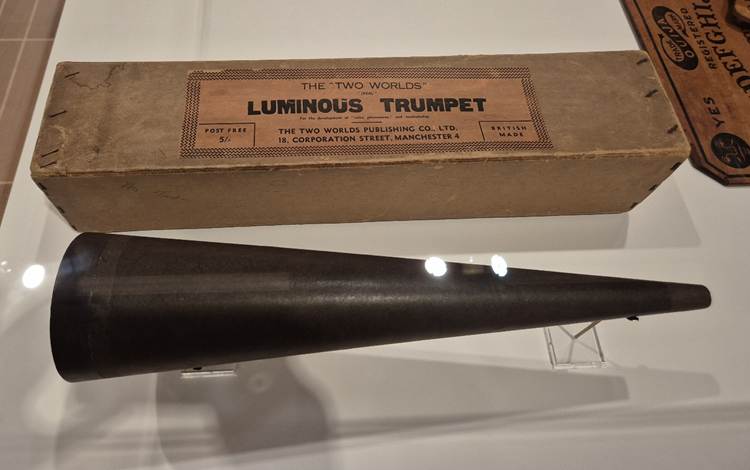
Figure 3. A ‘spirit trumpet’.
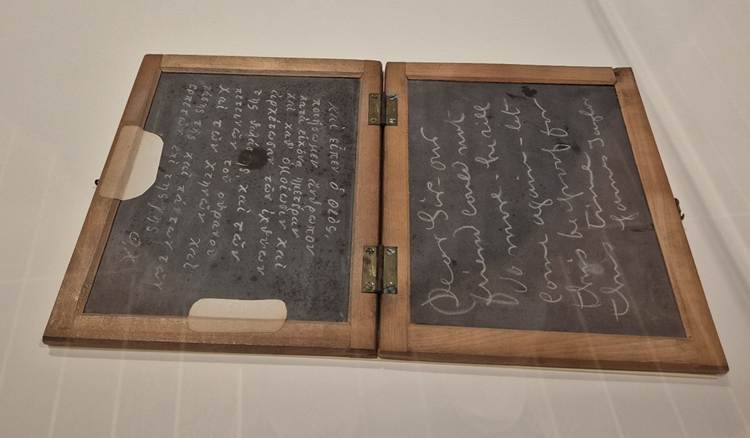
Figure 4. Slate for ‘spirit writings’.
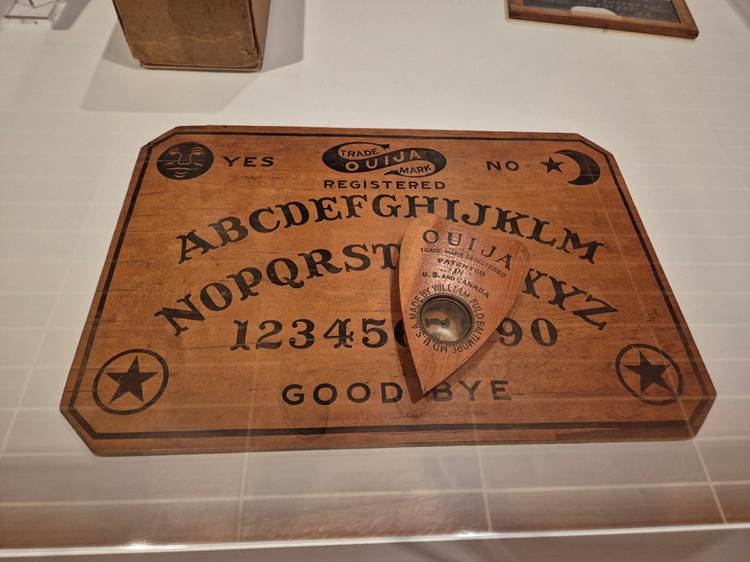
Figure 5. A Ouija board.
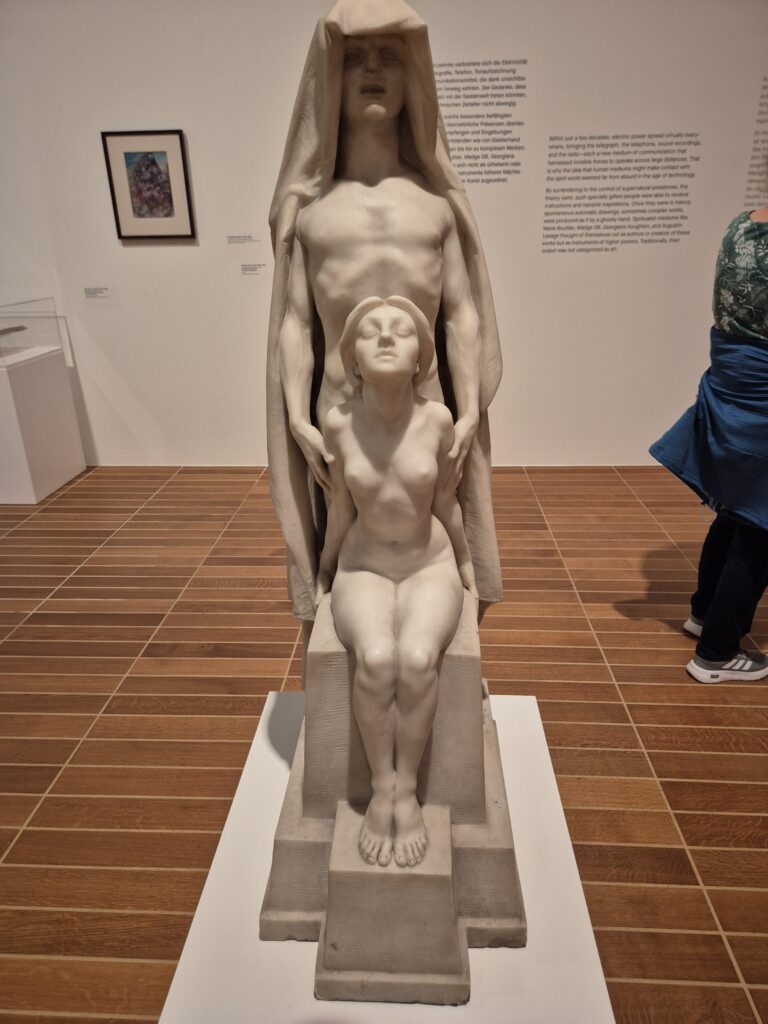
Figure 6. The sculpture The Medium and Her Spirit Guide, by George Henry Paulin.
Spirit Photography
Spirit photography was adopted early as a ‘technological witness’ to the world beyond, purportedly capturing what the human eye could not.
- The IGPP provided seminal examples of the genre, including works by William H. Mumler, a pioneering figure in spirit photography. His famous portrait of Mary Todd Lincoln with the spirit of President Abraham Lincoln was a centrepiece.
- The College of Psychic Studies supplied exhibits on European pioneers. The exhibition featured ‘skotographs’ (camera-less images) by Madge Donohoe and ‘Crewe Circle’ photographs by William Hope, which were promoted as authentic evidence of contact with the dead.
- The SPR also provided artefacts on spirit photography, such as pages from an album by the British photographer Ada Emma Deane (Figure 7).
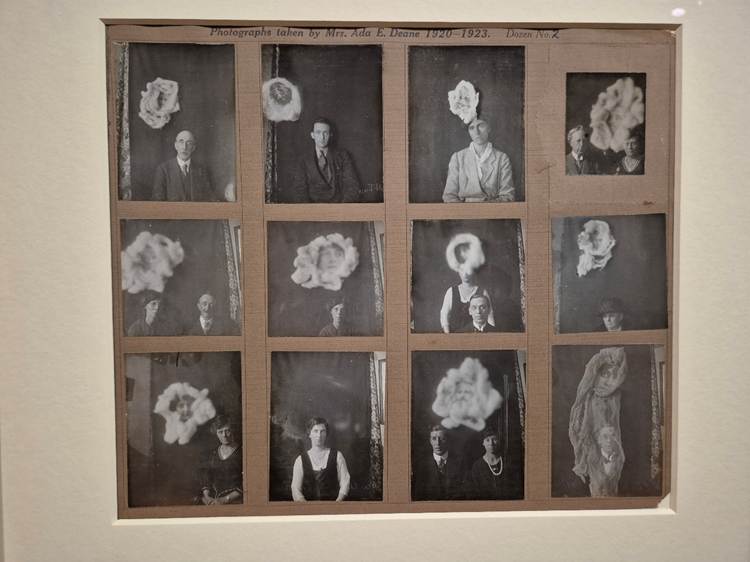
Figure 7. ‘Spirit photographs’ by Ada Emma Deane.
Psychological Perspectives: C G Jung
A pivotal section of the exhibition, supplied by the family archive of Jung’s heirs (Familienarchiv Jung Küsnacht), focused on the Swiss psychologist and psychiatrist Carl Gustav Jung.
- The shattered knife (Figure 8): A primary exhibit was a common kitchen knife from Jung’s household that spontaneously shattered with a loud bang into four pieces in his kitchen drawer in 1898.
- Externalised unconscious: This event served as a catalyst for Jung’s 1902 dissertation on the psychology and pathology of mediumship, and for his lifelong interest in occult phenomena. Jung proposed that ghosts and materialisations were genuine parapsychological phenomena, though he did not view ghosts and spirits as independent entities. Rather, he proposed that such phenomena were drastic externalisations of the individual and collective unconscious.
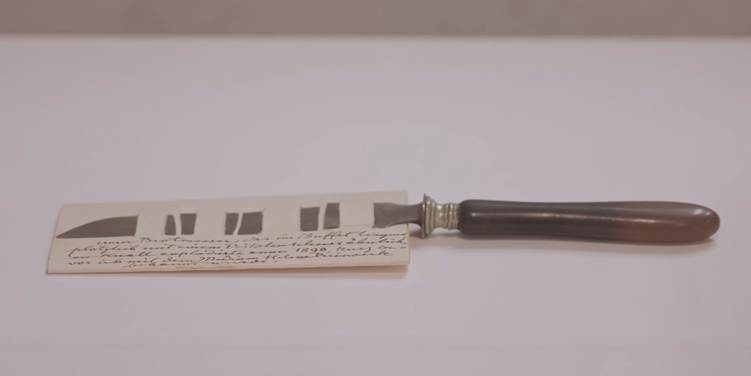
Figure 8. A bread knife owned by C G Jung, which spontaneously shattered in 1898.
Mediumistic Art
- The exhibition also highlighted ‘mediumistic art’, in which creators claimed to be mere instruments for higher powers.
- Spiritualist albums: The College of Psychic Studies provided Georgiana Houghton’s Album of Spirit Drawings (1860s–70s; Figure 9), consisting of intricate watercolours guided by ‘spirits’ as well as ‘archangels’.
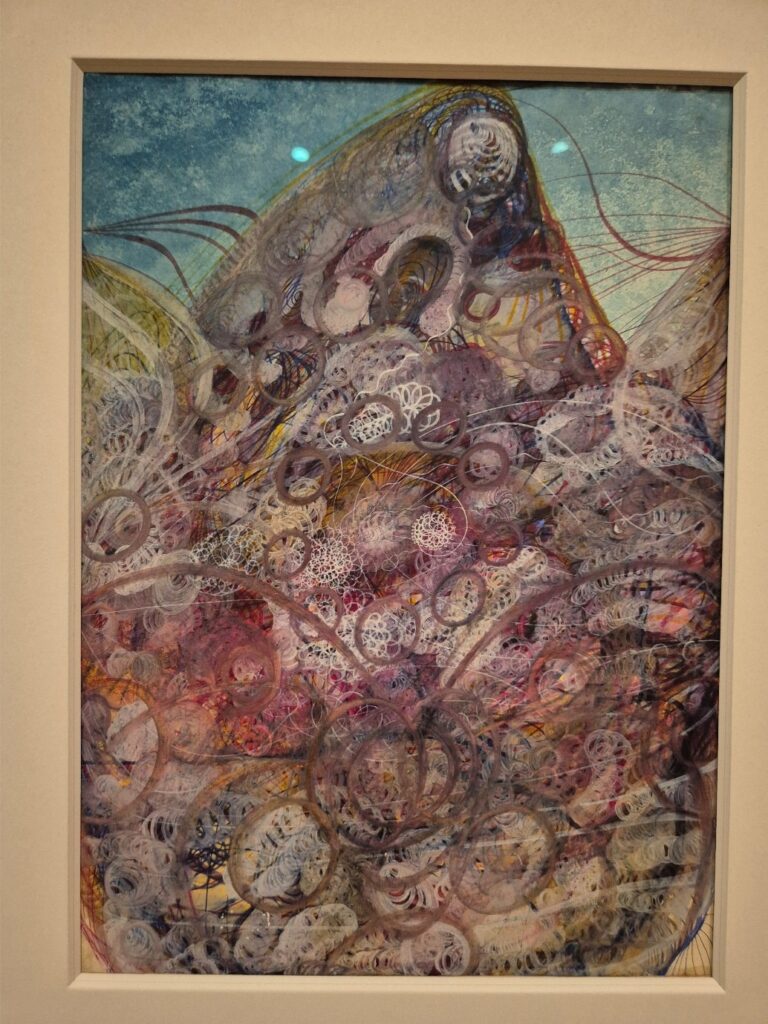
Figure 9. A mediumistic painting by Georgiana Houghton.
Andreas Sommer